Git archive

Repositories 962Checked
  1. 915

    agentclientprotocol/codex-acp

    What it does
    This adapter connects Codex to editors and clients supporting ACP. It is a protocol server, not a separate language model or a complete development environment. It accepts text, images and workspace context, starts the Codex App Server, and returns replies, tool events, file changes and permission requests. Clients can select models, reasoning effort, sandbox modes and allowed user permission profiles. Native subagent sessions and some mid-turn capabilities require capability negotiation with the client. The npm package includes a compatible Codex dependency, but client launch configuration and Codex authentication remain separate prerequisites. Authentication supports ChatGPT login, API keys and negotiated custom gateways. Installation does not automatically configure every editor or establish a safe approval policy, and some permission-profile fields use an experimental schema.
    License
    Custom license Custom or non-standard license. Read the license file before any reuse.
  2. 914

    govijr/terminal-mac

    What it does
    This tool gives computer-use AI agents a separate virtual Mac. Apple Virtualization runs macOS, while a helper inside the guest captures the screen and handles input. Agents request screenshots, clicks, drags, keystrokes and status through MCP or the command line. MCP is a common communication method connecting AI tools to external functions. Requests travel as messages through a shared folder, and results return as images or structured responses. Users can view the same guest in a compatible terminal or a native virtual machine window. Getting started requires an Apple silicon Mac with macOS 14 or later, a macOS restore image and storage space. A person must create the guest account and grant Screen Recording and Accessibility permissions during initial setup. The guest does not inherit host apps or signed-in sessions, but default networking can reach the host or local network. It is an early release candidate, and official validation documentation still lists end-to-end guest installation and screen control as incomplete.
    License
    MIT Permissive. Commercial use and changes are allowed if the copyright notice is kept.
  3. 913

    BryceYuuu/RUN

    What it does
    RUN is a curated overseas relocation handbook, not an application that processes immigration applications. It is primarily organized for Chinese-speaking readers comparing destinations and types of relocation. Readers start from a route-selection guide or country index and follow links to country pages, document checklists and source references. The repository stores structured route data in JSON and CSV alongside explanatory Markdown notes. A Python publishing script combines the data and notes into country documents, comparison tables and SVG charts. Reading the handbook does not require running that script, and its generated documents are reference material rather than an eligibility decision. The project disclaims legal, immigration, tax and investment advice, and the individual policy assertions have not been independently verified in this review.
    License
    CC-BY-SA-4.0 Custom or non-standard license. Read the license file before any reuse.
  4. 912

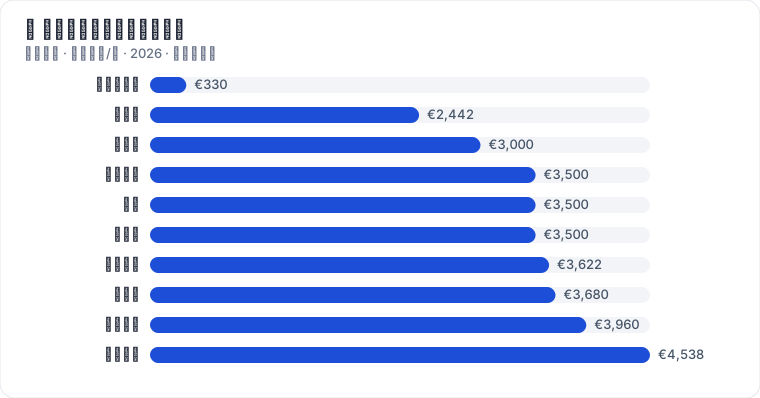
    Appllama/appllama-skills

    What it does
    This repository contains agent instructions for researching mobile app interfaces and building Expo or React Native screens. A user supplies an app idea, an existing screen, code, or a reference screen identifier. The research skill guides an agent through the Appllama MCP library of apps, screens, flows, and interface elements. The design skill turns those observations into layout, navigation, state, and motion requirements. Its expected output is an implemented interface plus checks in a simulator, including recordings of complete flows rather than screenshots alone. The design guidance can be used without the hosted MCP connection. Using the research library requires an Appllama account, the documented Pro access, and available call credits. Building and checking screens also requires a capable coding agent and the mobile development environment. These are procedural instructions rather than a bundled app generator or evidence that any resulting screen has already passed its quality checks.
    License
    MIT Permissive. Commercial use and changes are allowed if the copyright notice is kept.
  5. 911

    tembo/voxl

    What it does
    This Rust tool lets a web browser view and control a server or virtual machine desktop. It captures an X11 display on Linux and the running computer's screen on macOS and Windows. The screen is encoded as H.264, sent over a WebSocket and played through the browser's WebCodecs support. It provides mouse and keyboard input as well as clipboard, file transfer and audio features. Agents can use APIs for screenshots, video recording and waiting for screen changes or stillness. The wait implementation tracks changed screen regions and sequence numbers; a still screen does not itself establish task success. Getting started requires a target desktop and platform-specific video and audio libraries, with a protected connection such as HTTPS for remote browser access. It does not create a separate virtual machine, and authenticated viewers can normally control the streamed desktop. The documentation says Wayland and GPU encoding are not yet supported. Its own code is MIT, but the README states that distributed binaries linked with x264, and distributions bundling them, fall under the GPL.
    License
    MIT Permissive. Commercial use and changes are allowed if the copyright notice is kept.
  6. 910

    deeplethe/sandstorm

    What it does
    Sandstorm manages isolated execution environments for agent services that spend time waiting between requests. Developers supply an application template, resource limits, and sandbox creation requests. It returns sandbox state and command output through an HTTP API and provides a management console. A master keeps desired state in SQLite and distributes work to nodes. Idle environments move from running to paused, disk snapshots, and finally a state retaining only their volume. The node gateway restores an environment when traffic arrives, subject to admission and restore queue limits. It supports gVisor containers and Firecracker microVMs, with separate network namespaces for sandboxes. Setup requires Linux with cgroup v2 and backend dependencies, and Firecracker also requires a compatible virtualization environment. Snapshot placement depends on backend and host compatibility, and capacity pressure can produce refused requests rather than guaranteed immediate execution.
    License
    Apache-2.0 Permissive, with a patent grant. Commercial use is allowed; keep the notices and state your changes.
  7. 909

    NVIDIA/auto-ontology

    What it does
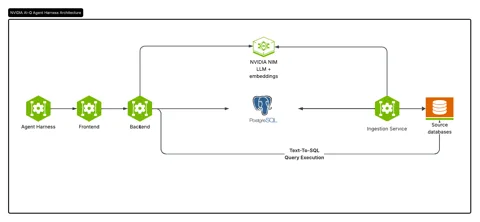
    Auto Ontology builds a shared meaning layer over enterprise databases so agents can interpret business terms before querying data. Developers connect source databases and ingest their table and column metadata. Business terms, relationships, and SQL expressions form a semantic catalog stored in Postgres with vector search support. Users ask questions in natural language, and the application generates SQL and executes it against connected sources. Results can include an answer, the SQL, and returned rows. The MCP interface exposes glossary lookup, answerability checks, and question answering through a restricted tool set. Deployment combines a web gateway, Python services, Postgres, and configured model endpoints. Starting requires database access, authentication settings, and inference credentials or equivalent configured endpoints. Generated SQL and answers still require validation, and database credentials added through the UI remain unencrypted in Postgres unless Vault is fully configured.
    License
    Apache-2.0 Permissive, with a patent grant. Commercial use is allowed; keep the notices and state your changes.
  8. 908

    tddworks/SkillsManager

    What it does
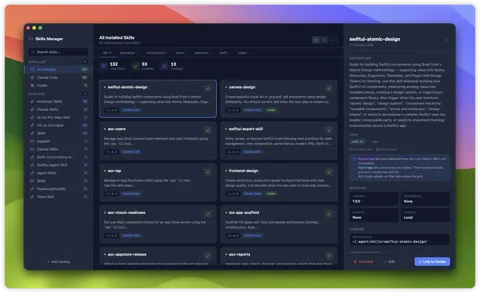
    This macOS app discovers and installs skills for Claude Code and Codex. A skill is a bundle of task instructions and reference files read by an AI coding tool. Users add a GitHub repository URL or local folder as a catalog. The app finds SKILL.md files and displays names, descriptions, tags and document contents. Search and shared custom tags organize entries across catalogs. Installation code writes the contents and source identity into the selected tool's skills directory and also copies reference files for remote skills. Local skills can be changed in an editor with a preview. To start, users obtain the released app and select a catalog and installation targets; the README requires macOS 15 or later. It is not described as a system for evaluating skill execution results or administering company approval policies.
    License
    No license No license file found. Without a license, reuse of the code is not permitted by default.
  9. 907

    davidakpele/wifi-densepose

    What it does
    This repository sketches a system for estimating human pose from WiFi channel state information, or CSI, rather than camera images. CSI describes changes in the radio channel, and the intended users are developers researching camera-free sensing. The proposed pipeline accepts CSI samples, processes their amplitude and phase, translates them into model features and exposes pose results through an API and streaming interface. The source includes PyTorch model components, service management and hardware and pose mock modes. However, the service's real CSI collection method is a placeholder that returns no samples. Loading trained pose weights is commented out, and parts of pose generation and activity classification produce synthetic results. The README describes package installation and hardware configuration, but those instructions alone do not establish a working sensing system. Actual use would require a verified CSI capture path, trained weights, room-specific calibration and measurement-based validation, so through-wall tracking and advertised accuracy or speed cannot be treated as established capabilities.
    License
    Custom license Custom or non-standard license. Read the license file before any reuse.

  10. 906

    mromidev/claude-animated-shorts

    What it does
    Claude Animated Shorts is a Claude Code skill and source template for making short vertical animated stories. It starts from a topic and verified facts, then organizes a script, narration with word timings, shots, characters, camera motion and sound into a video workflow. The visual approach places flat illustrated characters in a three-dimensional world rendered locally with three.js inside Remotion rather than using an AI video generator. The repository includes a bridge story example, rendering effects, Python sound synthesis and mixing helpers, and tools for still-image and frame inspection. Outputs described in the workflow include a vertical MP4, an audio mix, separate sound stems and inspection materials. Starting requires a separately prepared Remotion project, Node, Python and ffmpeg, and the templates need their expected model assets, narration audio and timing data. Voice generation or transcription can be supplied separately, and the repository is not a complete application with every asset and dependency bundled. The example has English narration and no captions, so other language workflows need adaptation, while the code and documentation are MIT and the reference frames are designated for style study only.
    License
    MIT Permissive. Commercial use and changes are allowed if the copyright notice is kept.
  11. 905

    mille-okws/pestinha

    What it does
    Pestinha is a local desktop pet for people who want a character that reacts to their computer use and touch. Its Bryan and Jorge characters share a brain design but keep separate personalities, content and memories. Mouse gestures, the foreground program name, idle time and window geometry become inputs to animated expressions, movement and play. A spiking neural network, whose simulated neurons fire after accumulating stimulation, determines behavioral tendencies together with explicitly programmed rules. Reward associations and habituation change some responses, and learned state is saved locally rather than in a cloud account. The project uses Python 3.11 or newer with PySide6 and platform interfaces for Windows, macOS and Linux X11, without requiring a model service API. The documented starting path is to prepare the Python dependencies and launch the desktop entry point, then review its onboarding permissions. It does not read window contents or titles, and the authors warn that macOS and Linux have not been tested on real machines and that Wayland has additional limitations.
    License
    GPL-3.0 Copyleft. Distributing software that includes this code requires releasing the source under GPL.
  12. 904

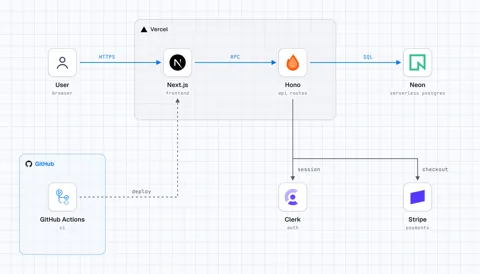
    caru-ini/stack-diagram

    What it does
    stack-diagram is an agent skill for people who need to explain a software stack visually without drawing every logo and connector themselves. The input is a description of technologies and their relationships, and the main output is a self-contained HTML architecture diagram. The agent chooses nodes, groups and connections, fetches brand logos, and places elements using documented coordinate and collision rules. Python scripts embed icons and fonts into the HTML, while Playwright and Chromium capture light and dark PNG versions. React components and shareable artifacts can also be derived from the same diagram. It supports skill-capable agents such as Claude Code and Codex, requires Python 3.9 or later, and needs network access when fetching logos. The documented starting path is to add the skill to a supported agent and describe the desired diagram; it is not an infrastructure discovery service or a hosted diagram API. Relationships inferred from a short technology list still need human review, third-party logo terms remain applicable, and public gallery submission is an optional separately approved step.
    License
    MIT Permissive. Commercial use and changes are allowed if the copyright notice is kept.
  13. 903

    Verlintas/NOIR

    What it does
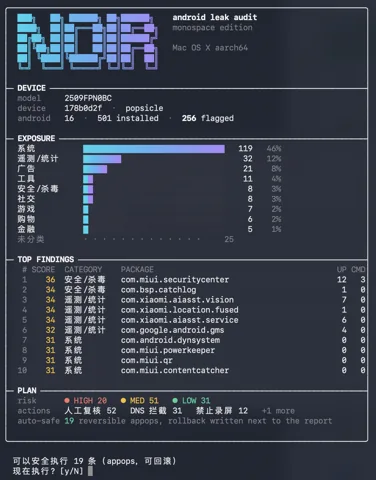
    NOIR is a desktop tool for inspecting privacy risks on Android devices that the operator owns or is authorized to audit. It reads installed applications, permissions and network address strings in APK files through adb, the Android device connection tool. It associates permission categories with possible destination domains and produces risk scores, JSON and Markdown reports, domain lists and remediation plans. Shared user permissions and application manifests provide additional evidence, while optional deeper inspection uses the separate local jadx decompiler. Its recommendations distinguish reversible application permission controls from actions requiring manual review and can produce rollback commands. The documented starting point is a portable package for Windows, macOS or Linux and a device that has authorized USB debugging, with adb prepared separately. Portable packages include a Java runtime, while source execution requires JDK 17 or later, and tool setup can download missing dependencies. These are static associations rather than proof of an actual transmission, and restricting permissions still requires checking whether legitimate application functions are affected.
    License
    MIT Permissive. Commercial use and changes are allowed if the copyright notice is kept.
  14. 902

    RikiyaT/lm_understand-logs

    What it does
    This repository is a research record collection for readers examining experiments in which a language model reads or writes neural network weights, not a ready-to-use editing service. Eight experiment folders cover identifying trained networks, repairing or creating networks and editing a small language model for math. The recorded inputs include prompts, task descriptions and network information, while outputs include replies, code, execution output, evaluations and final networks or weight differences. Experiment-specific READMEs connect reported results to runs and evidence files. Codex built-in tools were disabled, but several experiments used a separate Python execution loop that returned output to the model, so tool-free does not mean no computation anywhere in the experiment. The included sandbox example uses Linux bubblewrap with network isolation and resource limits, while full reproduction also depends on the relevant model access, data and evaluation environment. Readers can start with an experiment README and follow its links to prompts, run records and evaluation artifacts without calling a model API just to inspect them. Earlier prompt trials, some weights and intermediate data are absent, the math experiment's full agent harness is not included, and reuse must distinguish the licenses for records, scripts and third-party materials.
    License
    Custom license Custom or non-standard license. Read the license file before any reuse.
  15. 901

    rerun-build/rerun

    What it does
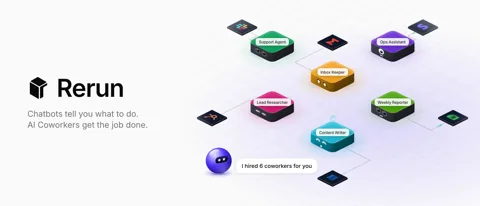
    Rerun is a self-hostable web application for teams that want AI coworkers with separate roles and recurring work. A Foreman collects natural-language requirements and helps form a team, while a board presents coworkers and their tasks. Requests, schedules, files and connected services feed agents that can use a browser and tools and produce messages, reports, files and database records. The architecture separates a Next.js interface, a workspace engine and Supabase for authentication, storage and application data. Its memory code creates a short index of active memories for later retrieval, and its scheduler launches due work while avoiding overlapping occurrences of the same schedule. External work requires separately authorized service connections through APIs or MCP, a standard interface for connecting model tools, and model access is also configured separately. The documented self-hosting path prepares Docker, Node.js 22, Supabase and model-provider settings before creating a coworker, so self-hosting does not remove those setup and usage dependencies. Although the README promises approval before consequential actions, the inspected chat approval endpoint returns HTTP 501 as unsupported, so the claimed approval guarantee is not established by this implementation and must be checked separately.
    License
    AGPL-3.0 Network copyleft. Offering a modified version as a service also requires releasing the source. Review before any product use.
  16. 900

    modelflare-ai/AnyModelBot

    What it does
    AnyModelBot is a local-first assistant application for people who want persistent bots with separate personas, workspaces, models and memory. Instructions and files arrive through its desktop or local web interface and supported messaging channels, and outputs include replies, files, command results and desktop actions. A Node.js backend stores conversations in SQLite, keeps scoped Markdown memory and runs agent sessions through DeepSeek Harness with a bundled model gateway. Background tasks and scheduled rules have their own state, budget handling and a queue for questions or approval requests. Read-only, workspace and full-access presets define different execution authority, while optional desktop-action approval is distinct from file permissions. Users start with a desktop package and Modelflare authorization or an API key, then choose a model and optionally connect messaging or supported data accounts. Windows, macOS and Linux are documented, but computer control requires a desktop session, macOS control is beta, and arbitrary user-added MCP connections remain on the roadmap. Local storage does not mean offline inference: selected context, tool results and screenshots travel through Modelflare to model providers, while scheduled work also depends on the host remaining available.
    License
    MIT Permissive. Commercial use and changes are allowed if the copyright notice is kept.
  17. 899

    Kohei-Wada/houritsu

    What it does
    houritsu is a Japanese law dataset for readers who need to see how statutory text changes across revisions rather than read only its current form. It takes e-Gov law API v2 data, converted by the separate Rust houritsu-builder project, and publishes Markdown law files with metadata and Git history. Commits group changes by amending law and enforcement date, so one amendment can produce separate commits when its provisions take effect on different dates. The main branch represents enforced revisions, and upcoming adds promulgated revisions that are not yet in force. Files retain law and revision identifiers, tables use HTML, and figures link to e-Gov attachments or explicitly indicate missing images. Users can start by finding a title and inspecting the corresponding file history and differences without running the builder or using a dedicated search API. Available history depends on e-Gov coverage, missing revisions can combine multiple changes in a later diff, and commit identifiers may change before version 1.0. The dataset uses CC BY 4.0 attribution terms, is not the official legal text, and requires checking the authoritative source before legal reliance.
    License
    Custom license Custom or non-standard license. Read the license file before any reuse.

  18. 898

    What it does
    NectarLink is a device companion for people who move between an Android phone and a Windows PC. With permission, phone notifications, messages, clipboard content, files, photos and screen content become available on the paired PC, and selected controls work in the other direction. A shared Rust core handles device identity and pairing, while the desktop and Android applications provide their respective interfaces. Devices normally communicate directly over the local network or USB using encrypted connections, and mobile-data relay is optional. Setup involves installing both applications, confirming pairing and enabling only the features the user wants; some advanced Android features require separately authorized debugging access. An optional local HTTP and JSON automation API supports actions such as sending files, notifications and camera requests, requires a Bearer token and is disabled by default. The documented v0.1.4 packages cover Windows x64 and Android, while Linux and Windows ARM64 packages are described as forthcoming and macOS remains a preview. This is not a cloud collaboration service, third-party chat history is limited by notification access, and call audio still stays on the phone even when calls are controlled from the PC.
    License
    Custom license Custom or non-standard license. Read the license file before any reuse.
  19. 897

    aaitor/skill-video-studio

    What it does
    Video Studio is a local production workspace for developers preparing product demonstrations with a Claude Code skill. Its inputs include a product URL, audience, message, timed scenes and brand assets recorded in a project brief. Playwright captures real browser interactions, HyperFrames composes titles and chapters around the footage, and FFmpeg produces master and web video copies. The workflow also provides thumbnails, contact sheets and media metadata inspection, with optional music, narration and subtitles. The included Acme walkthrough supplies a local demonstration app and capture and composition sources, whereas the short README demo only shows planning before capture or rendering. Planning starts with authenticated Claude Code in the full workspace; production additionally requires Node.js 22 or later, Python helpers, Chromium and FFmpeg. Narration needs a separately configured speech service, and presenter animation can require an additional GPU host and software. The pipeline was developed on Linux, portrait output remains planned, and local production still requires visual review and sanitized capture data rather than relying on offline checks alone.
    License
    MIT Permissive. Commercial use and changes are allowed if the copyright notice is kept.
  20. 896

    JiaFeiMiao-K-Cat/DiscImageStudio

    What it does
    Disc Image Studio is for users who want burning a disc to create a pattern visible on its surface, rather than print a label. It takes an image and optional accompanying files and converts them into data constrained by the physical recording formats of CD, DVD and single-layer BD-R. Its design workspace supports image layers, tone adjustments, previews and calibration. Outputs include CD audio tracks in WAV with CUE or RAW, and disc images such as ISO for the corresponding media. Separate media modules share a command and job interface, while experimental direct burning connects to a recorder through Windows IMAPI2. The Windows desktop interface supports design and burning, and the experimental Linux and macOS command-line packages generate images offline without a cloud API. The documented starting path is to obtain the matching release, select a disc type, import an image and inspect the preview before export. Visible results depend on the medium and recorder, and direct burning is experimental and can waste a blank disc if interrupted.
    License
    GPL-3.0 Copyleft. Distributing software that includes this code requires releasing the source under GPL.
  21. 895

    ivankovic/omnidiff

    What it does
    OmniDiff compares two files and presents changes according to their content rather than only matching lines. For supported programming languages, it parses syntax trees with tree-sitter and combines subtree matching, residual matching and move recovery to identify insertions, deletions, updates and moves. Images, archives, fonts, translation catalogs and PDFs have content-specific comparisons, while unsupported text uses line comparison and unknown binary content receives a change notice. Results can be viewed in an interactive terminal interface or emitted as plain text or JSON for other tools. Git and Jujutsu integrations require their own configuration, and the JSON format supplies file paths and changed ranges rather than embedding file contents. Linux, macOS and Windows binaries are documented, while building from source needs Rust 1.92 or later and a C compiler. Starting with a pair of local files does not require a model service, and the documented stable integration surfaces are the command line and JSON, not every internal Rust API. Reported performance and accuracy belong to the author's datasets, the stated highlighting accuracy goals are not yet met, and licensing needs review because the README and package declare AGPL with a separate commercial option.
    License
    Custom license Custom or non-standard license. Read the license file before any reuse.
  22. 894

    hyprwm/Hyprland

    What it does
    Hyprland is a Wayland compositor, a desktop system component that arranges application windows and combines them into the displayed screen. It is intended for users who want to customize a Linux desktop rather than build a web interface. Window state, input events, monitor settings and configuration determine the resulting layouts, workspaces and visual effects. It supports tiled, floating and fullscreen windows, multiple layout styles, window rules, animation and plugins. The current example uses Lua configuration, and the bundled hyprctl utility and local Unix sockets expose control, state queries and events to separate programs. Starting requires a compatible graphical environment, installing Hyprland and configuring a session, with terminals and other desktop utilities prepared separately because it is not a complete desktop environment. GPU drivers, virtual-machine graphics acceleration and application behavior under Wayland need separate checks, and it is neither a Windows desktop replacement package nor an AI agent execution system.
    License
    BSD-3-Clause Permissive. Commercial use is allowed; keep the notice and do not use the authors' names for endorsement.
  23. 893

    storytold/craft-anything

    What it does
    Craft Anything is a Rust application for inspecting websites, applications and games and having a coding agent create a separate project from the findings. Its intended users are people who want to understand software or build their own version, supplying a target address, files, screenshots and a natural-language request. The default Clean room mode uses externally visible material without reading the original code or page source, while Deep mode permits internal inspection of authorized targets. It follows a study, build, compare and refinement workflow, and website comparisons cover multiple screen widths. Each project keeps the request and history, captures, generated application, comparison results, evidence and open questions in separate files or folders. The same engine is available through a desktop interface, command-line tools and MCP, a protocol that lets agents call tools. Building primarily uses the user's signed-in Claude Code, while analysis can use Anthropic, OpenAI, OpenRouter or an OpenAI-compatible local server. The documented source setup requires Rust 1.97 or later and a local coding agent, and provides desktop and command-line entry points. It is early alpha: Codex and API-based builds lack live verification, some inspection tools are partial, game self-tests rely on the generated game's own report, and use must stay within examination and asset rights without bypassing DRM or logins.
    License
    Apache-2.0 Permissive, with a patent grant. Commercial use is allowed; keep the notices and state your changes.
  24. 892

    patch-gg/pixelfx

    What it does
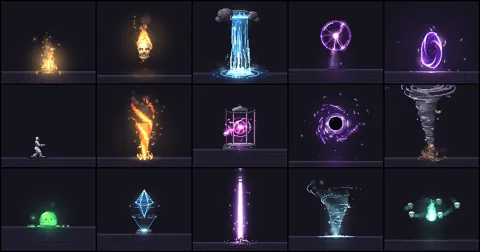
    pixelfx is a JavaScript pixel-art effects library and authoring workflow for game and visual-prototype developers. Its README lists 244 effects spanning fire, weather, interface animations, magic, and character moves. Each effect is code rather than a stored image, using either a time-based drawing function or a stateful simulation with update and draw methods. Callers supply palette, seed, position, mirroring, rotation, and brightness options, and the runtime combines pixel colors and lighting into frames. Character effects can include anticipation, impact pauses, target reactions, and recovery through separate action metadata. Outputs include live browser playback, preview images, transparent sprite sheets, and frame metadata, with optional GIF and MP4 export requiring ffmpeg. Users can browse the gallery or use the Node.js 18 or newer tooling, and a Claude Code skill describes drafting, rendering, inspecting, and refining new effects rather than providing a generative model. Effects designed around the stock character need adaptation for custom characters, and the MIT code license excludes the separately licensed bundled PatchPixel font.
    License
    MIT Permissive. Commercial use and changes are allowed if the copyright notice is kept.
  25. 891

    elvarofficial/teardown

    What it does
    Teardown is a Claude Code skill for making interactive 3D explanations of machines. A user describes a machine and the desired demonstration, and the agent builds a self-contained offline HTML page with optional review images or video. The page combines a running machine, controls, numerical panels, selectable parts and a guided tour that resumes when the viewer is idle. A shared simulation step updates mechanical state, and the scene and instruments read that state rather than using unrelated decorative numbers. The included V8 engine, Cessna and Strandbeest scenes demonstrate shared machine models with separate live and filmed presentations. Its kit uses Three.js and a stage runtime, while the build script bundles JavaScript and inlines fonts into the resulting HTML. The documented environment requires Node.js 20 or later and Playwright Chromium, with ffmpeg for video and Python 3 for procedural sound. Its API is the internal scene and simulation interface rather than a hosted business service, and the cinematic models and review guidance do not establish engineering accuracy or safety certification.
    License
    MIT Permissive. Commercial use and changes are allowed if the copyright notice is kept.
  26. 890

    benjitaylor/skills

    What it does
    This repository collects skills for coding agents doing design and motion work, with Stageshow as the documented offering. It targets designers and product teams that need illustrative product screens rather than a working application. Inputs are a brief, aspect ratio, reference screens and requested interactions, and outputs are React scenes such as stills, feature cards, cursor demonstrations and bento layouts. The skill combines composition and animation guidance with a reusable component kit, example scenes and local rendering utilities. Its workflow proposes a scene plan before building, checks still compositions before choreography and inspects captured frames while polishing. The kit provides windows, cursors, tooltips and shared visual styling, but scripted clicks illustrate interaction rather than operate a real application or its API. Previewing requires Node.js 20.19 or later and uses React with Vite, while capture uses playwright-core with locally installed Chrome and produces still images or contact sheets. These support agent review but do not prove visual quality or functional product behavior, and reuse requires checking the MIT licence and separate third-party asset and trademark notices.
    License
    No license No license file found. Without a license, reuse of the code is not permitted by default.
  27. 889

    emanuele-em/kanzo

    What it does
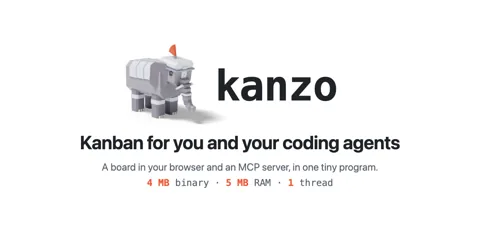
    Kanzo is a self-hosted task board that lets people and coding agents work on the same projects. People enter tasks, descriptions, comments and images through a browser, while agents use MCP, a protocol connecting AI tools, or the command line. The Rust program provides a REST-style JSON API and MCP over standard input and output or HTTP, stores tasks in SQLite and images as local files, and updates the browser through polling. A default launch opens localhost:4242, while sharing and joined modes provide a shared host board and relay remote requests. Tasks support todo, doing, review and done with optional backlog, tags, ordering, comments and timestamps, but the inspected schema does not provide assignees, dependencies or an audit history. The next_task operation selects a non-Human todo task and changes it to doing inside a write transaction, preventing competing selections by design without granting exclusive ownership. Human tasks are omitted from agent listing and automatic selection, but update and delete operations do not enforce Human protection when an agent knows the identifier. There is no separate read-only token, and anyone who can reach the shared port can change the board, so choosing local or shared operation, the data directory and network restrictions is a prerequisite. Distribution targets macOS, Linux and Windows under AGPL-3.0-only, while advertised size, memory use, start time and token savings remain upstream measurements rather than independently verified results.
    License
    AGPL-3.0 Network copyleft. Offering a modified version as a service also requires releasing the source. Review before any product use.
  28. 888

    zzp1221/Research-Assistant-Agent

    What it does
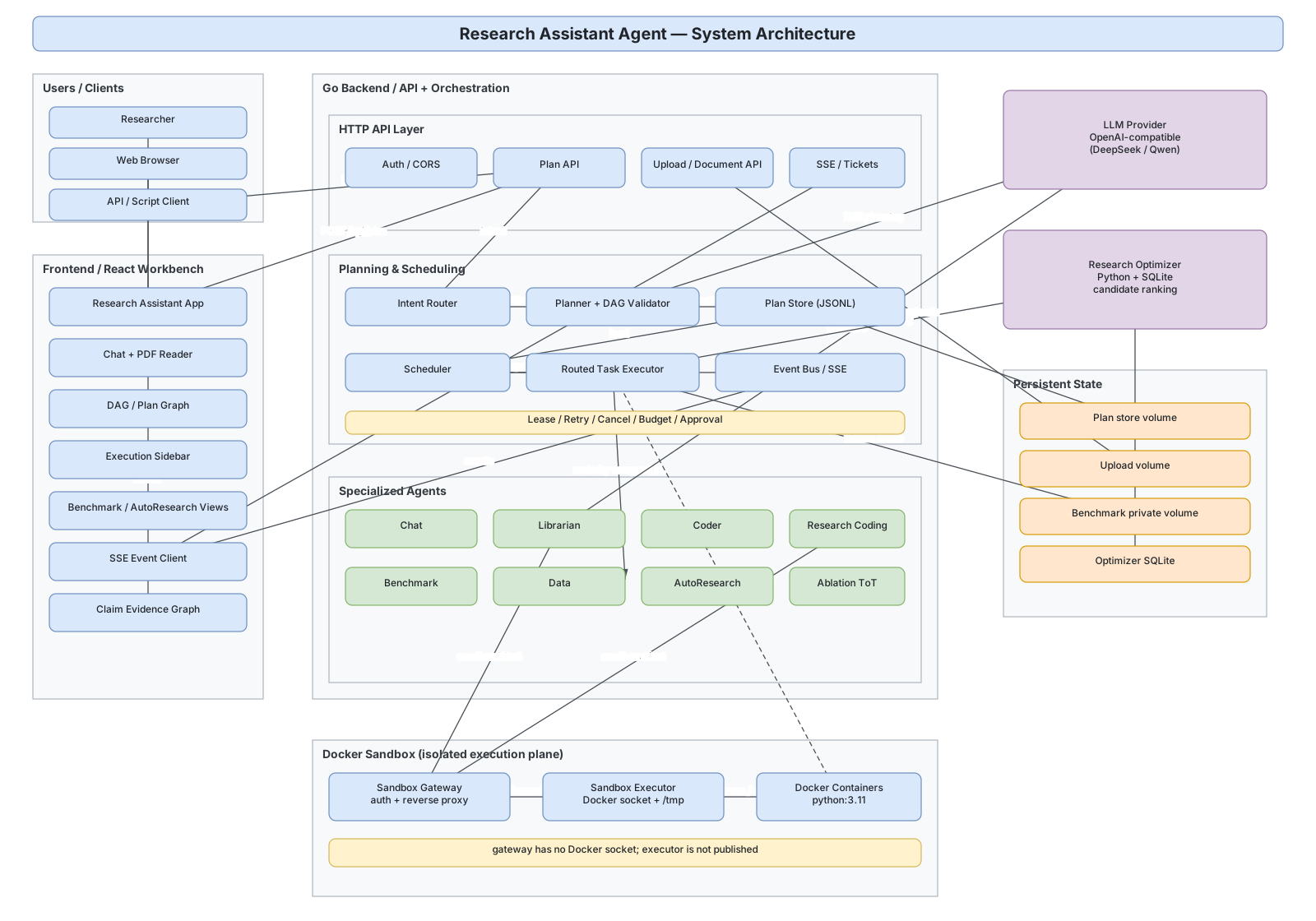
    Research Assistant Agent is a multi-agent research execution prototype for researchers reproducing papers, evaluating datasets and exploring candidates within a budget. Inputs are natural-language research goals, papers or attachments, repository addresses, datasets and resource constraints. A planner builds a dependency graph, meaning a plan with explicit task prerequisites, and a scheduler dispatches specialist agents with approval, retry, cancellation and budget handling. Outputs include experiment artifacts, metrics, environment manifests and links between individual claims and evidence, with separate outcomes for completed, partial, minimal-check, blocked and review-needed work. It also exposes literature search, page-based document retrieval, REST interfaces and live execution events to a React workbench. The main implementation combines a Go backend, a separate sandbox service and a Python optimizer, and the documented Compose setup requires Docker and an OpenAI-compatible model endpoint and key. Starting through that setup requires configuring service authentication and model access before opening the workbench, rather than merely opening a static page. Older root instructions say the backend is Linux-only, while the newer desktop section and desktop README describe a Windows Wails shell, native sandbox support and cross-builds, so native Windows readiness cannot be treated as settled from the overview alone. It remains a research prototype with limited production authentication and incomplete public raw verification logs. The verification document still lists claim-rubric parsing and paper-metadata extraction defects, and successful minimal runs or offline framework baselines are not full paper reproduction or real framework performance evidence.
    License
    MIT Permissive. Commercial use and changes are allowed if the copyright notice is kept.
  29. 887

    huaxialucaicaizi/ai-startup-skills

    What it does
    AI Startup Skills bundles seven agent instruction sets for solo founders and early teams building AI products, with a router that selects the appropriate stage. Users provide their product, current progress, target market, available resources and existing evidence, and the router asks at most two questions when the stage is unclear. The stages cover demand validation, business plans, policy support, pitching, customer acquisition, pricing and company registration. Outputs include validation reports, business-plan material, pitch scripts, pricing and quotation plans, and registration checklists and compliance calendars. The instructions pass earlier evidence into later stages, distinguish verified records from user statements and missing information, and prohibit invented market figures or testimonials. This is a collection of SKILL.md files, references and templates rather than an independent application or hosted API, and it is placed in a compatible agent's skill directory such as Codex or Claude Code. The repository also provides a synchronization script for the seven upstream repositories and a validator for skill metadata, not evidence that startup outcomes improve. Policy, registration and platform growth mainly target mainland China, policy links can expire, the pitch material targets incubators and competitions rather than VC fundraising, and the content is not legal or tax advice.
    License
    MIT Permissive. Commercial use and changes are allowed if the copyright notice is kept.
  30. 886

    l0ng-ai/openidea

    What it does
    OpenIDEA is a desktop development environment that brings IntelliJ-style shortcuts, tool windows, and global search to macOS, Windows, and Linux. Developers open source projects to edit code, inspect changes, debug, use Git and terminals, and access database and HTTP clients. Its interface uses React, TypeScript, and CodeMirror inside Tauri, with a Rust backend rather than an entirely Rust-written interface. The agent manager sends prompts and file context to external coding agents through adapters and ACP, an editor-to-agent communication protocol. Tasks can use the project directory or a separate Git worktree, and persist conversations, status, and changed-file information. Users start with a platform build or the documented Node, pnpm, and Rust development setup, while agent executables, service authentication, and some language tools are separate requirements. Conversation rewind does not restore modified files, and the implementation includes modes that can automatically approve tool requests. The project is Apache-2.0 with separate third-party notices, and its author's startup benchmark is not an equivalent-work comparison or an independently verified performance result.
    License
    Apache-2.0 Permissive, with a patent grant. Commercial use is allowed; keep the notices and state your changes.
  31. 885

    developeryj1992/ai-trend-studio

    What it does
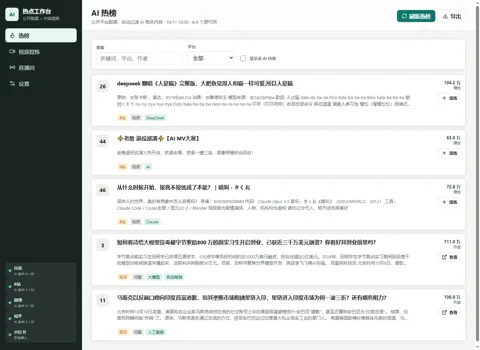
    AI Trend Studio is a local browser dashboard for people tracking AI topics and turning videos or live discussions into notes. It reads public Douyin, Bilibili, Weibo, and Zhihu signals, filters them by configurable keywords, and supports Bilibili keyword search. Users import descriptions, comments, transcripts, or SRT and VTT subtitles, and available public Bilibili subtitles can be fetched. Live sessions store user-entered speaker events rather than automatically recognizing audio or identifying speakers. Outputs include conclusions, key points, actions, risks, keywords, and a JSON workspace export. A Chinese extractive summarizer scores sentences locally, while an optional OpenAI-compatible Chat Completions endpoint can generate summaries and receives the submitted content. The Python 3.10 or newer standard-library server and static frontend start on localhost port 8765 and store state, including configured API keys, in data/db.json. Public interfaces can fail or change, protected content requires authorized input, and exposing the server requires additional authentication and transport protection.
    License
    MIT Permissive. Commercial use and changes are allowed if the copyright notice is kept.
  32. 884

    anomalyco/hex

    What it does
    Hex is a local voice-dictation desktop app for people entering text into applications on macOS, Windows, and Linux. Users hold a shortcut, speak into the microphone, release it, and receive recognized text pasted into the active app. The first use downloads a speech model, and ordinary transcription runs on the device through its Rust engine. Context-dependent processing can include correction and optional OpenCode rewriting, so the local-transcription claim should not be extended to every connected processing service. A separate TypeScript SDK accepts host-supplied PCM WAV and returns transcript text and duration through an authenticated local native helper. The SDK host owns recording, permissions, and consent, and should use the Node or Electron main process rather than an untrusted browser renderer. Users start from a platform download, while embedded SDK use requires Node.js 20.3.0 or newer and an explicit native executable because a bundled helper is not yet published. The Windows document says the current Rune interface has not been physically validated and its local transcription API is unavailable, so its platform boundary must be reconciled with the SDK guide. Windows is described as beta, SDK-controlled desktop capture is currently macOS-only, audio requests have size and duration-related limits, and the MIT source license does not establish the terms of every speech model.
    License
    MIT Permissive. Commercial use and changes are allowed if the copyright notice is kept.
  33. 883

    immortal71/openoncology

    What it does
    OpenOncology is a research platform that combines tumor alteration evidence and ranks drug candidates for expert review, not a validated treatment recommendation service. Documented inputs include mutations, copy number changes and fusions, while the submission API accepts biopsy and DNA files with cancer type and requires patient authentication. Outputs include variants, evidence levels, source records and candidate drug rankings through separate results and repurposing APIs. The FastAPI server works with a Next.js interface, PostgreSQL, Redis, object storage and background workers, and the Docker configuration uses Python 3.11 and Node.js 20. Genomic processing has additional workflow and reference-data requirements, so starting the development containers does not establish that raw sequencing analysis will finish. Candidate scoring combines several evidence sources with renormalized weights, penalties and evidence-level rules, and its current configuration differs from an older README weight description. The default worker centers candidate generation on the first targetable mutation, so the whole-patient description should not be assumed to describe every execution path. Setup requires service secrets and configured evidence access, and unavailable OncoKB access can use a static fallback whose provenance limitations matter. Official documents retract an earlier circular oncologist-agreement evaluation, and the retrospective MSK CHORD comparison measures agreement with label-matched drugs rather than treatment benefit. The risk analysis states that clinical validation gates are unmet and results must not guide treatment, while this investigation only read sources and did not verify medical validity, performance or deployment readiness.
    License
    MIT Permissive. Commercial use and changes are allowed if the copyright notice is kept.
  34. 882

    warmbly/warmbly

    What it does
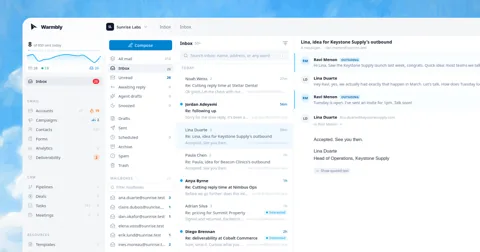
    Warmbly is a self-hostable sales-email and mailbox-warmup platform for teams using mailboxes they already own. Users connect Gmail, Microsoft or SMTP and IMAP accounts and provide contacts, message sequences, timing and sending limits. It produces campaign records, opening and click events, replies, shared-inbox views and customer-management records. Mailbox warmup means gradually exchanging scheduled messages within monitored mailbox pools, not a guarantee that future mail reaches the inbox. The architecture separates state-owning Go backend and consumer services from interchangeable Go workers, with Postgres, Redis and an event bus, a React dashboard and a separate realtime service. Workers submit mail through each mailbox provider rather than delivering directly to recipients, and the default local stack uses NATS, local key management and filesystem storage. REST interfaces, webhooks and documented integrations support external connections, while AI functionality requires separate model-provider configuration. The documented start uses Docker Compose release images or a source build, then a one-time instance claim and mailbox connection, with OAuth application configuration needed for Google and Microsoft accounts. Development seeding shares the database with self-hosting and publishes demo administrator credentials, so production secrets, encryption-key backups and demo separation are essential; sending performance, inbox placement and ATF integration were not verified in this review.
    License
    Apache-2.0 Permissive, with a patent grant. Commercial use is allowed; keep the notices and state your changes.
  35. 881

    aoguai/LiYing

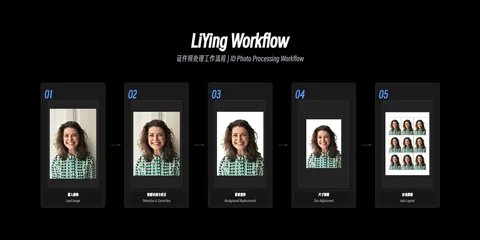
    What it does
    LiYing automates ID photo postprocessing for photo studios using a single-person portrait as input. It produces resized electronic photos and printable layouts with configurable backgrounds, spacing, and crop lines. Its Python pipeline combines YOLOv8 pose detection, YuNet or RetinaFace face detection, and RMBG background segmentation through local ONNX models. Shoulder keypoints guide angle correction, while face size and top margin guide cropping. CSV files define photo dimensions, resolution, colors, and file-size limits, with optional compression and skin retouching. Users can work through a command-line interface or Gradio browser interface, and Docker configuration is included. Starting requires separately obtained model files and Python dependencies, with compatible CUDA and cuDNN needed only for optional NVIDIA acceleration. Complex photographs are outside its intended input, transparent PNG saving skips target-size compression, and the AGPL-3.0 code license does not settle the separate model licenses.
    License
    AGPL-3.0 Network copyleft. Offering a modified version as a service also requires releasing the source. Review before any product use.
  36. 880

    deepseek-ai/dsh-superagent-prototype

    What it does
    dsh-superagent is a research prototype for handling team development requests in one GitHub repository through DeepSeek Harness. The repository states that it is not an official DeepSeek product or production-ready software, and some directions described in the paper are not implemented. It receives GitHub messages and optionally Feishu messages, turns authorized requests or rule-matched work into Tickets and processes them in separate sessions and directories. Results such as pull requests return to the original conversation, while a web panel highlights work needing human attention. Explicit requests are separated from inferred candidates, and the default observe mode does not accept inferred candidates as actual work. Setup requires a dedicated Harness profile, an agent GitHub user account, an authenticated gh CLI, a model provider and workspace configuration. The deployment guide requires Node.js, pnpm, git, Python and tmux, with a separately configured bot for Feishu. GitHub Enterprise Server is unsupported, and account wrappers do not isolate processes, so operating-system privileges and secret exposure require separate controls.
    License
    MIT Permissive. Commercial use and changes are allowed if the copyright notice is kept.
  37. 879

    ccch1mneyyy/dsh-Go

    What it does
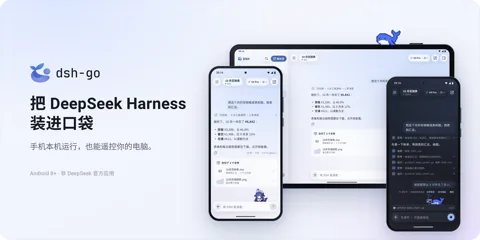
    DSH Go is an unofficial Android client for using DeepSeek Harness conversations and work. It can run the engine inside a phone environment containing Ubuntu, Node.js and DSH, or connect to a computer's engine through SSH or DSH Remote. It passes text, images and voice input and displays answers, tool approval requests and work status. Running the engine on a phone does not mean running the language model there, since model requests go to the configured provider. Android 8 or newer and an appropriate 64-bit package are required, followed by separate local-runtime or remote-host setup and model credentials. Phone screen control requires the local engine and additional permissions, while the documentation says sensitive actions such as payments and passwords return to the person. DSH Remote limits non-image attachments, the in-app web mode, DS Bot and conversation-log export, so capabilities vary by connection. Screen information may reach the model and anonymous usage statistics are enabled by default, making privacy settings important. The application identifies AGPL-3.0 and the SDK and examples identify MIT, but names and mascots have separate terms, so code and visual assets must be treated separately.
    License
    AGPL-3.0 Network copyleft. Offering a modified version as a service also requires releasing the source. Review before any product use.
  38. 878

    microsoft/TokenEconomizer

    What it does
    TokenEconomizer is a plugin intended to reduce waste when coding agents repeatedly work in the same repository. It takes session logs, tool usage and failure history and produces repository-specific learned facts, tool exclusion proposals or settings, and redirects for repeated failures. Micro-skills inject facts confirmed across sessions into later context and drop contradicted facts. Tool pruning collects evidence of nonuse, excludes tools through host settings and allows restoration. Failure-loop detection consults a judge model and suggests another approach, but does not stop work itself. It requires Python 3.10 or newer, an authenticated supported coding agent and plugin installation, with extra model calls handled through that agent's account. Configuration code disables micro-skills by default while enabling tool pruning and failure-loop nudges, so installation does not enable every learning feature. Claude Code, Codex, GitHub Copilot CLI and Pi are supported, opencode is experimental, and tool pruning does not act on Pi or opencode. State remains local, and the authors' cost experiments do not guarantee equivalent savings for individual workloads.
    License
    Apache-2.0 Permissive, with a patent grant. Commercial use is allowed; keep the notices and state your changes.
  39. 877

    patchy631/ai-engineering-hub

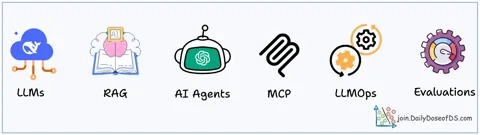
    What it does
    AI Engineering Hub collects tutorials and example code for developers learning LLMs, document retrieval and agents. It is a collection of projects grouped by difficulty and topic, not one finished service or a proprietary model. Examples cover document question answering, image text extraction, chat interfaces and MCP connections. The inspected Simple RAG example reads documents from a folder, builds a retrieval index and generates an answer from relevant passages. Its notebook connects LlamaIndex, llama3.2 through Ollama and HuggingFace embeddings, then streams an answer based on two retrieved passages. That example requires Python 3.10 or newer, Ollama, a notebook environment and separately supplied documents. Other projects use different models, external services and credentials, so their individual documentation and configuration must be checked. Downloading the repository does not activate every feature, and this review does not establish production readiness or retrieval quality.
    License
    MIT Permissive. Commercial use and changes are allowed if the copyright notice is kept.
  40. 876

    bregman-arie/devops-exercises

    What it does
    devops-exercises is a collection of questions and practice material for people studying development operations and site reliability. Topics include networking, operating systems, SQL, containers, cloud services, delivery workflows and observability. Readers select exercises, produce explanations, code or queries themselves and compare them with available answers or linked resources. It is not an executable product that deploys infrastructure or automatically grades answers. Reading requires no shared installation or API, while practical environments depend on the technology in each selected exercise. The author explains that the material neither reproduces actual interviews nor requires learning every listed technology. Some questions lack answers and some certification guidance is old, so answers and current requirements need independent checking. The README identifies CC BY-NC-ND 3.0 and the FAQ describes attribution and noncommercial conditions, which must be checked before commercial reuse or translated republication.
    License
    Custom license Custom or non-standard license. Read the license file before any reuse.
  41. 875

    wangzan101/Mika

    What it does
    Mika is a personal Android assistant that turns natural-language requests into app and web operations and shows results with execution history. It opens apps on a separate background display and reads interfaces through accessibility data, OCR and an optional vision model. Its built-in browser reads web material and handles files, while supported devices provide a Linux sandbox per conversation for computation and document processing. Installing the APK alone does not enable phone control; debugging pairing, permissions and a tool-capable model connection must be configured. Installation requires Android 11 or later, phone-app tasks require Android 13 or later, Android 14 is recommended, and the sandbox is arm64-only. Models connect through separate APIs or supported login flows, and screen content can reach the selected provider, so on-device execution does not mean fully offline processing. Login and verification challenges are handed to a person, but the default asking mode does not request approval for every message send or deletion. Autonomous mode also reduces payment-related confirmation, a distinction that matters for business accounts. This is a public beta with device compatibility limits, protected-screen visibility limits and third-party terms or account-restriction risks.
    License
    Apache-2.0 Permissive, with a patent grant. Commercial use is allowed; keep the notices and state your changes.
  42. 874

    heydamir/unslop

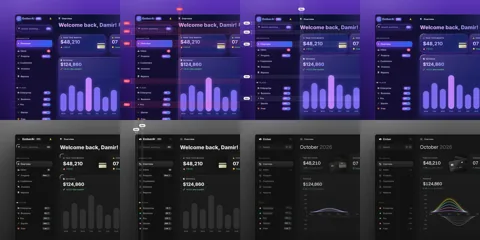
    What it does
    unslop is a Claude design skill for finding repetitive decoration and inconsistent spacing in AI-generated interfaces and revising them around the product's character. It is a bundle of instructions, reference material and helper scripts, not a standalone generation model or a service that edits a site upon installation. Given screen code, a site URL or an image, it first audits problems and proposes a design direction. Its improvement passes cover spacing, color, icons, copy, typography, layout, details, visuals and motion. Without original code, the result is a saved-page or reconstructed static HTML copy, not a production-site update. Files are placed where Claude Code reads skills and invoked there; real edits depend on the agent's file and browser permissions. Optional image generation needs an external service connection and paid-generation confirmation, while transformation videos need Playwright and ffmpeg. Design judgments are guided proposals, not guarantees of usability gains or compatibility with every framework. CC BY 4.0 requires retaining author credit and a repository link when sharing copies or adaptations.
    License
    CC-BY-4.0 Custom or non-standard license. Read the license file before any reuse.
  43. 873

    CopilotKit/OpenBot

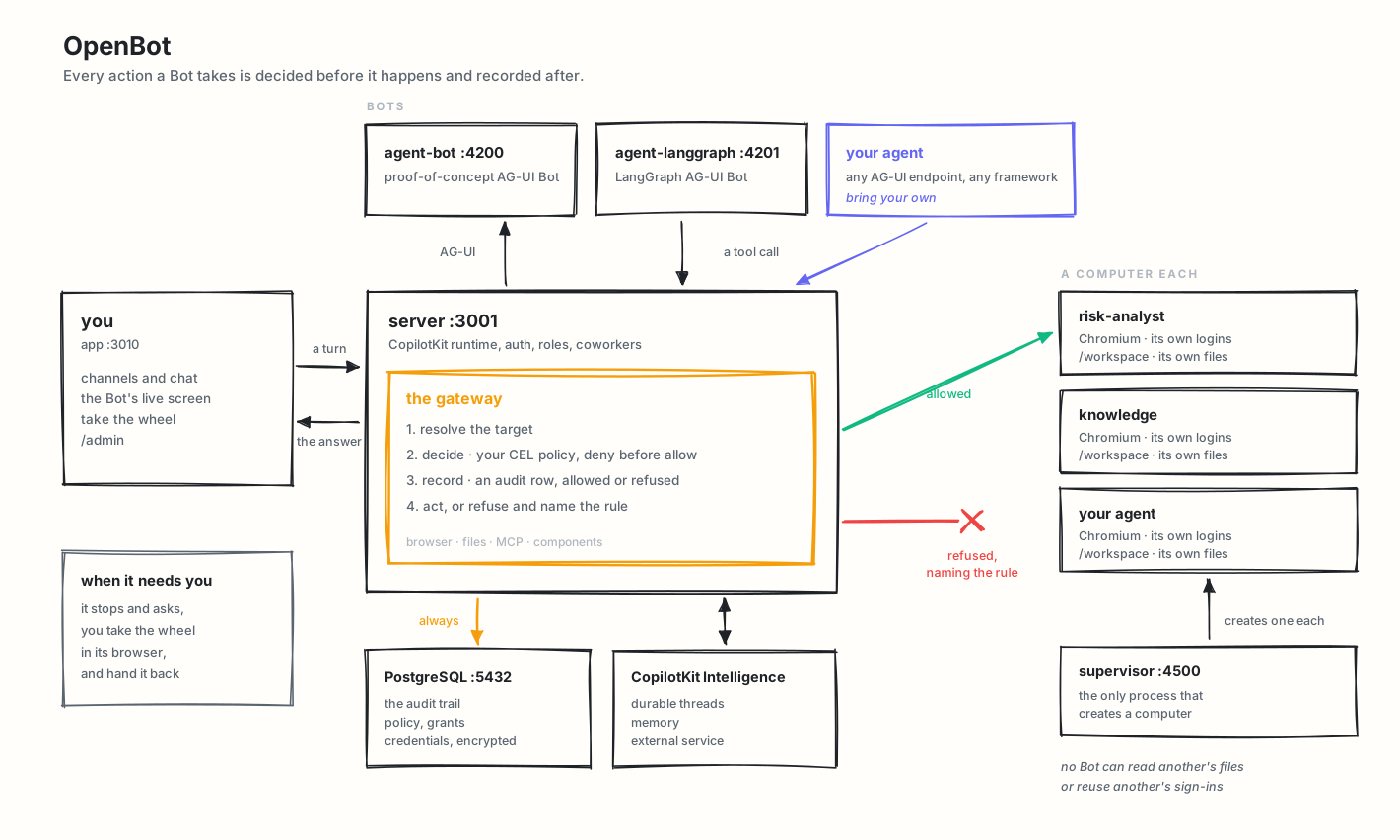
    What it does
    OpenBot is a beta AI-coworker platform template intended for companies to adapt and operate in their own environments. Rather than a finished hosted service or model, it supplies a React interface, API server, PostgreSQL, browser computers and AG-UI agent connections. Conversations and task requests flow to agents and onward to browser or file operations, result interfaces and audit records. The server gateway is designed to resolve targets, evaluate policy, write an audit record and only then forward permitted actions. Deny rules take precedence in the policy engine, but the shipped startup policy permits everything, so installation alone does not establish restrictive business permissions. Setup needs Docker, Bun, database and encryption configuration, separate model credentials, and a configured CopilotKit Intelligence connection and entitlement. Conversations and memory integrate with Intelligence, while app connectors and MCP tools require their own credentials and grants. Default single-user mode treats requests as one administrator, so authentication, roles and network isolation must be configured before others gain access. Browser logins and components controlling Docker require protection, and operators remain responsible for completing and validating the template for actual business use.
    License
    MIT Permissive. Commercial use and changes are allowed if the copyright notice is kept.
  44. 872

    vercel-labs/agent-desktop

    What it does
    This Rust CLI and C library lets AI agents read and operate desktop apps through OS accessibility trees rather than guessed coordinates. Automation developers select an app and window and receive a JSON snapshot with references for actionable elements. An agent requests clicks or text entry using those references, then takes another snapshot to check the result. Default actions use accessibility APIs without moving the pointer or bringing the app forward; physical input needs a separate mode. Entry points include npm packages and platform release archives, with Accessibility permission on macOS and a graphical session with AT-SPI on Linux. Windows callers must also consider process integrity levels and target-app conditions. Stale references and ambiguous targets return errors and require fresh observation. This is not a complete assistant with its own model or planner, and the native CLI requires no remote model, unlike the optional JEV helper. Snapshots, clipboard contents and screenshots may expose private information, and capabilities differ by OS.
    License
    Apache-2.0 Permissive, with a patent grant. Commercial use is allowed; keep the notices and state your changes.
  45. 871

    zklmiao/CodeWar

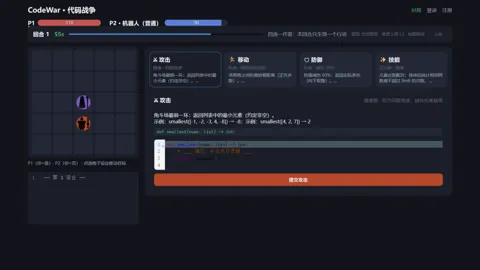
    What it does
    CodeWar is a browser-based Python programming game that turns solving exercises into actions in a turn-based battle. Learners choose an attack, movement, defense or skill problem and submit Python code, with correctness and solving time affecting the battle result. A server-controlled match engine generates numbered events while the browser renders the board, questions and battle log. The question factory combines templates with a seed, a value that makes the same generated exercise reproducible. A separate Python judging service executes submissions in disposable Docker containers with network and resource restrictions, compares outputs with expected values outside those containers and returns a verdict. The documented stack includes a Vue client, Go server, Python judge and PostgreSQL, with Docker Compose provided for local operation rather than an external AI service dependency. The README describes local two-window play, bot practice and a tutorial, but explicitly says online ranked matchmaking is not implemented. Its code is source-available under a noncommercial license, and the documented Docker socket access and remaining deployment risks mean the judging service must not be assumed safe for arbitrary public exposure.
    License
    Custom license Custom or non-standard license. Read the license file before any reuse.
  46. 870

    lexifina/global-law

    What it does
    global-law organizes legal corpora from different jurisdictions into a shared Git history for people researching which wording applied on a particular date. Each corpus remains a separate repository connected as a submodule, and the parent history records its changes in effective-date order. A user supplies a provision path, jurisdiction, search phrase or date and receives recorded text, differences, amendment history or attribution of words to amending laws. The Python reader uses effective-date metadata rather than relying on Git timestamps, including for dates before 1970. An MCP server, a tool interface for AI clients, exposes these reading and comparison operations over standard input and output. Local reading requires Python 3.10 or later, Git and the relevant corpus submodules, but the server itself makes no network requests. Coverage and historical depth differ by corpus, and a country folder alone does not prove that its law has been loaded. Missing results, reconstructed versions and retroactive application require careful interpretation, so the record is not a substitute for checking the original publisher.
    License
    Custom license Custom or non-standard license. Read the license file before any reuse.
  47. 869

    jacke-pp/open-yoki

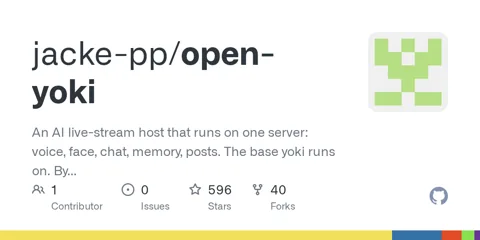
    What it does
    open-yoki is a self-hosted AI livestream host foundation for operators who want chat responses, voice and an animated avatar in one application. It accepts website comments or externally forwarded room events and produces spoken replies, subtitles, avatar behavior and a livestream feed. A fast language model handles conversation, while an optional longer-running agent keeps diary and persona files and prepares social posts. Local memory stores visitor notes and show summaries, and an outbox records the reported results of external posting. Headless Chrome renders the broadcast scene and ffmpeg sends it through RTMP, a protocol for sending live video to a platform. The documented starting environment uses Node.js and ffmpeg, with an x86_64 Ubuntu server for full deployment and services such as OpenRouter or DeepSeek, Volcengine voice and RTC, and Vidu for live avatar operation. Operators must provide authorized images, recordings, credentials, platform comment ingestion and each broadcast's streaming details because the original host's assets and accounts are not included. The release does not contain wallet or trading functions, and its one-server architecture does not mean offline operation or a fully automatic platform login and room-opening workflow.
    License
    MIT Permissive. Commercial use and changes are allowed if the copyright notice is kept.
  48. 868

    SheepSeb/tinyworldformer

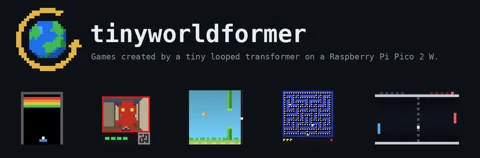
    What it does
    tinyworldformer is an experiment in generating and playing small games with two neural networks on a Raspberry Pi Pico 2 W. Its world model takes a token-grid frame and an action and predicts the next frame and reward. A separate actor reads features derived from the generated frame and chooses the next action, rather than controlling an ordinary game engine on the board. The world model reuses one transformer block across several passes and adds decoding constraints such as placing each ball or player only once. Python and PyTorch provide training, while quantization-aware training and export produce an int8 Rust inference engine for the microcontroller, host and WebAssembly. Training starts from transitions recorded in the supplied small games, and the board can optionally train a fresh streaming reinforcement-learning actor. Evaluation code compares generated transitions with the original game rules, because an actor can exploit mistakes in its learned environment. The project is not a general video world model or industrial simulator, the README leaves actual Pico frame rate unmeasured, and no repository license was identified in the inspected tree or package manifest.
    License
    No license No license file found. Without a license, reuse of the code is not permitted by default.
  49. 867

    JimLiu/baoyu-design

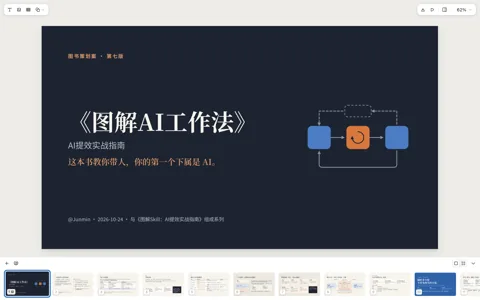
    What it does
    baoyu-design is a community-maintained collection of agent skills for people who want to create and revise visual deliverables with a local coding agent. A design request and reference materials such as screenshots, a codebase, HTML/CSS or a Figma file guide the agent toward UI mockups, prototypes, decks and other HTML artifacts. The main skill loads a shared design methodology, tool references for the agent environment and task-specific prompts or starter components. It also describes importing a version-pinned design-system copy into a project and recording that relationship in project metadata. Companion skills use their own file formats and local editors for slides, canvases, design systems and data dashboards. The workflow needs a file-capable AI agent and its model service, with Node.js for the local editor tools and Python available for a simple preview server. The README specifies Node 20 or later for most artifact editors and Node 22 or later for dashboards, while optional export or generation features have additional tools or service requirements. It is not an Anthropic-endorsed product, and local artifact storage does not establish offline model inference or guarantee production-ready UI and export fidelity.
    License
    MIT Permissive. Commercial use and changes are allowed if the copyright notice is kept.
  50. 866

    Renhuai123/ziwei-doushu

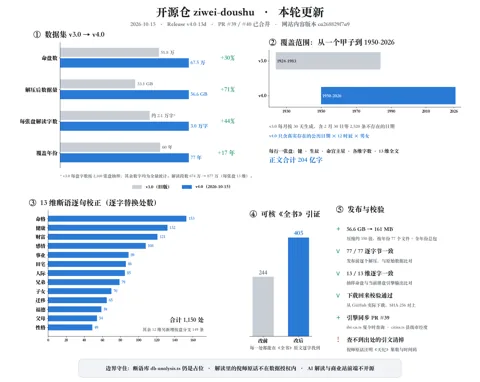
    What it does
    ziwei-doushu is a TypeScript engine and demonstration website for generating Zi Wei Dou Shu charts, a traditional Chinese divination system, with reference material based on Ni Haixia's Tian Ji teaching. It accepts a Gregorian birth date, a time-branch index and gender, with birth-location and time-correction information handled by related modules. The engine combines iztro and lunar-javascript with its own rule adjustments to produce a structured chart of palaces, stars and life periods. Supporting modules cover apparent solar time, leap-month conventions and configurable star-brightness schools, while the demo displays charts and classical texts. A Next.js environment with Node.js and npm is used, and ordinary chart generation runs in the browser without an AI API key. AI interpretation and compatibility-analysis API routes are not included, so adding a model key alone does not enable them. Interpretation datasets are distributed separately, but the production interpretation rule database, prompts and commercial interface are not included, and the checked database file is a placeholder. The README also notes differences between dataset and current engine conventions, and the materials inspected do not establish the scientific predictive validity of the divination interpretations.
    License
    MIT Permissive. Commercial use and changes are allowed if the copyright notice is kept.

Showing 50 of 962

Only repositories in the ranked Trendshift lists are included, and the lists are used only to find candidates. We do not copy their ranks. Descriptions, licenses and star counts come from each GitHub repository. The notes are our own reading. We have not tested these projects, and a place on a trending list does not prove quality. Trendshift RSS feed