SheepSeb/tinyworldformer
- Source
- GitHub
- First trending
- Category
- Model inference
- GitHub stars
- 96
- Main language
- Rust
This page introduces an external open-source repository. It is not an HDATF product.
What it does
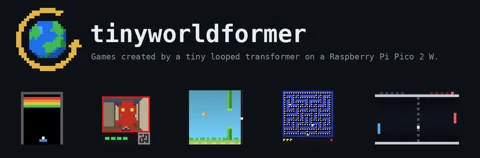
tinyworldformer is an experiment in generating and playing small games with two neural networks on a Raspberry Pi Pico 2 W. Its world model takes a token-grid frame and an action and predicts the next frame and reward. A separate actor reads features derived from the generated frame and chooses the next action, rather than controlling an ordinary game engine on the board. The world model reuses one transformer block across several passes and adds decoding constraints such as placing each ball or player only once. Python and PyTorch provide training, while quantization-aware training and export produce an int8 Rust inference engine for the microcontroller, host and WebAssembly. Training starts from transitions recorded in the supplied small games, and the board can optionally train a fresh streaming reinforcement-learning actor. Evaluation code compares generated transitions with the original game rules, because an actor can exploit mistakes in its learned environment. The project is not a general video world model or industrial simulator, the README leaves actual Pico frame rate unmeasured, and no repository license was identified in the inspected tree or package manifest.
License
No license No license file found. Without a license, reuse of the code is not permitted by default.
More in this category
- Generated-Computers/Locals
This local language-model server handles requests from multiple agents on Apple Silicon Macs. It is an execution layer loading MLX-family models with batching and prompt caching, not a set of model weights itself. Conversations and tool definitions enter through APIs, returning text, tool calls and structured JSON. It translates supported requests from OpenAI-compatible, Anthropic Messages and Ollama formats. Starting requires Apple Silicon M1 or newer, macOS 14 or newer, enough memory for the selected model and an initial model download. Existing apps need separate server and model configuration or the supplied launch connectors. It runs one model at a time and does not directly serve GGUF files. Published acceleration figures are the author's results for specified hardware and concurrency; single requests, long inputs and other quantization formats can behave differently. The default local server has no authentication, so external exposure needs care, and it does not replace every upstream feature such as Ollama embeddings or image understanding. - skyzh/tiny-llm
tiny-llm is a hands-on course for systems engineers who want to understand local LLM inference rather than treat a serving engine as a black box. It takes Qwen3 model weights and tokenized conversations through attention, sampling and repeated decoding to produce text. Learners implement operators with MLX arrays, Python, C++ and Metal, while MLX provides a correctness reference and performance baseline. Later chapters connect KV caches, which retain past attention keys and values, to continuous batching and paged memory management. Week 4 adds a teaching coding agent that validates JSON actions, obtains approval for effects and records observable results. The learner package contains unfinished exercises and is separate from the reference implementation. The supported native environment is an Apple Silicon Mac with the specified Python dependencies, Xcode and native extension toolchain. This is teaching material rather than a production sandbox or durable transaction system, and the real-model agent CLI does not compose all the later checkpoint and branching mechanisms. - Fractal-Compute-Orchestrations/FractalWorkspace
FractalWorkspace is a parent workspace and architecture collection for coordinating Python server components and Android edge-compute clients. Its README describes two workflows: distributing training tasks and aggregating returned checkpoints, and splitting model layers across devices for inference. Inputs are described as models, dataset segments, device registrations and resource budgets; proposed outputs include aggregated model updates and inference results. The submodule configuration separates FractalCore and FractalAndroid, so downloading this parent alone does not establish a working compute service. The documented setup requires Python, Android build tools, compatible devices and a Firebase project with Firestore, plus server and client configuration. Battery and thermal gates, task identifiers and tenant isolation are described as system contracts, but their end-to-end implementation was not verified in the component code during this review. The README's privacy wording is broader than its diagram showing model and data-bin downloads, so actual data movement must be inspected rather than assuming raw data never moves. Its license is proprietary source-available with commercial restrictions, including internal business use without separate permission; it is not an unrestricted open-source framework. - deepseek-ai/DeepInfer
DeepInfer is an execution framework for large-scale DeepSeek inference, and its public release provides offline inference rather than a complete online service. Model operators supply prompts and checkpoints and receive generated tokens and text. The listed model is DeepSeek-V4.1-Flash, with text and image inputs in the examples. Optimized kernels, data and expert parallelism, draft-token verification and asynchronous scheduling organize inference work. It also supports output constraints using regex, JSON schemas and grammars. Prerequisites include Linux, Python 3.12, GCC 13 or newer and NVIDIA SM100 or Huawei Ascend 950 hardware, with CUDA 13 or CANN 9.2 respectively. The starting example downloads weights from Hugging Face or uses a local checkpoint. A complete service still needs a KV cache system, stage disaggregation and load balancing across replicas, and published benchmarks should not be treated as ordinary PC results. - deepseek-ai/deepseek-recipe
deepseek-recipe is a collection of Rust libraries and Python bindings connecting AI API formats to DeepSeek inference backends. It converts Messages, Chat Completions and Responses requests into a common conversation representation, then model prompts and token inputs. Backend outputs can be converted back into complete protocol responses or streaming events. It handles tool definitions, generation settings and structured-output information, but callers supply actual inference, tool execution and HTTP transport. Python 3.10 or newer is supported, while image handling requires attention to OpenCV setup and model-specific capabilities. DeepSeek V4 does not accept images, unlike the V4.1 image-input path. The FastAPI example uses fixed-answer mock inference rather than a real model. That example lacks authentication and private-network image-address filtering, so installation is not a production service, and actual enforcement of output constraints remains the backend's responsibility.
Only repositories in the ranked Trendshift lists are included, and the lists are used only to find candidates. We do not copy their ranks. Descriptions, licenses and star counts come from each GitHub repository. The notes are our own reading. We have not tested these projects, and a place on a trending list does not prove quality.