heydamir/unslop
- Source
- GitHub
- First trending
- Category
- Design and UI
- GitHub stars
- 8,679
- Main language
- JavaScript
This page introduces an external open-source repository. It is not an HDATF product.
What it does
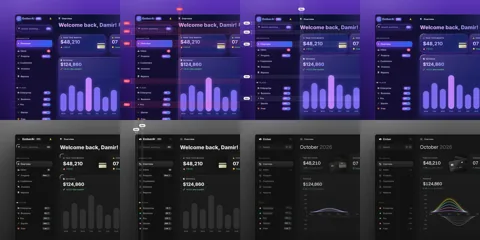
unslop is a Claude design skill for finding repetitive decoration and inconsistent spacing in AI-generated interfaces and revising them around the product's character. It is a bundle of instructions, reference material and helper scripts, not a standalone generation model or a service that edits a site upon installation. Given screen code, a site URL or an image, it first audits problems and proposes a design direction. Its improvement passes cover spacing, color, icons, copy, typography, layout, details, visuals and motion. Without original code, the result is a saved-page or reconstructed static HTML copy, not a production-site update. Files are placed where Claude Code reads skills and invoked there; real edits depend on the agent's file and browser permissions. Optional image generation needs an external service connection and paid-generation confirmation, while transformation videos need Playwright and ffmpeg. Design judgments are guided proposals, not guarantees of usability gains or compatibility with every framework. CC BY 4.0 requires retaining author credit and a repository link when sharing copies or adaptations.
License
CC-BY-4.0 Custom or non-standard license. Read the license file before any reuse.
More in this category
- patch-gg/pixelfx
pixelfx is a JavaScript pixel-art effects library and authoring workflow for game and visual-prototype developers. Its README lists 244 effects spanning fire, weather, interface animations, magic, and character moves. Each effect is code rather than a stored image, using either a time-based drawing function or a stateful simulation with update and draw methods. Callers supply palette, seed, position, mirroring, rotation, and brightness options, and the runtime combines pixel colors and lighting into frames. Character effects can include anticipation, impact pauses, target reactions, and recovery through separate action metadata. Outputs include live browser playback, preview images, transparent sprite sheets, and frame metadata, with optional GIF and MP4 export requiring ffmpeg. Users can browse the gallery or use the Node.js 18 or newer tooling, and a Claude Code skill describes drafting, rendering, inspecting, and refining new effects rather than providing a generative model. Effects designed around the stock character need adaptation for custom characters, and the MIT code license excludes the separately licensed bundled PatchPixel font. - JimLiu/baoyu-design
baoyu-design is a community-maintained collection of agent skills for people who want to create and revise visual deliverables with a local coding agent. A design request and reference materials such as screenshots, a codebase, HTML/CSS or a Figma file guide the agent toward UI mockups, prototypes, decks and other HTML artifacts. The main skill loads a shared design methodology, tool references for the agent environment and task-specific prompts or starter components. It also describes importing a version-pinned design-system copy into a project and recording that relationship in project metadata. Companion skills use their own file formats and local editors for slides, canvases, design systems and data dashboards. The workflow needs a file-capable AI agent and its model service, with Node.js for the local editor tools and Python available for a simple preview server. The README specifies Node 20 or later for most artifact editors and Node 22 or later for dashboards, while optional export or generation features have additional tools or service requirements. It is not an Anthropic-endorsed product, and local artifact storage does not establish offline model inference or guarantee production-ready UI and export fidelity. - enesozturk/dimensional-drawing
This repository provides agent skills for explaining a UI component's spacing, corner radii, layers and placement as a technical drawing rather than a screenshot alone. Its intended users include developers and designers handing over a component specification. Inputs can be source files, Storybook stories, URLs or screenshots, while the measurement procedure calls for reading the actual source and inspecting rendered boxes and computed styles with Playwright. The result is a self-contained HTML document with SVG plan views, exploded layers, details and variable tables. Dimensions use named variables and formulas, real copy is omitted, and unsupported values remain TBD instead of being invented. Drawing requires an agent that can read the skill and access the relevant source and browser environment. An optional motion skill targets Claude Motion, while its separate rendering path uses Node 18 or later, Playwright Chromium and ffmpeg to capture frames and encode an MP4. These are drawing instructions and rendering helpers, not evidence that a screenshot yields exact measurements or that the resulting component works correctly. - current/deadcell-framework
This repository supplies the Dear ImGui foundation used by a separate deadcell menu, rather than the menu application itself. It targets C++ developers who need native windows and interactive controls. Application widget calls and operating system input become draw data, which the DirectX 11 backend submits to the GPU. The application repeats frame initialization, widget calls and rendering every frame instead of maintaining a retained widget tree. The build configuration combines the ImGui core and Win32 and DirectX 11 backends into a static library. The documented starting environment requires CMake 3.16 or later, a C++17 compiler, and an application providing a window and graphics device. The Windows build links Direct3D related libraries, while the backend source also uses the shader compiler. The public header identifies a fixed 1.89.5 WIP snapshot, so this is not evidence of current upstream feature coverage. The README says other bundled backends are not tested in this snapshot, and the downstream menu implementation is outside this repository. - pengchujin/aerial-tv
Aerial is an Android TV home-screen app that shows applications and wallpaper instead of advertisements and recommendation feeds. Its main users are owners seeking a different launcher for televisions such as Xiaomi and TCL models. Remote input, installed applications, input sources and photos produce an app grid, control center and screensavers. It uses Kotlin and Jetpack Compose, while a QR-linked phone page supports photo uploads and wallpaper settings. Deployment requires APK installation, TV-side ADB approval and permission configuration, with a documented restoration path that does not delete system apps. Source builds require JDK 17 and Android SDK 36. Aerial videos and daily backgrounds use external Apple and Bing materials, so connectivity and separate copyright conditions matter. Default-launcher recovery and startup behavior vary by device, and elevated permissions and optional persistent ADB require careful review.
Only repositories in the ranked Trendshift lists are included, and the lists are used only to find candidates. We do not copy their ranks. Descriptions, licenses and star counts come from each GitHub repository. The notes are our own reading. We have not tested these projects, and a place on a trending list does not prove quality.