zklmiao/CodeWar
- Source
- GitHub
- First trending
- Category
- Coding tools
- GitHub stars
- 77
- Main language
- Go
This page introduces an external open-source repository. It is not an HDATF product.
What it does
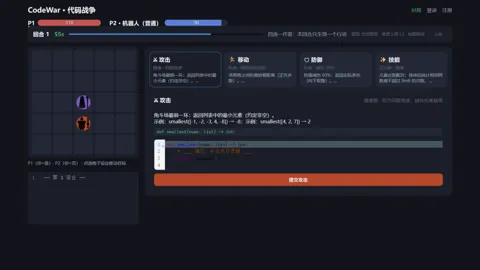
CodeWar is a browser-based Python programming game that turns solving exercises into actions in a turn-based battle. Learners choose an attack, movement, defense or skill problem and submit Python code, with correctness and solving time affecting the battle result. A server-controlled match engine generates numbered events while the browser renders the board, questions and battle log. The question factory combines templates with a seed, a value that makes the same generated exercise reproducible. A separate Python judging service executes submissions in disposable Docker containers with network and resource restrictions, compares outputs with expected values outside those containers and returns a verdict. The documented stack includes a Vue client, Go server, Python judge and PostgreSQL, with Docker Compose provided for local operation rather than an external AI service dependency. The README describes local two-window play, bot practice and a tutorial, but explicitly says online ranked matchmaking is not implemented. Its code is source-available under a noncommercial license, and the documented Docker socket access and remaining deployment risks mean the judging service must not be assumed safe for arbitrary public exposure.
License
Custom license Custom or non-standard license. Read the license file before any reuse.
More in this category
- microsoft/TokenEconomizer
TokenEconomizer is a plugin intended to reduce waste when coding agents repeatedly work in the same repository. It takes session logs, tool usage and failure history and produces repository-specific learned facts, tool exclusion proposals or settings, and redirects for repeated failures. Micro-skills inject facts confirmed across sessions into later context and drop contradicted facts. Tool pruning collects evidence of nonuse, excludes tools through host settings and allows restoration. Failure-loop detection consults a judge model and suggests another approach, but does not stop work itself. It requires Python 3.10 or newer, an authenticated supported coding agent and plugin installation, with extra model calls handled through that agent's account. Configuration code disables micro-skills by default while enabling tool pruning and failure-loop nudges, so installation does not enable every learning feature. Claude Code, Codex, GitHub Copilot CLI and Pi are supported, opencode is experimental, and tool pruning does not act on Pi or opencode. State remains local, and the authors' cost experiments do not guarantee equivalent savings for individual workloads. - haydenschmitty/floorplan
Floorplan is a Claude Code and Codex plugin for turning code structure into an explorable map. It targets builders trying to understand AI-assisted applications and developers joining unfamiliar projects. Repository files, imports, server routes and web requests become a local HTML map with relationship graphs and explanations. Node.js scripts discover files and links, while the AI reads code and describes components. Users can follow screens through servers and data, inspect recent changes and explore question-specific flows. It requires Node.js 18 or newer and authenticated Claude Code or Codex, followed by an explicit request to create the project's map. Updates rescan changes and retain unchanged descriptions. Request-to-endpoint matching is pattern-based rather than a compiler or runtime trace, so connections can be missed. Maps open locally, but description writing and questions can send code through the existing AI account. Its secret and exposed-endpoint checks are preliminary aids, not a security audit. - l0ng-ai/openidea
OpenIDEA is a desktop development environment that brings IntelliJ-style shortcuts, tool windows, and global search to macOS, Windows, and Linux. Developers open source projects to edit code, inspect changes, debug, use Git and terminals, and access database and HTTP clients. Its interface uses React, TypeScript, and CodeMirror inside Tauri, with a Rust backend rather than an entirely Rust-written interface. The agent manager sends prompts and file context to external coding agents through adapters and ACP, an editor-to-agent communication protocol. Tasks can use the project directory or a separate Git worktree, and persist conversations, status, and changed-file information. Users start with a platform build or the documented Node, pnpm, and Rust development setup, while agent executables, service authentication, and some language tools are separate requirements. Conversation rewind does not restore modified files, and the implementation includes modes that can automatically approve tool requests. The project is Apache-2.0 with separate third-party notices, and its author's startup benchmark is not an equivalent-work comparison or an independently verified performance result. - indexable-inc/blaze
blaze is a development build tool for Rust programmers who repeatedly wait for a program to rebuild after small edits. It accepts a Cargo project, source changes, and familiar build, run, or test requests, and produces development executables or test results. The initial build uses Cargo and rustc while a persistent worker loads the project and retains its analysis state in memory. Subsequent edits use rust-analyzer and salsa analysis, compile affected functions through a machine code backend such as Cranelift, and patch code into an existing executable rather than always relinking the entire program. Unsupported cases or changes outside the modeled inputs can return to Cargo, and the inspected state source records build guards and reasons for that decision. The documented accelerated path targets Apple Silicon macOS and Linux, while Windows builds use Cargo and Intel Macs are not supported. It uses the nightly toolchain pinned by blaze rather than honoring every project's toolchain pin, and retains extra memory and disk state. Live updates are optional and require a participating application, while changes to the shape of data already held by that application can require a restart. The inspected usage document warns that version 0.1.0 lacks borrow checking and main has incomplete coverage, so standard cargo check and CI remain necessary and published speed figures are not proof of equivalent behavior or gains in our environment. - storytold/craft-anything
Craft Anything is a Rust application for inspecting websites, applications and games and having a coding agent create a separate project from the findings. Its intended users are people who want to understand software or build their own version, supplying a target address, files, screenshots and a natural-language request. The default Clean room mode uses externally visible material without reading the original code or page source, while Deep mode permits internal inspection of authorized targets. It follows a study, build, compare and refinement workflow, and website comparisons cover multiple screen widths. Each project keeps the request and history, captures, generated application, comparison results, evidence and open questions in separate files or folders. The same engine is available through a desktop interface, command-line tools and MCP, a protocol that lets agents call tools. Building primarily uses the user's signed-in Claude Code, while analysis can use Anthropic, OpenAI, OpenRouter or an OpenAI-compatible local server. The documented source setup requires Rust 1.97 or later and a local coding agent, and provides desktop and command-line entry points. It is early alpha: Codex and API-based builds lack live verification, some inspection tools are partial, game self-tests rely on the generated game's own report, and use must stay within examination and asset rights without bypassing DRM or logins.
Only repositories in the ranked Trendshift lists are included, and the lists are used only to find candidates. We do not copy their ranks. Descriptions, licenses and star counts come from each GitHub repository. The notes are our own reading. We have not tested these projects, and a place on a trending list does not prove quality.