zzp1221/Research-Assistant-Agent
- Source
- GitHub
- First trending
- Category
- Agents
- GitHub stars
- 101
- Main language
- Go
This page introduces an external open-source repository. It is not an HDATF product.
What it does
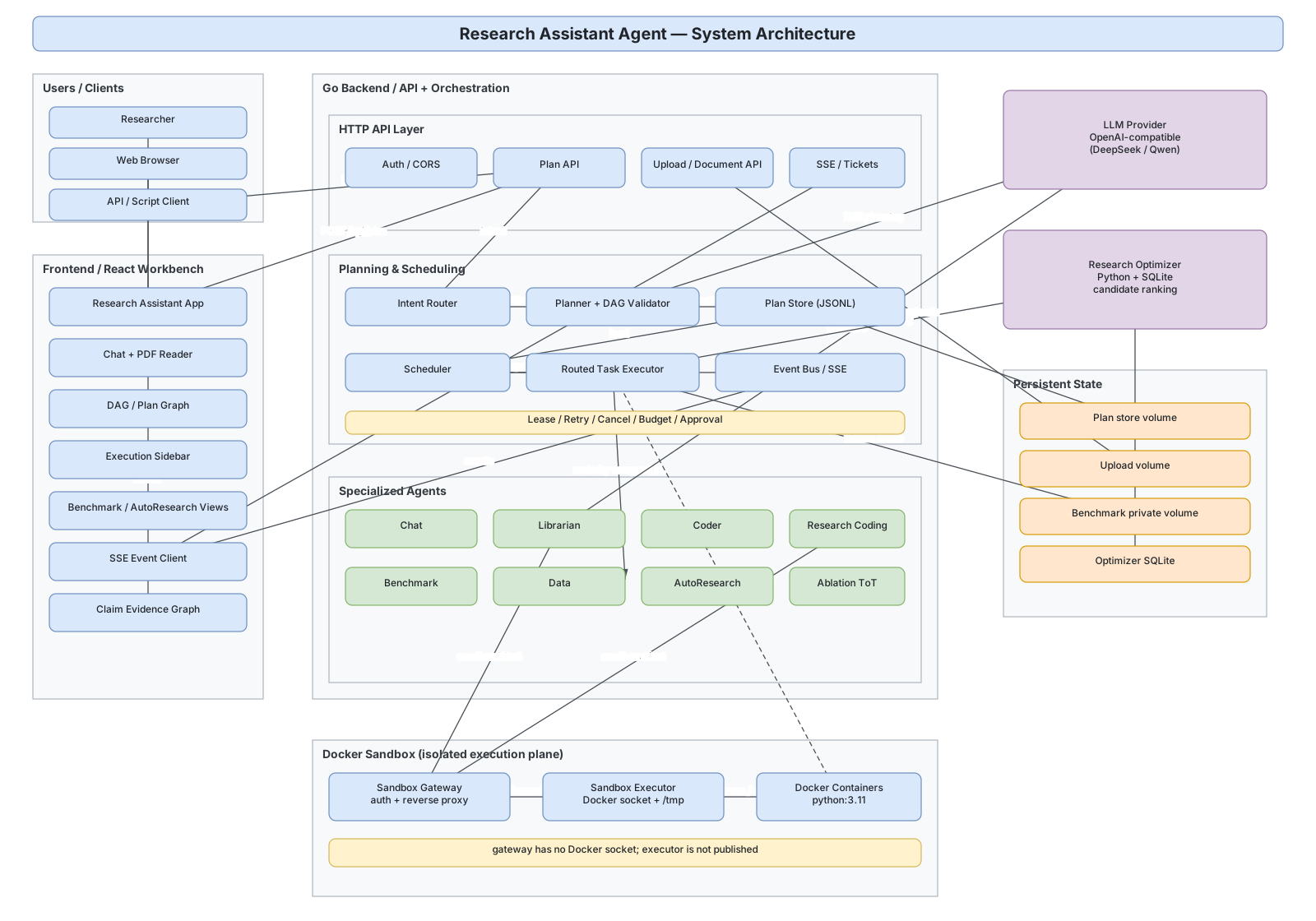
Research Assistant Agent is a multi-agent research execution prototype for researchers reproducing papers, evaluating datasets and exploring candidates within a budget. Inputs are natural-language research goals, papers or attachments, repository addresses, datasets and resource constraints. A planner builds a dependency graph, meaning a plan with explicit task prerequisites, and a scheduler dispatches specialist agents with approval, retry, cancellation and budget handling. Outputs include experiment artifacts, metrics, environment manifests and links between individual claims and evidence, with separate outcomes for completed, partial, minimal-check, blocked and review-needed work. It also exposes literature search, page-based document retrieval, REST interfaces and live execution events to a React workbench. The main implementation combines a Go backend, a separate sandbox service and a Python optimizer, and the documented Compose setup requires Docker and an OpenAI-compatible model endpoint and key. Starting through that setup requires configuring service authentication and model access before opening the workbench, rather than merely opening a static page. Older root instructions say the backend is Linux-only, while the newer desktop section and desktop README describe a Windows Wails shell, native sandbox support and cross-builds, so native Windows readiness cannot be treated as settled from the overview alone. It remains a research prototype with limited production authentication and incomplete public raw verification logs. The verification document still lists claim-rubric parsing and paper-metadata extraction defects, and successful minimal runs or offline framework baselines are not full paper reproduction or real framework performance evidence.
License
MIT Permissive. Commercial use and changes are allowed if the copyright notice is kept.
More in this category
- modelflare-ai/AnyModelBot
AnyModelBot is a local-first assistant application for people who want persistent bots with separate personas, workspaces, models and memory. Instructions and files arrive through its desktop or local web interface and supported messaging channels, and outputs include replies, files, command results and desktop actions. A Node.js backend stores conversations in SQLite, keeps scoped Markdown memory and runs agent sessions through DeepSeek Harness with a bundled model gateway. Background tasks and scheduled rules have their own state, budget handling and a queue for questions or approval requests. Read-only, workspace and full-access presets define different execution authority, while optional desktop-action approval is distinct from file permissions. Users start with a desktop package and Modelflare authorization or an API key, then choose a model and optionally connect messaging or supported data accounts. Windows, macOS and Linux are documented, but computer control requires a desktop session, macOS control is beta, and arbitrary user-added MCP connections remain on the roadmap. Local storage does not mean offline inference: selected context, tool results and screenshots travel through Modelflare to model providers, while scheduled work also depends on the host remaining available. - deepseek-ai/dsh-superagent-prototype
dsh-superagent is a research prototype for handling team development requests in one GitHub repository through DeepSeek Harness. The repository states that it is not an official DeepSeek product or production-ready software, and some directions described in the paper are not implemented. It receives GitHub messages and optionally Feishu messages, turns authorized requests or rule-matched work into Tickets and processes them in separate sessions and directories. Results such as pull requests return to the original conversation, while a web panel highlights work needing human attention. Explicit requests are separated from inferred candidates, and the default observe mode does not accept inferred candidates as actual work. Setup requires a dedicated Harness profile, an agent GitHub user account, an authenticated gh CLI, a model provider and workspace configuration. The deployment guide requires Node.js, pnpm, git, Python and tmux, with a separately configured bot for Feishu. GitHub Enterprise Server is unsupported, and account wrappers do not isolate processes, so operating-system privileges and secret exposure require separate controls. - rerun-build/rerun
Rerun is a self-hostable web application for teams that want AI coworkers with separate roles and recurring work. A Foreman collects natural-language requirements and helps form a team, while a board presents coworkers and their tasks. Requests, schedules, files and connected services feed agents that can use a browser and tools and produce messages, reports, files and database records. The architecture separates a Next.js interface, a workspace engine and Supabase for authentication, storage and application data. Its memory code creates a short index of active memories for later retrieval, and its scheduler launches due work while avoiding overlapping occurrences of the same schedule. External work requires separately authorized service connections through APIs or MCP, a standard interface for connecting model tools, and model access is also configured separately. The documented self-hosting path prepares Docker, Node.js 22, Supabase and model-provider settings before creating a coworker, so self-hosting does not remove those setup and usage dependencies. Although the README promises approval before consequential actions, the inspected chat approval endpoint returns HTTP 501 as unsupported, so the claimed approval guarantee is not established by this implementation and must be checked separately. - ccch1mneyyy/dsh-Go
DSH Go is an unofficial Android client for using DeepSeek Harness conversations and work. It can run the engine inside a phone environment containing Ubuntu, Node.js and DSH, or connect to a computer's engine through SSH or DSH Remote. It passes text, images and voice input and displays answers, tool approval requests and work status. Running the engine on a phone does not mean running the language model there, since model requests go to the configured provider. Android 8 or newer and an appropriate 64-bit package are required, followed by separate local-runtime or remote-host setup and model credentials. Phone screen control requires the local engine and additional permissions, while the documentation says sensitive actions such as payments and passwords return to the person. DSH Remote limits non-image attachments, the in-app web mode, DS Bot and conversation-log export, so capabilities vary by connection. Screen information may reach the model and anonymous usage statistics are enabled by default, making privacy settings important. The application identifies AGPL-3.0 and the SDK and examples identify MIT, but names and mascots have separate terms, so code and visual assets must be treated separately. - deeplethe/sandstorm
Sandstorm manages isolated execution environments for agent services that spend time waiting between requests. Developers supply an application template, resource limits, and sandbox creation requests. It returns sandbox state and command output through an HTTP API and provides a management console. A master keeps desired state in SQLite and distributes work to nodes. Idle environments move from running to paused, disk snapshots, and finally a state retaining only their volume. The node gateway restores an environment when traffic arrives, subject to admission and restore queue limits. It supports gVisor containers and Firecracker microVMs, with separate network namespaces for sandboxes. Setup requires Linux with cgroup v2 and backend dependencies, and Firecracker also requires a compatible virtualization environment. Snapshot placement depends on backend and host compatibility, and capacity pressure can produce refused requests rather than guaranteed immediate execution.
Only repositories in the ranked Trendshift lists are included, and the lists are used only to find candidates. We do not copy their ranks. Descriptions, licenses and star counts come from each GitHub repository. The notes are our own reading. We have not tested these projects, and a place on a trending list does not prove quality.