Renhuai123/ziwei-doushu
- Source
- GitHub
- First trending
- Category
- Other
- GitHub stars
- 14,042
- Main language
- TypeScript
This page introduces an external open-source repository. It is not an HDATF product.
What it does
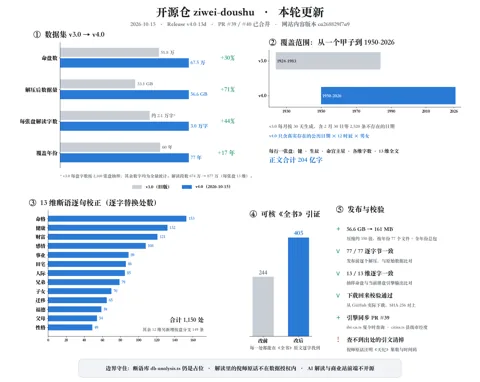
ziwei-doushu is a TypeScript engine and demonstration website for generating Zi Wei Dou Shu charts, a traditional Chinese divination system, with reference material based on Ni Haixia's Tian Ji teaching. It accepts a Gregorian birth date, a time-branch index and gender, with birth-location and time-correction information handled by related modules. The engine combines iztro and lunar-javascript with its own rule adjustments to produce a structured chart of palaces, stars and life periods. Supporting modules cover apparent solar time, leap-month conventions and configurable star-brightness schools, while the demo displays charts and classical texts. A Next.js environment with Node.js and npm is used, and ordinary chart generation runs in the browser without an AI API key. AI interpretation and compatibility-analysis API routes are not included, so adding a model key alone does not enable them. Interpretation datasets are distributed separately, but the production interpretation rule database, prompts and commercial interface are not included, and the checked database file is a placeholder. The README also notes differences between dataset and current engine conventions, and the materials inspected do not establish the scientific predictive validity of the divination interpretations.
License
MIT Permissive. Commercial use and changes are allowed if the copyright notice is kept.
More in this category
- bregman-arie/devops-exercises
devops-exercises is a collection of questions and practice material for people studying development operations and site reliability. Topics include networking, operating systems, SQL, containers, cloud services, delivery workflows and observability. Readers select exercises, produce explanations, code or queries themselves and compare them with available answers or linked resources. It is not an executable product that deploys infrastructure or automatically grades answers. Reading requires no shared installation or API, while practical environments depend on the technology in each selected exercise. The author explains that the material neither reproduces actual interviews nor requires learning every listed technology. Some questions lack answers and some certification guidance is old, so answers and current requirements need independent checking. The README identifies CC BY-NC-ND 3.0 and the FAQ describes attribution and noncommercial conditions, which must be checked before commercial reuse or translated republication. - LiberNT/LiberNT
LiberNT is a ReactOS-derived operating system targeting Windows 11 compatibility for operating system and driver developers. NT means the kernel, driver model and system services behind Windows. Users supply applications and device inputs, while the system manages processes, files and display output. The source separates the kernel, hardware abstraction, drivers and user libraries, and its CreateProcessW implementation delegates process creation to an internal function. The README lists amd64, arm64 and riscv64 images, but compatibility is a development target, not evidence that arbitrary Windows software works. Testing starts with an ISO or preinstalled disk in a virtual machine or on spare hardware. Source builds use RosBE, CMake and Ninja on Linux, macOS or Windows through WSL2, with menuconfig selecting architecture and features. Connections are operating system interfaces rather than an AI service API, and the distributed Debug prereleases are explicitly unsuitable for a computer relied on for daily work. - hyprwm/Hyprland
Hyprland is a Wayland compositor, a desktop system component that arranges application windows and combines them into the displayed screen. It is intended for users who want to customize a Linux desktop rather than build a web interface. Window state, input events, monitor settings and configuration determine the resulting layouts, workspaces and visual effects. It supports tiled, floating and fullscreen windows, multiple layout styles, window rules, animation and plugins. The current example uses Lua configuration, and the bundled hyprctl utility and local Unix sockets expose control, state queries and events to separate programs. Starting requires a compatible graphical environment, installing Hyprland and configuring a session, with terminals and other desktop utilities prepared separately because it is not a complete desktop environment. GPU drivers, virtual-machine graphics acceleration and application behavior under Wayland need separate checks, and it is neither a Windows desktop replacement package nor an AI agent execution system. - designfuchen/word-atlas
Word Atlas is a web app for learning IELTS vocabulary through pictures and sound, with a reusable structured dataset. Learners answer recognition and spelling questions using word cards and examples, producing progress records and future review dates. Definitions, examples, British and American audio, and illustrations are connected through FSRS scheduling. Typing and dictation practice keep separate statistics without changing memory state. No account is required, progress stays on the device, and files support backup and restoration. Previously viewed material can be cached for offline review, but not every image or audio file is downloaded initially. Self-hosting requires Node.js 20 or later to build a static site, while JSON and CSV can be used separately. AI-generated material has automated checks but not complete human proofreading, and it is neither an official IELTS list nor a score guarantee. Code and learning content have different licensing terms, including attribution requirements for reused content. - RikiyaT/lm_understand-logs
This repository is a research record collection for readers examining experiments in which a language model reads or writes neural network weights, not a ready-to-use editing service. Eight experiment folders cover identifying trained networks, repairing or creating networks and editing a small language model for math. The recorded inputs include prompts, task descriptions and network information, while outputs include replies, code, execution output, evaluations and final networks or weight differences. Experiment-specific READMEs connect reported results to runs and evidence files. Codex built-in tools were disabled, but several experiments used a separate Python execution loop that returned output to the model, so tool-free does not mean no computation anywhere in the experiment. The included sandbox example uses Linux bubblewrap with network isolation and resource limits, while full reproduction also depends on the relevant model access, data and evaluation environment. Readers can start with an experiment README and follow its links to prompts, run records and evaluation artifacts without calling a model API just to inspect them. Earlier prompt trials, some weights and intermediate data are absent, the math experiment's full agent harness is not included, and reuse must distinguish the licenses for records, scripts and third-party materials.
Only repositories in the ranked Trendshift lists are included, and the lists are used only to find candidates. We do not copy their ranks. Descriptions, licenses and star counts come from each GitHub repository. The notes are our own reading. We have not tested these projects, and a place on a trending list does not prove quality.