Git archive

Repositories 962Checked
  1. 815

    liguobao/ds-harness-remote

    What it does
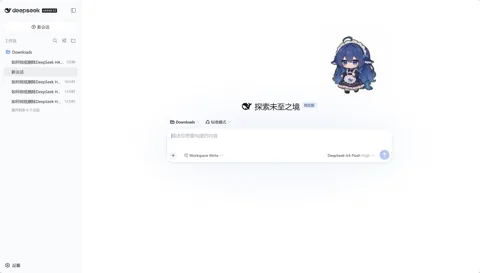
    DS Harness Remote is a community plugin and client set for accessing an existing DeepSeek Harness host from another computer, a browser or Android. Prompts and authorized interactions reach the original host, which retains workspaces, tools and session execution; installing it does not move the agent into the phone. Setup requires a compatible Harness installation, the host plugin, account sign-in and device authorization, with the project's hosted coordination service used by default. Connections prefer direct paths and can fall back through TURN or an encrypted WebSocket relay without requiring a public listening port on the host. The documented Noise channel and the inspected client transport bind communication to device identities and connection context, but encryption does not hide routing metadata or protect compromised endpoints. Remote terminals are enabled by default and run with host-user privileges independently of agent approvals, so they require separate review. iOS is a beta and some alternative agent adapters are experimental. The encryption document contains an older no-terminal description that conflicts with the current README, so the enabled release's actual permission surface must be checked.
    License
    No license No license file found. Without a license, reuse of the code is not permitted by default.
  2. 814

    Fractal-Compute-Orchestrations/FractalWorkspace

    What it does
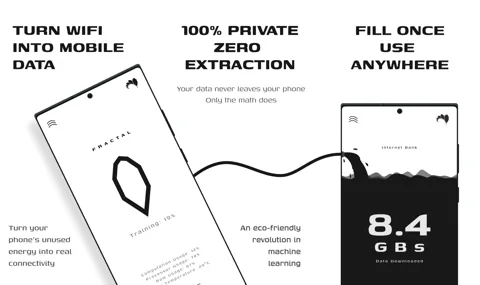
    FractalWorkspace is a parent workspace and architecture collection for coordinating Python server components and Android edge-compute clients. Its README describes two workflows: distributing training tasks and aggregating returned checkpoints, and splitting model layers across devices for inference. Inputs are described as models, dataset segments, device registrations and resource budgets; proposed outputs include aggregated model updates and inference results. The submodule configuration separates FractalCore and FractalAndroid, so downloading this parent alone does not establish a working compute service. The documented setup requires Python, Android build tools, compatible devices and a Firebase project with Firestore, plus server and client configuration. Battery and thermal gates, task identifiers and tenant isolation are described as system contracts, but their end-to-end implementation was not verified in the component code during this review. The README's privacy wording is broader than its diagram showing model and data-bin downloads, so actual data movement must be inspected rather than assuming raw data never moves. Its license is proprietary source-available with commercial restrictions, including internal business use without separate permission; it is not an unrestricted open-source framework.
    License
    Custom license Custom or non-standard license. Read the license file before any reuse.
  3. 813

    paradigmxyz/iron-proxy

    What it does
    iron-proxy is an outbound traffic proxy for CI jobs, coding agents and containers that should not have unrestricted internet access. It accepts workload requests and a YAML policy, then forwards permitted traffic or rejects it while producing structured audit events. Its DNS and TLS interception route requests through ordered transforms, including destination allowlists and replacement of placeholder tokens with real credentials held by the proxy. The inspected allowlist implementation rejects unmatched requests unless an explicit warning-only mode is selected. Deployment requires the proxy process or container, configured destinations and secret sources, client trust in its CA, and actual routing through it. DNS configuration alone is not a containment boundary because a workload can connect directly, so separate network enforcement is needed. Optional MCP policy filters tools and arguments over Streamable HTTP, but its documented scope does not cover resources or prompts. Audit body capture and header annotations can expose plaintext, and TLS interception makes the proxy and CA sensitive infrastructure rather than an automatic guarantee against data leakage.
    License
    Apache-2.0 Permissive, with a patent grant. Commercial use is allowed; keep the notices and state your changes.
  4. 812

    fastapi/fastapi

    What it does
    FastAPI is a Python web API framework, not a ready-made business application or an AI model. Developers declare routes and typed request models so that HTTP path values, query parameters and JSON bodies are converted and validated before reaching application logic. Functions return Python data that the framework serializes as responses, while the same declarations generate OpenAPI schemas and interactive documentation. It builds on Starlette for web behavior and Pydantic for data handling, with both synchronous and asynchronous endpoint styles documented. The inspected request-body example accepts an Item model and returns it, demonstrating the connection between a declared schema and an API handler. Getting started requires a Python environment, project dependencies, application code and an ASGI server such as Uvicorn; installing the package does not create a database connection or deploy a service. Authentication, business permissions, persistent storage and production operation must still be configured for the application. The optional cloud deployment service is not a requirement for using the framework, and advertised productivity or speed figures should not be assumed for a specific workload.
    License
    MIT Permissive. Commercial use and changes are allowed if the copyright notice is kept.
  5. 811

    openai/php2shell-checker

    What it does
    PHP Version Checker helps website operators identify PHP versions that fall within the repository's php2shell vulnerability ranges. It accepts a website URL or a local PHP executable as input. The URL path reads Server and X-Powered-By response headers, while the local path reads the executable's version output. It compares the extracted version against an embedded table of vulnerable patch cutoffs for each listed branch. Results are OK, VULNERABLE, or UNKNOWN, with JSON output and exit codes available for automation. The repository also provides separate agent instructions for URL-only checks and checks with server access. Direct use requires Node.js, and checking the actual serving build requires access to the relevant server installation. It neither follows redirects nor inspects response bodies, and hidden headers, modified banners, vendor backports, and a different command-line PHP installation can make the result incomplete or misleading.
    License
    Apache-2.0 Permissive, with a patent grant. Commercial use is allowed; keep the notices and state your changes.
  6. 810

    simbasjungles/free-my-tv

    What it does
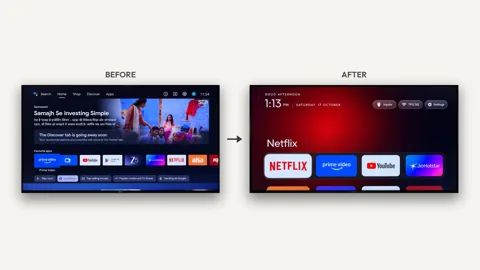
    Free My TV provides an ad-free television home screen with app shortcuts and media recommendations. It combines installed-app information and regional TMDB availability to show titles, with Open-Meteo supplying weather and sunset data. On Android TV 9 or newer, a Java app uses user-authorized local ADB access to switch the launcher and disable selected bundled apps without uninstalling them. Saved state supports returning to the original launcher, and a watchdog requests recovery after repeated crashes. LG webOS and Samsung Tizen variants run as separate web apps rather than replacing the factory launcher. Installation needs a compatible television, a computer on the same network and developer access, while recommendations need a TMDB key and do not replace streaming subscriptions.
    License
    MIT Permissive. Commercial use and changes are allowed if the copyright notice is kept.
  7. 809

    AhmadHassan-BTed/Jantt

    What it does
    Jantt is a TypeScript project timeline engine for teams and AI-assisted planning tools that exchange plans as JSON. Inputs describe tasks, dates, categories, dependencies and optional progress, milestones or baselines. It renders an interactive Gantt chart and returns changed plan data when a user commits an edit. The validator checks dates, identifiers, dependency references and cycles, while a separate resolver shifts successor dates according to prerequisite finish dates and gaps. In the inspected implementation, date propagation uses a bounded repeated pass and leaves locked tasks unchanged. React and standalone browser surfaces are provided, and a separate Node.js CLI supports local JSON file interaction. Starting requires a valid plan document and a compatible host surface, while cloud collaboration adds separate authentication and infrastructure requirements. JSON generation does not guarantee a feasible business plan, and the inspected core package declares fflate despite the README claiming zero runtime dependencies.
    License
    MIT Permissive. Commercial use and changes are allowed if the copyright notice is kept.
  8. 808

    peach-mitao/peach

    What it does
    Peach is a single-user, local-first library for adults managing their own adult media. It takes local folders, mounted cloud drives, existing metadata and creator subscriptions, then presents a searchable collection and browser playback. A FastAPI backend stores records in SQLite and serves a React interface. Scanning leaves original files unchanged, while manual organization can rename or move them. Windows packages are available, with macOS and Docker paths documented separately. External sources require appropriate accounts and access rights, and optional diagnostics mean local-first does not mean no network transmission.
    License
    AGPL-3.0 Network copyleft. Offering a modified version as a service also requires releasing the source. Review before any product use.
  9. 807

    nikopueringer/CorridorKey2.0

    What it does
    CorridorKey 2.0 is a video matting model and Python inference tool for artists separating subjects from green or blue screen footage. It takes video or an image sequence, with an optional first-frame matte or full hint video. It outputs a transparency mask and foreground color, with optional review composites and OpenEXR sequences. It combines features from C-RADIO, MoGe and RVM, processes overlapping time windows, then predicts final-resolution frames. Hints identify the intended subject, while predictions from earlier overlapping windows can carry that guidance forward. Starting requires an NVIDIA CUDA GPU, CUDA-enabled PyTorch, ffmpeg and downloaded model assets. Long or crowded shots can drift, smaller windows reduce temporal context, and managed color sources require preparation outside the tool. Its custom license distinguishes commercial footage production from restricted software integration, resale and paid inference services.
    License
    Custom license Custom or non-standard license. Read the license file before any reuse.
  10. 806

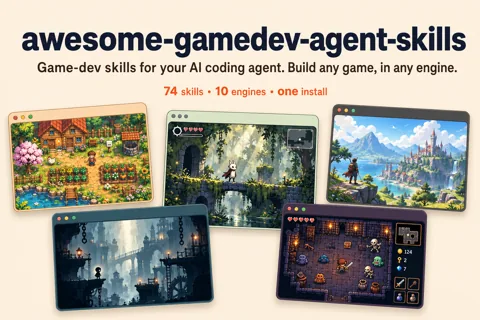
    gamedev-skills/awesome-gamedev-agent-skills

    What it does
    This repository collects game-development instructions that coding agents can load for a specific engine and task. Its README lists 74 specialized skills and a router covering engines such as Godot, Unity, Unreal, and browser-based frameworks. The inputs are a development request and project files that reveal the engine and version. The router selects one engine family, adds the relevant discipline, genre, and workflow guidance, and asks the agent to read only those documents. The immediate output is a selected set of instructions, while code changes and playable results depend on the host agent and development tools. SKILL.md files contain portable metadata and procedures, with additional references loaded when needed. Starting requires a compatible agent, readable skill folders, and the appropriate project and engine environment. This is not a game engine or independent execution service, and its version baselines and structural validator do not establish that generated code works in every project.
    License
    Apache-2.0 Permissive, with a patent grant. Commercial use is allowed; keep the notices and state your changes.
  11. 805

    What it does
    AI Job Search is a file-based job application workflow built around Claude Code for individual job seekers. Inputs are a verified career profile, supporting documents and a job posting supplied as a URL or text. Portal skills collect opportunities, and evaluation criteria compare postings with the candidate before drafting begins with approval. A drafting agent produces tailored application documents, while a separate reviewer critiques them before revision. The workflow compiles CV and cover-letter PDFs and inspects layout and extractable text instead of stopping at source files. Local files also hold application status and submitted materials for later outcome tracking and interview preparation. Starting requires agent access, Python, Bun and the relevant document compilation tools, while the bundled portal integrations focus mainly on Denmark. Sensitive profile data can enter tracked files, local execution still involves model services, and the documented prompt-injection defenses are not a sandbox.
    License
    MIT Permissive. Commercial use and changes are allowed if the copyright notice is kept.
  12. 804

    twentyhq/twenty

    What it does
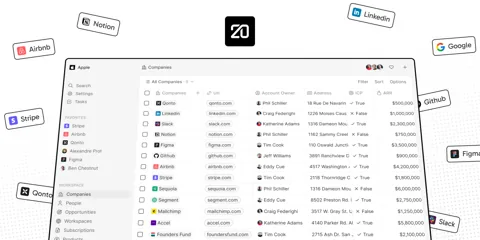
    Twenty is a customizable CRM, meaning software for organizing customer relationships and related business records. It targets technical teams that need to adapt customer data models and workflows as their business changes. Users enter and maintain business records, while developers can define objects, typed fields, views, and other app components in TypeScript. Its app workflow turns source definitions into changes on a running Twenty server, making those definitions visible in the workspace interface. The repository describes workflows and agents alongside CRM features and supplies dedicated skills for app development and workspace access. Self-hosting uses separate server and worker services with PostgreSQL and Redis, rather than only a browser interface. App development requires a running instance, authorized workspace access, and the documented Node.js and Yarn environment, with Docker needed for the local server route. Existing CRM capabilities do not establish ready-made MES or ERP integration, and operating the service still requires attention to access control, data changes, backups, and applicable license terms.
    License
    Custom license Custom or non-standard license. Read the license file before any reuse.
  13. 803

    pengchujin/aerial-tv

    What it does
    Aerial is an Android TV home-screen app that shows applications and wallpaper instead of advertisements and recommendation feeds. Its main users are owners seeking a different launcher for televisions such as Xiaomi and TCL models. Remote input, installed applications, input sources and photos produce an app grid, control center and screensavers. It uses Kotlin and Jetpack Compose, while a QR-linked phone page supports photo uploads and wallpaper settings. Deployment requires APK installation, TV-side ADB approval and permission configuration, with a documented restoration path that does not delete system apps. Source builds require JDK 17 and Android SDK 36. Aerial videos and daily backgrounds use external Apple and Bing materials, so connectivity and separate copyright conditions matter. Default-launcher recovery and startup behavior vary by device, and elevated permissions and optional persistent ADB require careful review.
    License
    MIT Permissive. Commercial use and changes are allowed if the copyright notice is kept.
  14. 802

    dominikmartn/harp

    What it does
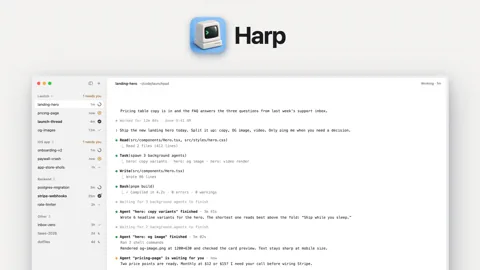
    Harp is an unofficial macOS fork of the Warp terminal for overseeing multiple Claude Code and Codex jobs. Developers use terminal sessions and agent events to see working, waiting and completed states in a sidebar. Tabs can be grouped and marked unread, while optional tmux integration preserves names and group order. Usage rings read a local JSON file maintained by another tool rather than querying provider APIs themselves. A DMG distribution provides a starting point, but tmux and usage integrations are disabled by default and require configuration. An optional Claude Code hook for more accurate background-work status needs the official Warp plugin plus bash, jq and perl. Existing Warp AI and cloud features still communicate with Warp servers, and login through Harp is described as untested. It is not entirely local-only, and the code's AGPL terms must be distinguished from its MIT components.
    License
    AGPL-3.0 Network copyleft. Offering a modified version as a service also requires releasing the source. Review before any product use.
  15. 801

    deepseek-ai/DeepInfer

    What it does
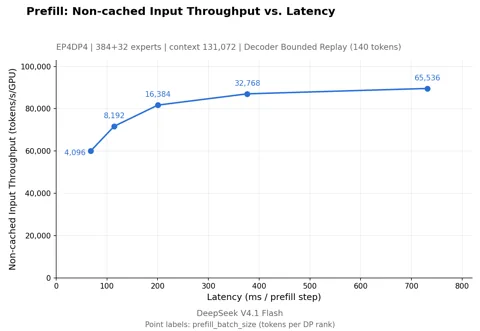
    DeepInfer is an execution framework for large-scale DeepSeek inference, and its public release provides offline inference rather than a complete online service. Model operators supply prompts and checkpoints and receive generated tokens and text. The listed model is DeepSeek-V4.1-Flash, with text and image inputs in the examples. Optimized kernels, data and expert parallelism, draft-token verification and asynchronous scheduling organize inference work. It also supports output constraints using regex, JSON schemas and grammars. Prerequisites include Linux, Python 3.12, GCC 13 or newer and NVIDIA SM100 or Huawei Ascend 950 hardware, with CUDA 13 or CANN 9.2 respectively. The starting example downloads weights from Hugging Face or uses a local checkpoint. A complete service still needs a KV cache system, stage disaggregation and load balancing across replicas, and published benchmarks should not be treated as ordinary PC results.
    License
    Apache-2.0 Permissive, with a patent grant. Commercial use is allowed; keep the notices and state your changes.
  16. 800

    deepseek-ai/deepseek-recipe

    What it does
    deepseek-recipe is a collection of Rust libraries and Python bindings connecting AI API formats to DeepSeek inference backends. It converts Messages, Chat Completions and Responses requests into a common conversation representation, then model prompts and token inputs. Backend outputs can be converted back into complete protocol responses or streaming events. It handles tool definitions, generation settings and structured-output information, but callers supply actual inference, tool execution and HTTP transport. Python 3.10 or newer is supported, while image handling requires attention to OpenCV setup and model-specific capabilities. DeepSeek V4 does not accept images, unlike the V4.1 image-input path. The FastAPI example uses fixed-answer mock inference rather than a real model. That example lacks authentication and private-network image-address filtering, so installation is not a production service, and actual enforcement of output constraints remains the backend's responsibility.
    License
    MIT Permissive. Commercial use and changes are allowed if the copyright notice is kept.
  17. 799

    shaobeichen/dsh-pocket

    What it does
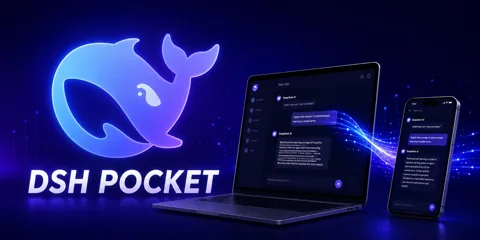
    DSH Pocket is a plugin for controlling a computer's running DeepSeek Harness web interface from a phone. A QR address and access password open the same session for submitting tasks, viewing output and handling approvals. An HTTP and WebSocket proxy plus mobile-layout adjustments connect the existing interface rather than running a separate model. It requires DeepSeek Harness and Node 22 or newer, and dsh web must restart after plugin installation. Local-network access is separate from public access, which requires explicitly enabling a cloudflared tunnel. A fixed-domain mode needs a Cloudflare account, domain and tunnel configuration. Default and custom passwords have different rotation behavior, and the inspected settings source defaults local access and local authentication to enabled. Remote control reaches the computer's code-execution capabilities, so exposing a company network needs caution, and desktop advanced mode is documented as unsupported.
    License
    GPL-2.0 Custom or non-standard license. Read the license file before any reuse.
  18. 798

    bowenliang123/dsh-context

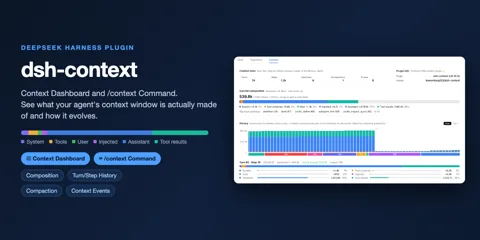
    What it does
    dsh-context is a plugin for inspecting what context DeepSeek Harness sends to a model. Users managing long conversations or multiple agents provide session records and the host's token-meter projections as its inputs. Dashboards and a context browser show session composition, request-level changes, compaction events and file activity. The Fleet view displays the current agent, its parents and subagents with their relationships and states. Users add the plugin to a compatible DeepSeek Harness web profile and open its tabs or command; it is not a standalone model service. The package specifies Node 22.19-series or 24 and newer, plus host-version compatibility requirements. Category token estimates are distinguished from provider-reported actual values, and displayed costs are estimates. Configured system-prompt prefixes and suffixes can change behavior from the next model step, so it should not be treated solely as read-only statistics.
    License
    Apache-2.0 Permissive, with a patent grant. Commercial use is allowed; keep the notices and state your changes.
  19. 797

    Alpha-Dojo/DojoAgents

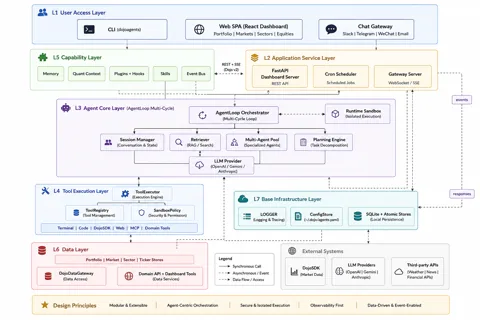
    What it does
    DojoAgents is an AI agent framework for personal-investment research and portfolio review. Questions, holdings and market data lead to tool-assisted analysis and dashboard results. Its README describes workflows using US, Hong Kong and mainland Chinese market data and holdings screenshots. It separates the core loop from a financial Harness; the inspected financial factory assembles tool providers, memory, policies and result presenters. Python 3.11 or newer and model API configuration are required, while source frontend builds need Node 18 or newer and npm 9 or newer. Users can start from the distribution package and configure a provider or custom endpoint in the local dashboard. The financial data backend uses SDK or HTTP connections, so installation does not guarantee current or accessible data. The project identifies research and demonstration use, and should not be interpreted as an automated trading product guaranteeing accuracy or returns.
    License
    Apache-2.0 Permissive, with a patent grant. Commercial use is allowed; keep the notices and state your changes.
  20. 796

    tywr/Nordwand-Mono

    What it does
    Nordwand Mono is a compact monospace font project for developers' editors and terminals. Characters and font settings determine code and symbol rendering in fixed-width cells. Alternative glyphs and OpenType stylistic sets provide selectable arrow ligatures and joined repeated symbols. These features need explicit editor or terminal configuration and do not automatically apply everywhere. Custom font generation requires Python 3.11 or newer, font-building dependencies and a configuration file. The README describes drawing glyphs with Python classes and adjusting dimensions such as height. It warns that changed metrics may require manual glyph corrections. Separately from GitHub's headline license, the font files have a SIL Open Font License 1.1 notice, so distribution must distinguish code and font terms.
    License
    MIT Permissive. Commercial use and changes are allowed if the copyright notice is kept.
  21. 795

    xiaoyang111222/cn-math-taxonomy

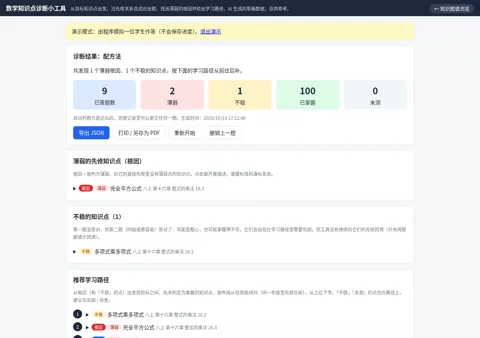
    What it does
    This project combines a dataset of Chinese primary and junior-secondary mathematics topics and prerequisites with a static graph browser and diagnostic tool. A student or parent selects a target topic or chapter and answers questions to obtain possible prerequisite weaknesses and a learning path. Its inputs are JSON files for topics, dependencies, curriculum mappings and a question bank. Diagnosis starts at the target, asks at most two questions per topic and traces backward to prerequisites after two failures. A correct first answer infers mastery of ancestors, while a correct second answer marks the topic as unstable, so the result is not a comprehensive assessment. Outputs include a path diagram, answer history and curriculum items, with browser-local progress, JSON export and printing. It uses a static HTTP server and browser without a model API or backend, but opening files directly is unsuitable for its data fetching. Topics, questions and dependency judgments are AI drafts without teacher review, and some textbook outlines and curriculum text remain unverified. The project carries a non-commercial condition, so both educational validity and permission for commercial use need separate review.
    License
    Custom license Custom or non-standard license. Read the license file before any reuse.
  22. 794

    Gathin23/cleanyourtv

    What it does
    This is a collection of a launcher, per-device package lists, an assistant prompt and management tools for owners who want a simpler Android TV or Google TV home screen. Inputs are the TV model, installed apps, features to retain and the desired home layout. A computer on the same network inspects the TV through an explicitly authorized ADB connection and disables selected packages rather than uninstalling them. A Java launcher then supplies a favorite-app dock and an app grid and becomes the default Home. Themes use configuration files and artwork, while cards declared by other apps appear only after owner approval. Getting started requires developer options and debugging approval on the TV and a Python environment on the computer; building the launcher also requires JDK 17 and Android SDK 34. The restore tool re-enables packages from the applied list and restores the stock launcher, but cannot undo unrelated changes outside that list. Fire TV supports the debloating portion only, and this Android launcher does not target Samsung Tizen or LG webOS. Review the device-specific list and recovery path first because needed apps or update services can be disabled, and turn debugging off afterward.
    License
    Custom license Custom or non-standard license. Read the license file before any reuse.
  23. 793

    Leonxlnx/earshot

    What it does
    earshot is a local analysis and sound-making tool for coding agents that cannot directly listen to their audio outputs. Inputs are audio or video files, a desired sound description, optional reference recordings and visual timing information. Outputs include descriptions and similarity scores, loudness and peak measurements, event timelines, annotated images and review reports. It combines CLAP and AudioSet model estimates with signal measurements and exposes a CLI, Python API and MCP server. It also synthesizes effects from code and fits recordings to adjustable synthesis recipes, while the shipped sound bank has a rendering path without models or network access. Python 3.10 or later and ffmpeg and ffprobe are required, and first use of model-based analysis downloads model files, so not every path is offline immediately after installation. Agent use requires separate MCP registration with the proper runtime or API wiring; external Gemini critique is optional and needs a key and upload consent. It does not transcribe speech or determine copyright, and labels inside dense mixes and music-mood judgments are hints. Optimizing its own scoring models is not equivalent to improving perceived quality, so review the finished video and listen with a human as well.
    License
    MIT Permissive. Commercial use and changes are allowed if the copyright notice is kept.
  24. 792

    MaryCache/imozuru

    What it does
    imozuru is a research skill for Claude Code designed to reach original evidence instead of stopping at summaries of highly ranked search results in an unfamiliar field. Inputs are a question and claims needed to answer it; outputs are a map of terms and people, a research log, saved source texts and a claim-by-claim extract page. Differently oriented search roles gather leads before following references, authors and document links. It distinguishes papers, official documentation, firsthand records and video transcripts by source type. Original text stays in local files with file and line references, and the report generator checks normalized extracts against their source regions and stops on a mismatch. The skill must be registered with Claude Code and invoked for a research task; installation does not start continuous research automatically. Scripts require Python 3.10 or later, separate tools are needed for PDF, OCR and video transcripts, and citation tracing contacts OpenAlex. Research stops when evidence is attached or exploration saturates and records unreachable material, but the procedure does not certify that sources are true. Search terms leave the machine and saved originals are not for redistribution, so confidential questions and source rights need care.
    License
    MIT Permissive. Commercial use and changes are allowed if the copyright notice is kept.
  25. 791

    kuafuai/andee

    What it does
    Andee is an experimental Android agent application that accepts voice or text requests, reads other apps' screens and operates them. Accessibility trees and screenshots are inputs, while taps, scrolling, text entry and result pages are outputs. When accessible elements are unavailable it targets a labeled screenshot grid, and notifications and scheduled tasks can also initiate work. Its default on-device mode means the agent loop runs on the device, not that language-model inference necessarily runs there. A self-configured setup needs an OpenAI-compatible model endpoint and key, with separate configuration for the chosen external voice service. On Android 11 or later, installing the APK must be followed by overlay, accessibility and other required grants; installation alone does not activate automation. It manages notes and scenes and has some code-level restrictions, including denying vault access to notification-originated turns, but these do not block every risky action. The security document lists an unauthenticated device WebSocket server, a plaintext hub link and screen-content prompt injection, so safe prevention of payments or outgoing messages cannot be assumed. Conversations and audio may leave for selected providers, and its license adds conditions on multi-customer hosting and distribution inside another product.
    License
    Custom license Custom or non-standard license. Read the license file before any reuse.
  26. 790

    PC2005-cloud/dsh-pet

    What it does
    dsh-pet is a DeepSeek Harness plugin that presents execution state through animated characters and speech bubbles, alongside a workflow for making character assets. Inputs include session and tool events, display settings, animations and responses from a selected model. A browser overlay and transparent Electron windows show working, waiting, success and error states, with dragging and multiple characters. The state-processing source distinguishes an intermediate tool result from completion of the whole goal to avoid premature success during automatic continuation. Registration in the host's plugin manager must be followed by a restart, and desktop mode may download Electron if the runtime is absent. Chat and usage displays depend on host models and provider credentials; standalone mode supplies animation but not host-dependent chat or usage functions. A local HTTP API exposes state and animation and bubble control without authentication and must not be published externally. Custom assets require separate video generation, transparency processing, normalization and conversion, while Safari transparency needs alternate assets and configuration. Code is described as MIT, but animations, prompts and source videos carry a non-commercial restriction and separate attribution requirements, so code and asset rights must be distinguished.
    License
    MIT Permissive. Commercial use and changes are allowed if the copyright notice is kept.
  27. 789

    Check-Risk-WAF/Check-Risk-WAF

    What it does
    This repository presents the Check Risk WAF product and its interface assets for inspecting requests before they reach websites and APIs. The public tree centers on a README and images; it was not confirmed as an open firewall-engine source library. Intended users are web-service operators, with HTTP and HTTPS requests and administrator policies as inputs. The product description says a reverse proxy checks requests, forwards allowed traffic to the original application and logs blocking reasons and rules. Its panel configures web-attack filtering, bot checks, request-rate limits and attack-event analysis. An AI feature explains a selected incident and proposes exceptions, but this does not certify detection accuracy. On-premise installation requires an Ubuntu Server 24.04 LTS x86_64 host and an external distribution package, while cloud setup requires registering the domain and upstream and rerouting traffic. Downloading the repository does not enable protection; TLS certificates, upstream routing and real-client-IP forwarding need separate configuration. Deployment variants differ in features and terms, so review commercial-use conditions, data handling and false blocking of legitimate requests.
    License
    No license No license file found. Without a license, reuse of the code is not permitted by default.
  28. 788

    kksimp/Mac.apk

    What it does
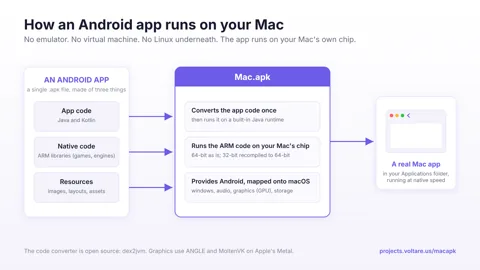
    Mac.apk is an early-stage compatibility runtime for people who want to run Android applications on Apple Silicon Macs. It accepts user-supplied APKs and supported split-package formats, installs them as macOS applications and runs them in individual windows with Dock entries. Instead of booting an entire Android system in a virtual machine, it implements an Android application environment on macOS. The official material describes an Android framework reimplementation, native runtime, ARM loader and translation components in the source tree. It requires Apple Silicon and macOS 26.4 or later, with no Intel Mac support. After installing the application, users must separately install its runtime and add trusted app packages; installing the shell alone does not prepare every Android app. Compatibility varies by app, and first launch requires preparation time. Android applications run with the Mac user's permissions without a phone-style application sandbox, so access to personal files is a material risk. Saved data resides inside the app bundle, so consult the management workflow before deletion, and check AGPL obligations or the separate commercial-license option before redistribution.
    License
    AGPL-3.0 Network copyleft. Offering a modified version as a service also requires releasing the source. Review before any product use.
  29. 787

    alchaincyf/huashu-motion

    What it does
    huashu-motion is an Agent Skill, CLI and browser studio that lets coding agents such as Claude Code and Codex make launch films as code. From a product site, CSV or recording, the agent proposes three directions, writes a rhythm sheet and builds one GSAP index.html with sound effects and, for launch films, an ABC notation score. Clicking a frame in the local studio sends a comment with time, scene and element to an inbox file, and the agent edits only that part, keeping every version. Rendering uses the installed Chrome without a video model and exports MP4, MOV, WebM, GIF or a share page. Preferences and lessons stay in a local experience file. Node 22, Chrome and FFmpeg must also be installed; the skill script runs a cloned CLI or fetches the npm package. Per the README, music is made locally without paid APIs, testing covered macOS only, and Codex users must approve the blocked preview. GSAP, fonts and the author's cartoon character keep non-MIT terms.
    License
    MIT Permissive. Commercial use and changes are allowed if the copyright notice is kept.
  30. 786

    Gathin23/tv-vibehack

    What it does
    This prompt plus scripts kit, with a native launcher, lets TV owners disable ad services, telemetry and preloaded apps on Android TV and Google TV. The README says Claude Code did the original work on a real TV with PROMPT.md. Once USB debugging is on and the computer is approved on the TV, a coding assistant with shell access follows the prompt and asks which apps to keep. Over ADB (Android Debug Bridge) it backs up packages and settings, disables apps with pm disable-user and checks each step with TV screenshots. The tools/restore.sh script re-enables those packages and the stock launcher. The Java launcher lists installed apps, pins four to a dock, switches HDMI and Live TV inputs and lacks internet permission. It builds with JDK 17 and Android SDK 34; manual tools need Python 3 with adb-shell. Five tested model lists are included; Samsung, LG and Fire TV are unsupported. Most lists also disable the update service, so firmware updates stop until it is re-enabled.
    License
    Custom license Custom or non-standard license. Read the license file before any reuse.
  31. 785

    EpicGames/unreal-engine-skills-for-claude-code-plugin

    What it does
    This Claude Code plugin from the EpicGames organization gives Unreal Engine developers three skills and a SessionStart hook for controlling and extending a running Unreal Editor through MCP. The unreal-mcp skill has Claude discover toolsets with list_toolsets and describe_toolset and run editor tools through call_tool. The README claims hundreds of tools across 30+ toolsets, including actors, Blueprints, Niagara and automation tests. Two other skills cover writing tested C++ or Python toolsets and building Agent Skills as Python classes or assets. The hook detects a .uproject file or GenerateProjectFiles script, adds a short project note to context and runs under bash. After marketplace installation, the editor still needs the ModelContextProtocol and AllToolsets plugins enabled, a started server and an .mcp.json file. The README warns that the MCP server listens on localhost, yet any process running as the same user on that machine can connect. It also warns one tool runs arbitrary Python in the editor and advises saving, committing and avoiding permission-skipping modes. The minimum engine version is unconfirmed.
    License
    MIT Permissive. Commercial use and changes are allowed if the copyright notice is kept.
  32. 784

    yuanbw2025/storyforge

    What it does
    StoryForge is an open source, local-first web application for writing fiction with AI. Writers create long and short novels and adapt them into screenplays, comics and motion-drama preproduction packages, while node workflows and interactive play are previews. AI output arrives as candidates that the author reviews before write-back. A shared execution layer, which the project calls its harness, records run contracts, inputs, versions, checkpoints and receipts, and blocks stale candidates. Long-form memory links source text, structured facts, layered summaries and retrieval, recording which sources were read. Works stay in browser IndexedDB and export by product as Markdown, TXT, JSON, Fountain, FDX, PNG, CBZ or PDF. It runs from source with Node.js and npm or from a portable ZIP; generation needs the user's own OpenAI-compatible API, a local model server or a ChatGPT login through a local Codex app-server, and providers charge fees. Native UI plugins share the app's origin, so their authors and code must be trusted. The README limits its million-character tests to proving engineering scale.
    License
    MIT Permissive. Commercial use and changes are allowed if the copyright notice is kept.
  33. 783

    omnimind-ai/OmniInfer

    What it does
    OmniInfer is a Rust CLI and local gateway that runs LLMs and vision-language models locally through existing runtimes such as llama.cpp, MLX, MNN and vLLM. Release builds cover Linux, macOS and Windows, and Android and iOS apps can embed it as a Gradle module or Swift package. Running omniinfer opens a terminal UI that recommends a compatible backend, loads a local model and starts a chat. The installer adds only the CLI, so runtimes and models are installed separately, with SHA-256 checks on prebuilt runtimes. The serve command starts a gateway at 127.0.0.1:9000 with OpenAI-compatible chat for text and images and an Anthropic-compatible Messages adapter that maps tool calls. Chat requests work only after a model is loaded. LAN mode and Cloudflare Quick Tunnel require an API key and keep management endpoints local-only, while local requests need no key. Memory figures from the built-in advisor are estimates, runtimes vary by device, and README speed claims were not verified. The license is Apache-2.0.
    License
    Apache-2.0 Permissive, with a patent grant. Commercial use is allowed; keep the notices and state your changes.
  34. 782

    mlabonne/llm-course

    What it does
    This is a course for people getting into large language models (LLMs), kept in one GitHub README with roadmap images, concept notes and resource links. Its three parts are optional fundamentals (math, Python, neural networks), The LLM Scientist on model building, and The LLM Engineer on applications and deployment. The Scientist track covers architecture, pre-training, post-training data, fine-tuning, preference alignment, evaluation, quantization and model merging. The Engineer track covers running models, vector storage, retrieval-augmented generation (RAG), agents, inference optimization, deployment and security. Hands-on notebooks for fine-tuning, quantization and merging are linked on Google Colab outside the repository; some descriptions name RunPod, the Hugging Face Hub or ZeroGPU. The repository holds only the README, a license and images, so nothing needs installing; the README says the course will stay free. Notebook contents, GPU requirements and linked materials' terms were not inspected. Notebook titles target models such as Llama 2, Llama 3.1 and Mistral-7b, so library versions should be checked first.
    License
    Apache-2.0 Permissive, with a patent grant. Commercial use is allowed; keep the notices and state your changes.
  35. 781

    Comfy-Org/ComfyUI

    What it does
    ComfyUI is a runnable application that builds and runs generative AI workflows as a node graph, aimed at visual creators. Users connect nodes that load models, encode prompts, sample and save, producing images, video, audio, 3D or text depending on installed models. Runs are queued, and only graph parts that changed and lead to a valid output are executed. Workflows save as JSON, and a local HTTP API accepts their API-format export while a WebSocket and history endpoint return progress and results. Setup options are a desktop app, a Windows portable build and a manual Python install, with NVIDIA, AMD, Intel, Apple Silicon and Ascend listed. Model files are downloaded separately after installation. Paid partner nodes call external closed-source models, and an offline option turns them off. Its security policy assumes local use, treats custom nodes as arbitrary Python code and leaves network exposure to the operator. The license is GPL-3.0, and the README speed and low-VRAM claims were not verified.
    License
    GPL-3.0 Copyleft. Distributing software that includes this code requires releasing the source under GPL.
  36. 780

    tangency-labs/solidcraft

    What it does
    SolidCraft is a Rust parametric 3D CAD application for parts rebuilt from dimensions. Designers supply sketches, dimensions and constraints, then build solids through timeline features such as extrusion and fillets. Parameter changes recompute affected geometry. Outputs include design files, exchange geometry such as STEP and STL, and preview images. Desktop, browser and headless CLI interfaces are provided, with JSON command examples. Its MCP server lets an AI invoke the same design commands, measure parts and inspect images. AI operation requires a separately connected MCP client; controlling a running desktop app needs an additional bridge configuration. The project describes itself as early but usable for simple parts, and reference-part tests do not establish full CAD equivalence. Download packages are not yet signed, and automation file-access boundaries need review.
    License
    Apache-2.0 Permissive, with a patent grant. Commercial use is allowed; keep the notices and state your changes.
  37. 779

    google-research/harness2

    What it does
    This research framework helps agent developers refine an execution harness without changing model weights. Given a task and a base harness, it proposes edits, probes them on that task and composes refinements from execution contrasts. Editable components include prompts, memory, tool guidance and skills. Parallel recursion explores candidates while sequential recursion carries refinements forward. Adopted harnesses and evidence-supported lessons update the improvement harness for later tasks. Outputs include deliverables, adopted configurations, reflections and evaluation records. It targets Linux and Python; model experiments additionally require credentials, an executor and benchmark-specific dependencies. The local demo needs no model credentials, but model experiments incur API costs. Installation does not automatically improve an existing agent. Executor network access and Codex's disabled sandbox require separate controls, and this is not an officially supported Google product.
    License
    Apache-2.0 Permissive, with a patent grant. Commercial use is allowed; keep the notices and state your changes.
  38. 778

    KnifeLemon/Filee

    What it does
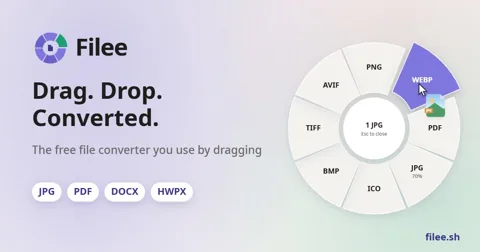
    Filee is a local format-conversion application that does not upload input files to an external server. Users working with documents, HWP and HWPX, images or media choose files and an output format. A modifier-key drag opens suitable formats around the cursor, with results saved beside originals by default. It connects format-specific engines and searches multistep routes when direct conversion is unavailable. The route-planning source allows at most three steps and returns no route when conversion is impossible. Batch processing, watch folders and a CLI sharing the app's engines are included. Windows installer and portable packages are available; macOS and Linux are previews. Some formats need separately downloaded optional engines such as FFmpeg, LibreOffice or Pandoc rather than only the default engines. Conversion works offline, but update checks and engine downloads use the network. Format support does not imply preservation of every original layout or editable detail.
    License
    MIT Permissive. Commercial use and changes are allowed if the copyright notice is kept.
  39. 777

    DmNote-App/DmNote

    What it does
    DM Note is a key-viewer application that shows viewers which keys a player presses. It began for DJMAX RESPECT V but can display input for other games. Key mappings and input states become overlay highlights, note effects and key counters. It also provides input-rate statistics, graphs and key sounds, with per-key images, CSS and plugins for customization. Besides a desktop overlay, it supports connection as an OBS browser source. Windows 10 and 11 and macOS are supported; Linux users are directed to a separate community fork. Users run a downloaded application, and macOS requires separate Accessibility and Input Monitoring permissions followed by an app restart. OBS display also needs browser-source configuration. Some fullscreen games can hide the overlay, and untrusted plugins should not be loaded.
    License
    GPL-3.0 Copyleft. Distributing software that includes this code requires releasing the source under GPL.
  40. 776

    anthropics/claude-quickstarts

    What it does
    Claude Quickstarts is an official collection of example projects for developers building with the Claude API. It is not one finished product: developers select and extend examples for support, financial analysis or computer and browser interaction. Depending on the project, inputs are questions, documents or task instructions, and outputs include answers, tool results and application interfaces. The autonomous-coding example describes separate initializer and coding agents with progress retained across sessions. Managed Agents examples additionally cover messaging integrations, daily briefs and knowledge wikis. The inspected minimal browser example drives one Chromium tab over CDP and connects tool calls to the model runner. Model execution needs Claude API authentication, example-specific Python or Node.js environments and external-service configuration. Installing the repository neither activates every example nor connects business systems. The minimal browser driver is not production code and omits capabilities such as typing and uploads. Page content can influence the agent, requiring disposable browser profiles, isolation and network controls.
    License
    MIT Permissive. Commercial use and changes are allowed if the copyright notice is kept.
  41. 775

    Tencent-Hunyuan/Hy-Memory

    What it does
    Hy Memory is a Python memory SDK and engine for agents that need to retain conversations and work traces across tasks. It accepts text, messages and tool-call traces, and returns memories organized for chat, productivity work or coding. Chat uses hierarchical memory, working separates session facts from reusable experiences, and coding adds version-change context to that two-layer structure. The documentation describes storing real diffs from Git or recognizable replacement actions, but the chain is best effort and its implementation was not independently inspected here. Starting requires configuring model and embedding endpoints and explicitly wiring memory writes and searches into the caller; installation alone does not capture application activity. Working and coding behavior requires pro or ultra mode and tool-call evidence, while lite ignores the scene and stores raw memory. The same repository also contains MemHub, a separate local-first desktop and CLI product with independent permissions for reading sources, model processing and host access; its documented release targets are Linux and macOS, not Windows. SDK installation, MemHub runtime installation and connecting authorized applications are different steps, and neither local-first operation nor publishing model weights guarantees that all processing remains offline.
    License
    Custom license Custom or non-standard license. Read the license file before any reuse.
  42. 774

    anujasid/mcp-for-blender-pro

    What it does
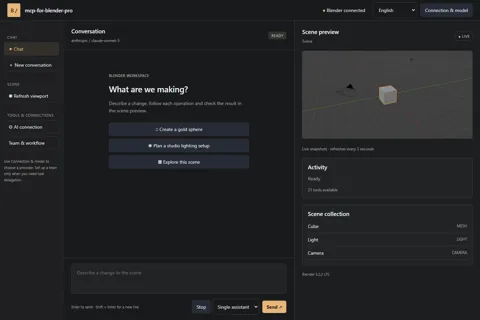
    This is a Blender extension with an AI chat workspace and a built-in MCP server for artists, technical artists and developers automating scene work. It combines a creative request with scene and object information, then uses tools to create or edit objects, assign materials, capture the viewport or prepare scene exports. A companion Studio window exposes conversation, scene previews, approvals and a task board. The documented team workflow uses a manager, workers and reviewers in sequence, with one correction attempt before a second failed review stops the chain. The release targets Windows x64 with Blender 4.2 or later, and setup additionally requires a selected tool-capable model and configured cloud credentials or a local model endpoint. External MCP clients require the server to be enabled and an authenticated local connection, while OpenCode keeps its provider credentials separate from Blender profiles. Asset services may require additional keys and their assets retain separate licensing obligations. Approval and Python validation are not a security sandbox, external clients control their own approval policies, and the implementation and resulting scene quality were not independently tested here.
    License
    MIT Permissive. Commercial use and changes are allowed if the copyright notice is kept.
  43. 773

    lucannez64/darling-lol

    What it does
    This is an experimental collection of Darling runtime patches and integration tools for developers testing the macOS League of Legends client on x86-64 Linux. It addresses graphics, audio, input and startup compatibility rather than providing a finished game launcher. Inputs include pinned Darling sources and a separately obtained official game installation; the intended result is a patched runtime that can launch the client and game. The repository contains source patches and build, installation and regression-check tools, but does not include game files, account databases or tokens. Requirements include Linux 5.14 or newer, X11 or Xwayland, hardware Vulkan/OpenGL drivers, build dependencies and Python 3.12 or newer. Building the runtime and installing the game are separate tasks, so downloading this repository alone does not make the game usable. The author reports limited maintenance and says a fresh checkout has not been validated end to end on another machine. The README explicitly warns of permanent account bans; compatibility work is not Riot approval, and the reported performance was not independently verified here.
    License
    GPL-3.0 Copyleft. Distributing software that includes this code requires releasing the source under GPL.
  44. 772

    cursor/plugins

    What it does
    This repository is a collection of official Cursor plugins for developers, rather than a standalone assistant or model. A marketplace manifest lists plugins, while each plugin has its own manifest and can package skills, rules, agents, hooks or MCP connection settings. Inputs vary by plugin and include development requests, repository context and conversation transcripts; outputs can be review guidance, workflow actions or maintained project instructions. The continual-learning example combines a stop hook, an orchestration skill and a memory-updater subagent to update AGENTS.md from new or changed transcripts. Its inspected TypeScript hook checks completion status, turn count, elapsed time and transcript modification time before returning a follow-up request, rather than directly performing the entire memory update. Starting requires selecting and installing the relevant plugin in Cursor; the inspected hook also invokes Bun. Installing a service plugin does not by itself authorize that service, and external credentials and permissions must be configured separately. Behavior and dependencies differ across plugins, and neither every integration nor compatibility with other agent hosts was verified here.
    License
    No license No license file found. Without a license, reuse of the code is not permitted by default.
  45. 771

    darlinghq/darling

    What it does
    Darling is a compatibility runtime for developers seeking to run macOS programs on Linux without a virtual machine. It takes macOS executables and their required files and provides a Linux-hosted environment intended to run them. The official README describes a Mach-O loader, a userspace darlingserver and reimplemented Darwin interfaces and Apple frameworks; the underlying source was not independently audited here. Some command-line tools work, while graphical application support remains under development and Xcode itself is not yet supported. Users can begin with an available official package or build the runtime with its documented dependencies, then prepare the application separately. The build guide requires x86-64 Linux and tools such as Clang and CMake, together with submodules and supporting libraries. DPREFIX keeps a macOS-like filesystem, but its overlayfs use restricts locations such as NFS or eCryptfs. Installing the runtime is not a promise that a particular application will work, and community packages are explicitly not vetted by the project.
    License
    GPL-3.0 Copyleft. Distributing software that includes this code requires releasing the source under GPL.
  46. 770

    chenglou/handwired

    What it does
    Handwired is an MIT-licensed TypeScript project that writes program logic in the form of a neural net. A program is a fixed list of operations over 32-bit floats, mostly weighted sums and ReLU products plus 0-or-1 rounding and table reads, and its weights are written by hand without training. The README presents it as turning regular JavaScript into a neural net. The docs state that no tool converts existing JavaScript source, and programs are written in builder code that appends operations to a Circuit. An if-else becomes arithmetic in which both branches are computed and a value of 0 or 1 picks one, and the README says this keeps the whole program differentiable, while the docs require explicit gradient options for rounding and table reads. The program reads one Float32Array of cells, and host JavaScript writes inputs into it, runs an evaluation, copies the next state back and draws the results in the DOM. Programs run in JavaScript on the CPU, and only the JSON search demo turns them into WebGPU shaders to search 100,000 generated JSON documents at each keystroke. The demos are HandwiredOS, with three windows and a dock run by one program, a photo gallery whose layout network is trained with the program's gradients, and the JSON search page. Getting started needs Bun, with 1.4.3 as the tested version, where bun install and bun start open the demo site and a toggle switch template is the start of a new app. The lab status page lists known issues such as gradients that change with the order of code statements, and the lab folder holds older experiments.
    License
    MIT Permissive. Commercial use and changes are allowed if the copyright notice is kept.
  47. 769

    nyacg/do-on-container

    What it does
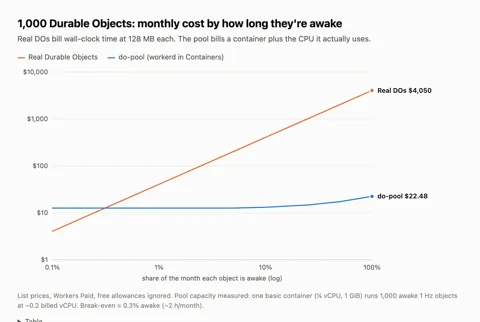
    do-pool is a TypeScript experiment in the repository do-on-container. It runs the same Cloudflare Durable Object classes either as real Durable Objects or hundreds per container inside workerd on Cloudflare Containers. It targets objects that stay awake but do little, such as game loops, presence, upstream feeds and AI agents waiting on models, which are billed for every second they stay awake. In POST.md, 1,000 such objects cost about 22 dollars a month in the pool and about 4,050 dollars as real Durable Objects, and objects that mostly hibernate are said to fit real Durable Objects better. A placement object assigns objects to containers, scales nodes from CPU and connection statistics, moves several objects at a time off busy nodes and uses per-assignment epochs against stale moves. Every 30 seconds each node writes all changed objects as one R2 segment plus a manifest, and on SIGTERM the node saves everything first. On a hard failure up to 30 seconds of writes can be lost, and in the write-up's SIGKILL test 5 of 10 writes survived while all 10 survived a drain. Container location cannot be chosen, and in the write-up's browser measurement pool round trips took about 80 ms against about 20 ms for real Durable Objects. Running it needs a Cloudflare account and API token, an R2 bucket and Docker to build the linux/amd64 image, and status endpoints are public while only admin calls need a token. The write-up is marked as a draft, the repository has no license file, and the two demos are live cursors and a Yjs collaborative editor.
    License
    No license No license file found. Without a license, reuse of the code is not permitted by default.
  48. 768

    ahwootech/BRUTAL

    What it does
    BRUTAL is a C# framework from Ahwoo for making games or a custom game engine. According to the README, Kitten Space Agency was built directly on it, and Ludeon built its Waylith engine on it to move RimWorld off Unity. Its core is an interop layer that calls native APIs directly from C#, surrounded by unmanaged memory, allocation-free collections, maths, a job system, logging and localization. Bindings cover Vulkan, OpenGL, GLFW, SDL, Dear ImGui, FMOD, OpenAL, RakNet, Jolt, Box2D, shader compilers and more, and a separate C# library loads glTF files. It has no editor, scene graph or renderer, and each top-level folder is one NuGet package so that a project references only what it needs. Getting started needs the .NET 10 SDK on Windows or Linux and a Vulkan 1.3 GPU for rendering, and the README's first example opens a window with the Core and Glfw packages. Project files, a solution and build scripts are still to come, so the repository is for reading and forking and builds use the NuGet packages. The license is based on MIT and is free for commercial games, and a separate commercial license can be arranged. A product distributed to end users must put the BRUTAL copyright notice in its credits and ship NOTICE.txt, and it shows the logo before its main function starts unless that is waived, as for non-profit projects or products without graphics. The license has yet to be submitted for OSI approval, it follows New Zealand law, and third-party components such as FMOD keep their own licenses.
    License
    Custom license Custom or non-standard license. Read the license file before any reuse.
  49. 767

    deeplethe/solid-glass

    What it does
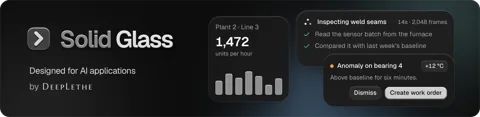
    Solid Glass is an MIT-licensed theme for shadcn/ui from DeepLethe, made for AI application interfaces, with a glass look that reads as solid from a distance. Its four rules put the finish only at the edge, with a rim of light, a hairline and a shadow, keep surfaces neutral grey, express depth as thickness and use one style for hovered, selected and open states. The theme is one CSS file that uses shadcn/ui's own variable names and finds component parts by their data-slot, so existing components need no changes. It adds 12 components for screens where an agent works while someone watches. They include folded tool call steps (tool steps), a question card with choice buttons (ask card), a context usage display (context ring) and task notices (task notice). Blocks show whole screens built from the components, and one of them is an agent workspace with sessions, a conversation thread, files and background tasks. Installation starts from a shadcn/ui project with React 19, Tailwind CSS 4 and Base UI, adds the stylesheet with the shadcn command and removes the colour variables written by shadcn init. Dark mode is the main design with a light mode included, and a Create page adjusts thickness, tint, chart colour, type, radius, rim and blur and outputs the matching CSS. The fonts default to Geist and Geist Mono with system fallback, and no Korean font is specified. The components and documents taken from shadcn/ui keep that project's MIT notice.

    License
    MIT Permissive. Commercial use and changes are allowed if the copyright notice is kept.
  50. 766

    SakanaAI/AI-Scientist-v3

    What it does
    The Agentic Scientist, in the repository AI-Scientist-v3, is Sakana AI's Apache-2.0 Python pipeline in which coding agents carry a task through experiments to a paper. It is for computational research with a program to improve and an evaluator that scores it, and the examples are circle packing on a CPU and GRPO training on two GPUs. Input is a task directory with task.md, an initial program and an evaluator, and drafting a task from a short brief alone is experimental, works for small tasks such as circle packing and may fail on larger ones. Six phases run in order: task drafting, investigation that repeats ideas and experiments, ablations against baselines, a sealed final evaluation, post-hoc analysis and paper writing. Each run creates a directory with the task snapshot, attempts and results, cost records and a LaTeX paper with its PDF, and a run inspector shows it in the browser. The paper phase links each claim to evidence files with hashes and gathers references from Semantic Scholar, OpenAlex or Google Scholar, and it fails when citations or evidence links do not pass validation. It drives Claude Code, Codex, Cursor, OpenCode, Gemini and Pi through the Headless CLI, and an optional review phase sends the finished paper to an OpenAI-based reviewer model. Getting started needs Python 3.11 or later with uv, Docker, and API keys or a Claude login in .env, GPUs are needed only for GPU presets, and agsci doctor is the first check. The README warns that agents run any command with full tool permissions, inherit the API keys and are steered by the files they read, and it asks for runs inside Docker. One GRPO evaluation trains for one to two hours, and the cost files separate provider-reported costs from list-price estimates, leave hardware costs out and are run telemetry, with provider invoices as the billing record.
    License
    Apache-2.0 Permissive, with a patent grant. Commercial use is allowed; keep the notices and state your changes.

Showing 50 of 962

Only repositories in the ranked Trendshift lists are included, and the lists are used only to find candidates. We do not copy their ranks. Descriptions, licenses and star counts come from each GitHub repository. The notes are our own reading. We have not tested these projects, and a place on a trending list does not prove quality. Trendshift RSS feed