gamedev-skills/awesome-gamedev-agent-skills
- Source
- GitHub
- First trending
- Category
- Skills
- GitHub stars
- 2,540
- Main language
- Python
This page introduces an external open-source repository. It is not an HDATF product.
What it does
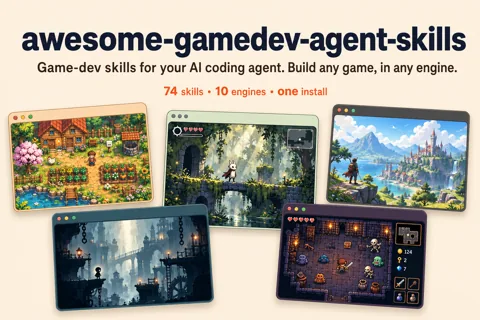
This repository collects game-development instructions that coding agents can load for a specific engine and task. Its README lists 74 specialized skills and a router covering engines such as Godot, Unity, Unreal, and browser-based frameworks. The inputs are a development request and project files that reveal the engine and version. The router selects one engine family, adds the relevant discipline, genre, and workflow guidance, and asks the agent to read only those documents. The immediate output is a selected set of instructions, while code changes and playable results depend on the host agent and development tools. SKILL.md files contain portable metadata and procedures, with additional references loaded when needed. Starting requires a compatible agent, readable skill folders, and the appropriate project and engine environment. This is not a game engine or independent execution service, and its version baselines and structural validator do not establish that generated code works in every project.
License
Apache-2.0 Permissive, with a patent grant. Commercial use is allowed; keep the notices and state your changes.
More in this category
- MaryCache/imozuru
imozuru is a research skill for Claude Code designed to reach original evidence instead of stopping at summaries of highly ranked search results in an unfamiliar field. Inputs are a question and claims needed to answer it; outputs are a map of terms and people, a research log, saved source texts and a claim-by-claim extract page. Differently oriented search roles gather leads before following references, authors and document links. It distinguishes papers, official documentation, firsthand records and video transcripts by source type. Original text stays in local files with file and line references, and the report generator checks normalized extracts against their source regions and stops on a mismatch. The skill must be registered with Claude Code and invoked for a research task; installation does not start continuous research automatically. Scripts require Python 3.10 or later, separate tools are needed for PDF, OCR and video transcripts, and citation tracing contacts OpenAlex. Research stops when evidence is attached or exploration saturates and records unreachable material, but the procedure does not certify that sources are true. Search terms leave the machine and saved originals are not for redistribution, so confidential questions and source rights need care. - alchaincyf/huashu-motion
huashu-motion is an Agent Skill, CLI and browser studio that lets coding agents such as Claude Code and Codex make launch films as code. From a product site, CSV or recording, the agent proposes three directions, writes a rhythm sheet and builds one GSAP index.html with sound effects and, for launch films, an ABC notation score. Clicking a frame in the local studio sends a comment with time, scene and element to an inbox file, and the agent edits only that part, keeping every version. Rendering uses the installed Chrome without a video model and exports MP4, MOV, WebM, GIF or a share page. Preferences and lessons stay in a local experience file. Node 22, Chrome and FFmpeg must also be installed; the skill script runs a cloned CLI or fetches the npm package. Per the README, music is made locally without paid APIs, testing covered macOS only, and Codex users must approve the blocked preview. GSAP, fonts and the author's cartoon character keep non-MIT terms. - EpicGames/unreal-engine-skills-for-claude-code-plugin
This Claude Code plugin from the EpicGames organization gives Unreal Engine developers three skills and a SessionStart hook for controlling and extending a running Unreal Editor through MCP. The unreal-mcp skill has Claude discover toolsets with list_toolsets and describe_toolset and run editor tools through call_tool. The README claims hundreds of tools across 30+ toolsets, including actors, Blueprints, Niagara and automation tests. Two other skills cover writing tested C++ or Python toolsets and building Agent Skills as Python classes or assets. The hook detects a .uproject file or GenerateProjectFiles script, adds a short project note to context and runs under bash. After marketplace installation, the editor still needs the ModelContextProtocol and AllToolsets plugins enabled, a started server and an .mcp.json file. The README warns that the MCP server listens on localhost, yet any process running as the same user on that machine can connect. It also warns one tool runs arbitrary Python in the editor and advises saving, committing and avoiding permission-skipping modes. The minimum engine version is unconfirmed. - cursor/plugins
This repository is a collection of official Cursor plugins for developers, rather than a standalone assistant or model. A marketplace manifest lists plugins, while each plugin has its own manifest and can package skills, rules, agents, hooks or MCP connection settings. Inputs vary by plugin and include development requests, repository context and conversation transcripts; outputs can be review guidance, workflow actions or maintained project instructions. The continual-learning example combines a stop hook, an orchestration skill and a memory-updater subagent to update AGENTS.md from new or changed transcripts. Its inspected TypeScript hook checks completion status, turn count, elapsed time and transcript modification time before returning a follow-up request, rather than directly performing the entire memory update. Starting requires selecting and installing the relevant plugin in Cursor; the inspected hook also invokes Bun. Installing a service plugin does not by itself authorize that service, and external credentials and permissions must be configured separately. Behavior and dependencies differ across plugins, and neither every integration nor compatibility with other agent hosts was verified here. - threerocks/hand-drawn-styles
hand-drawn-styles is a library of prompt recipes for hand-drawn style illustrations, shipped both as a Claude Code skill and as tool-agnostic documents. The repository currently holds 18 styles plus one variant, 19 recipes in total, and the figure of 5 in the repository description is outdated. When a user describes the content and the style, the final output is the prompt text for image generation. The images themselves are produced by the user in separate image tools such as gpt-image, Jimeng or Midjourney. The skill pulls the recipe text verbatim through a bundled Python script, shows a menu and waits for a choice when no style is named, and fills placeholders from the request. Variant 3.1 outputs a JSON package with a fixed three-stage workflow and checks the anchor image by its 1086x1448 size and a pixel SHA-256 value. For Claude Code it is installed by cloning into the skills folder, and other tools follow the PROTOCOL.md and STYLES.md documents. The license is MIT, but style 3 carries the Ghibli name, so commercial use needs a rights review.
Only repositories in the ranked Trendshift lists are included, and the lists are used only to find candidates. We do not copy their ranks. Descriptions, licenses and star counts come from each GitHub repository. The notes are our own reading. We have not tested these projects, and a place on a trending list does not prove quality.