shaobeichen/dsh-pocket
- Source
- GitHub
- First trending
- Category
- Agents
- GitHub stars
- 2,017
- Main language
- JavaScript
This page introduces an external open-source repository. It is not an HDATF product.
What it does
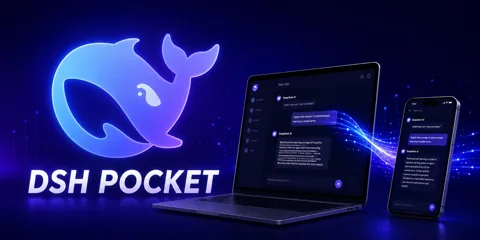
DSH Pocket is a plugin for controlling a computer's running DeepSeek Harness web interface from a phone. A QR address and access password open the same session for submitting tasks, viewing output and handling approvals. An HTTP and WebSocket proxy plus mobile-layout adjustments connect the existing interface rather than running a separate model. It requires DeepSeek Harness and Node 22 or newer, and dsh web must restart after plugin installation. Local-network access is separate from public access, which requires explicitly enabling a cloudflared tunnel. A fixed-domain mode needs a Cloudflare account, domain and tunnel configuration. Default and custom passwords have different rotation behavior, and the inspected settings source defaults local access and local authentication to enabled. Remote control reaches the computer's code-execution capabilities, so exposing a company network needs caution, and desktop advanced mode is documented as unsupported.
License
GPL-2.0 Custom or non-standard license. Read the license file before any reuse.
More in this category
- bowenliang123/dsh-context
dsh-context is a plugin for inspecting what context DeepSeek Harness sends to a model. Users managing long conversations or multiple agents provide session records and the host's token-meter projections as its inputs. Dashboards and a context browser show session composition, request-level changes, compaction events and file activity. The Fleet view displays the current agent, its parents and subagents with their relationships and states. Users add the plugin to a compatible DeepSeek Harness web profile and open its tabs or command; it is not a standalone model service. The package specifies Node 22.19-series or 24 and newer, plus host-version compatibility requirements. Category token estimates are distinguished from provider-reported actual values, and displayed costs are estimates. Configured system-prompt prefixes and suffixes can change behavior from the next model step, so it should not be treated solely as read-only statistics. - Alpha-Dojo/DojoAgents
DojoAgents is an AI agent framework for personal-investment research and portfolio review. Questions, holdings and market data lead to tool-assisted analysis and dashboard results. Its README describes workflows using US, Hong Kong and mainland Chinese market data and holdings screenshots. It separates the core loop from a financial Harness; the inspected financial factory assembles tool providers, memory, policies and result presenters. Python 3.11 or newer and model API configuration are required, while source frontend builds need Node 18 or newer and npm 9 or newer. Users can start from the distribution package and configure a provider or custom endpoint in the local dashboard. The financial data backend uses SDK or HTTP connections, so installation does not guarantee current or accessible data. The project identifies research and demonstration use, and should not be interpreted as an automated trading product guaranteeing accuracy or returns. - kuafuai/andee
Andee is an experimental Android agent application that accepts voice or text requests, reads other apps' screens and operates them. Accessibility trees and screenshots are inputs, while taps, scrolling, text entry and result pages are outputs. When accessible elements are unavailable it targets a labeled screenshot grid, and notifications and scheduled tasks can also initiate work. Its default on-device mode means the agent loop runs on the device, not that language-model inference necessarily runs there. A self-configured setup needs an OpenAI-compatible model endpoint and key, with separate configuration for the chosen external voice service. On Android 11 or later, installing the APK must be followed by overlay, accessibility and other required grants; installation alone does not activate automation. It manages notes and scenes and has some code-level restrictions, including denying vault access to notification-originated turns, but these do not block every risky action. The security document lists an unauthenticated device WebSocket server, a plaintext hub link and screen-content prompt injection, so safe prevention of payments or outgoing messages cannot be assumed. Conversations and audio may leave for selected providers, and its license adds conditions on multi-customer hosting and distribution inside another product. - google-research/harness2
This research framework helps agent developers refine an execution harness without changing model weights. Given a task and a base harness, it proposes edits, probes them on that task and composes refinements from execution contrasts. Editable components include prompts, memory, tool guidance and skills. Parallel recursion explores candidates while sequential recursion carries refinements forward. Adopted harnesses and evidence-supported lessons update the improvement harness for later tasks. Outputs include deliverables, adopted configurations, reflections and evaluation records. It targets Linux and Python; model experiments additionally require credentials, an executor and benchmark-specific dependencies. The local demo needs no model credentials, but model experiments incur API costs. Installation does not automatically improve an existing agent. Executor network access and Codex's disabled sandbox require separate controls, and this is not an officially supported Google product. - anthropics/claude-quickstarts
Claude Quickstarts is an official collection of example projects for developers building with the Claude API. It is not one finished product: developers select and extend examples for support, financial analysis or computer and browser interaction. Depending on the project, inputs are questions, documents or task instructions, and outputs include answers, tool results and application interfaces. The autonomous-coding example describes separate initializer and coding agents with progress retained across sessions. Managed Agents examples additionally cover messaging integrations, daily briefs and knowledge wikis. The inspected minimal browser example drives one Chromium tab over CDP and connects tool calls to the model runner. Model execution needs Claude API authentication, example-specific Python or Node.js environments and external-service configuration. Installing the repository neither activates every example nor connects business systems. The minimal browser driver is not production code and omits capabilities such as typing and uploads. Page content can influence the agent, requiring disposable browser profiles, isolation and network controls.
Only repositories in the ranked Trendshift lists are included, and the lists are used only to find candidates. We do not copy their ranks. Descriptions, licenses and star counts come from each GitHub repository. The notes are our own reading. We have not tested these projects, and a place on a trending list does not prove quality.