simplexai-labs/linger
- Source
- GitHub
- First trending
- Category
- Agents
- GitHub stars
- 3,849
- Main language
- TypeScript
This page introduces an external open-source repository. It is not an HDATF product.
What it does
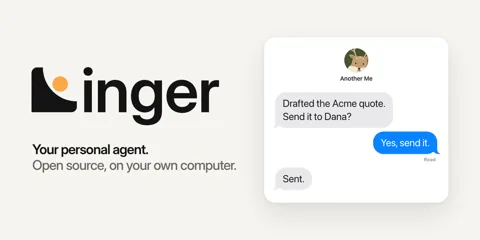
Linger is an agent system for conversation and work using a personal computer and connected work sources. It describes turning email, chats, meetings and files into entity-based wikis and task results. Documentation separates the personal wiki from each agent's memory and describes checking proposed changes against existing pages while retaining provenance and change logs. Search documentation ranks wiki pages and originals separately using keyword search and fusion across multiple queries. The inspected wiki recovery code includes duplicate-execution locking, failure retries and checks for already completed work. It distinguishes the server from executors on connected computers and supports subscription runtimes as well as local models. Local execution therefore does not establish that every connection or model call remains off external services. Preparation requires server configuration, source permissions and memory and storage appropriate to the selected model, while performance and memory-accuracy claims were not reproduced here.
License
Custom license Custom or non-standard license. Read the license file before any reuse.
More in this category
- diggerhq/opencomputer
OpenComputer lets a development team assign coding work from Slack. It accepts instructions in a conversation and works on connected repositories through a remote coding agent. Users can see progress and send further instructions, while a pull request is the intended deliverable. The reviewed session code connects streamed agent events, questions and permission prompts to the conversation. Workspace code creates session-specific working directories and Git branches. Official self-hosting documentation requires cloud infrastructure, Slack and GitHub applications, identity configuration and model credentials. The README also describes Cloudflare services, so self-hosting does not mean an entirely offline single-machine application. Its statement about container isolation conflicts with a separate permissions document that describes shared session privileges and unfinished isolation. Neither that security boundary nor the advertised speed advantage was verified by execution here. - Tracer-Cloud/opensre
OpenSRE is an agent for investigating CI failures and assisting repair review. It targets developers and operators who otherwise trace failed logs manually. Repository check results, logs and change history become evidence-linked explanations or repair commits. The core source implements a loop of model tool calls and observed results. Official documentation separates read-only health investigation from repairs that write to a PR branch. Alongside a signed-in model path, it documents headless operation with a configured model provider and key. GitHub investigation needs connection permissions, while repair and push require additional write access. It is a public alpha whose interfaces and integrations may change. Telemetry is documented as enabled by default, so external log handling needs separate review, and no repair was executed during this investigation. - bookwjitchieni1986/blender-ai-mcp-addon
This project describes a Blender add-on for artists and developers who want AI-assisted scene editing. Its documented inputs are user requests and scene context, with scene changes and viewport previews as outputs. The README describes chat, object inspection, materials, asset search and export tools. It also describes managers assigning work, workers editing scenes and reviewers checking results in sequence. MCP is the connection protocol through which external AI clients can call program tools. The documented bundle targets Windows x64 with Blender 4.2 or later and needs a tool-capable local model or external model API. Only documentation and release assets were found, so the core implementation was not inspected. The README says Python validation is not a security sandbox and external clients control their own approvals. - open-jarvis/OpenJarvis
OpenJarvis is a local-first personal AI framework for users and researchers who want more control over inference and agent operation. Users provide questions, indexed documents, agent settings and optionally connected account data. Its presets cover simple chat, cited research, code assistance and scheduled monitoring, rather than one fixed assistant workflow. The research guide describes splitting files into chunks, storing them in SQLite with full-text search and repeatedly retrieving evidence for an answer. Local inference can use Ollama, while the cloud engine source also implements external provider routing, so local-first does not guarantee an offline or local-only deployment. Web research and account connectors can introduce additional external services. The README describes evaluation of quality alongside latency, energy and cost, plus learning from local traces, but those claims were not reproduced here. The project requires Python 3.11 or newer and an appropriate model runtime, and answer quality, resource use and privacy boundaries depend on the selected model, tools and configuration. - pierridotite/mobile-agent-testers
mobile-agent-testers helps mobile app teams explore usability and functional problems with parallel AI testers. Inputs include an app repository or build, a task brief and personas specifying devices, languages and display settings. GitHub Actions gives each selected persona its own Android emulator or iOS Simulator and Claude Code agent. The agent reads screenshots and accessibility elements, then taps, swipes and types to pursue its assigned goal. Briefs support open exploration, feature walkthroughs, bug reproduction and comparison of two versions. Outputs include reproduction steps, numbered screenshots and structured findings, with artifacts encrypted before upload and collected locally for a summary. Model access uses Claude credentials or an Anthropic-compatible API, and optional duplicate grouping sends report titles, screens and severities to Claude. The environments are simulated devices, findings can misread screens, and variable exploration does not replace scripted regression tests.
Only repositories in the ranked Trendshift lists are included, and the lists are used only to find candidates. We do not copy their ranks. Descriptions, licenses and star counts come from each GitHub repository. The notes are our own reading. We have not tested these projects, and a place on a trending list does not prove quality.