XinaTian/MROffice
- Source
- GitHub
- First trending
- Category
- Documents
- GitHub stars
- 3,795
- Main language
- TypeScript
This page introduces an external open-source repository. It is not an HDATF product.
What it does
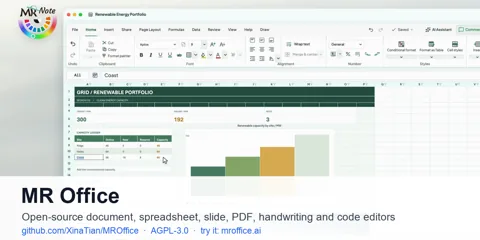
This repository publishes MR Office editor sources for developers embedding document editing in a browser. Document, spreadsheet, presentation, PDF, handwriting and code editors share a core and separate packages. Content is saved in native formats, while selected editors handle HTML, Markdown, CSV and TSV. The document editor describes pages and tables, and the spreadsheet supports arithmetic between cells. Function evaluation such as SUM, chart processing and Microsoft Office file import and export must be distinguished from the public editors. The main documentation assigns those capabilities to the desktop product using a separate closed-source component. Displaying and annotating PDFs in the public editor also differs from saving edits into the original file. Use requires a web build environment and fonts, and differences between package-level and top-level feature descriptions require individual behavior checks.
License
AGPL-3.0 Network copyleft. Offering a modified version as a service also requires releasing the source. Review before any product use.
More in this category
- JimLiu/open-artifact
Open Artifact helps coding-agent users review and revise generated work. It covers slides, designs, whiteboards, spreadsheets, dashboards, documents and motion. Requests and source files become local folders edited in a browser. Its document tools import Markdown, Word and PDF, and export those formats plus HTML. The document model tracks stable identifiers, proposed edits and version history. Comment routing attempts delivery to the owning agent session and otherwise queues messages. The documented environment needs Node.js 22.18 or later and an agent, while live dashboards require separately configured external data connectors. Scanned PDFs are refused, some formatting is lost on import, and session delivery depends on the agent application. - SimonBure/presse
presse is a Rust command-line tool for locally compressing and combining PDFs and images. It takes multiple PDFs or images and outputs compressed PDFs, merged documents or PDFs converted from images. It combines image re-encoding, duplicate-stream coalescing and structural compression, with selectable quality and resolution caps. The inspected merger preserves input page order and reconstructs object numbering and the page tree. Additional optimizations and experimental GPU paths exist alongside the default CPU path, but their build features and runtime dependencies differ. Source builds require a Rust toolchain, while basic processing does not require an external AI service. The project states that CMYK images are not compressed, and lossy compression or resolution changes do not imply preservation of all original information. Speed comparisons are specific to the author's corpus and settings, and neither performance nor document preservation was reproduced in this review. - ghosundict/dict
This repository incrementally publishes material about word roots and etymology. Its audience is language learners and developers interested in etymological resources. Verified public artifacts include Chinese explanatory text, WPS mind-map files, and an introduction page. They describe relationships between roots, derived elements, and words. A complete dictionary app, query API, or learning-model implementation was not established. Large vocabulary counts in the README describe the author's accumulated collection, not the number of downloadable structured records. Plain text can be read in an ordinary editor, while mind maps need compatible tools. The author describes cleaning omissions, duplicates, and inconsistent formats as publication proceeds. The repository license alone does not settle redistribution rights for underlying third-party dictionary material. - toeverything/AFFiNE
AFFiNE organizes documents, whiteboards and tables in one workspace. It targets individuals and teams who struggle to keep written and visual material together. Text, notes and linked pages become blocks arranged in documents or an edgeless canvas. The README describes combining writing, planning and collaboration in the same space. Local-workspace source includes IndexedDB and SQLite storage paths and Yjs document handling. Desktop, web and self-hosted usage are documented, while server operation needs a separate deployment environment. AI features are also described, but local storage and external-model access conditions must not be conflated. The root license assigns separate terms to some server and native paths, so the entire repository cannot simply be described as MIT. Synchronization, permissions and AI features were not executed or validated in this review. - supercli-site/xiaobai-kanban
xiaobai-kanban is a Chinese educational repository and documentation website about working with coding agents, not an operational kanban application. It targets beginners learning what agents are, how to express requirements, how to prepare tools and how to finish a first project. Learners provide natural-language instructions, background, goals, scope and acceptance criteria, supplemented by file locations, reference images and original error messages. A separately installed agent turns those instructions into file changes and command-line actions, while the first exercise produces an HTML page for the learner to inspect in a browser. The teaching method combines small changes, hands-on acceptance checks, explicit corrections, Git checkpoints and written handoffs rather than implementing a task-execution service. Reading requires a browser, while the documentation site's maintenance configuration uses Node.js, pnpm, VitePress and Cloudflare Pages. Extended exercises introduce authenticated GitHub, GitLab and Lark tools, plus optional Agent Mail with human account creation and authorization. The optional magpie chapter describes a local model gateway using provider accounts and API keys, with masking limited to routed requests and free usage dependent on provider quotas rather than account or subscription bypass.
Only repositories in the ranked Trendshift lists are included, and the lists are used only to find candidates. We do not copy their ranks. Descriptions, licenses and star counts come from each GitHub repository. The notes are our own reading. We have not tested these projects, and a place on a trending list does not prove quality.