ivarvong/mpl
- Source
- GitHub
- First trending
- Category
- Design and UI
- GitHub stars
- 45
- Main language
- TypeScript
This page introduces an external open-source repository. It is not an HDATF product.
What it does
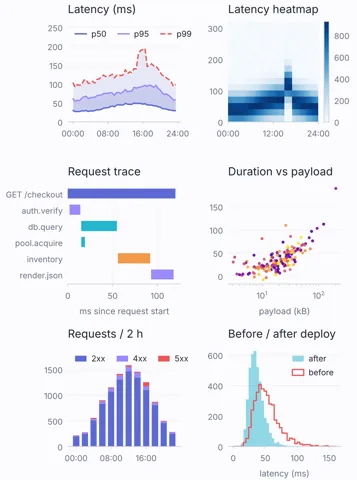
mpljs is a rendering library for developers who want matplotlib-style charts in JavaScript environments. Numeric arrays and axis, font and style settings produce PNG, SVG or scene data. It offers lines, bars, scatter plots and multi-axis layouts and describes its own Agg-style rasterization implementation. The official trace example lays out request start times and durations as horizontal bars. Documentation covers Node, browsers and Cloudflare Workers and specifies Node 24 or later for building. Rendering does not require an external chart server, but the fonts and colormaps used must be supplied. README pixel-equivalence figures are the author's fixture comparisons and were not reproduced in this review. General mathematical text and some chart types remain unsupported, and bundled fonts alone do not guarantee Korean text rendering.
License
ISC Custom or non-standard license. Read the license file before any reuse.
More in this category
- a2ui-project/a2ui
A2UI supplements text-only agent replies with interactive interfaces. It is for developers building agent-backed web and mobile applications. Inputs include permitted component catalogs, application data and model output. Development tools derive model instructions from catalogs and turn model output into checked UI messages. A renderer displays those messages through native components and sends user actions back. Layout and data are updated separately through messages such as updateComponents and updateDataModel. Integration needs an application, compatible development tools, a catalog and an agent connection, while model inference and business APIs remain application responsibilities. UI checks do not establish business truth, and the official travel sample is educational rather than production-ready. - ersinkoc/phonebox
PhoneBox turns an Android phone into a configurable desk display and touch controller for a computer. An Android application pairs with a desktop agent on Windows, Linux or macOS and shows information through configurable widgets and pages. Inputs include system measurements, supported coding-agent sessions, service data, webhooks and touch actions, while outputs include live panels, notifications and configured computer controls. A browser editor arranges layouts, and widgets cover system resources, coding quotas, media, calendars and automation. The Android WebView sends agent requests through a native proxy, using an adb tunnel over USB or paired HTTPS with a pinned certificate over Wi-Fi. Live events use a server-sent-events stream with polling as a fallback, and sensitive commands and integration credentials remain on the computer according to the documentation. The core panel needs no PhoneBox cloud account, but optional weather, quota, GitHub and other integrations contact external services. It requires Android 7 or later, and widget availability depends on host hardware, tools and permissions, so the documented platform support is not identical for every control. - iebb/mithka
Mithka is an independent Telegram client for people using mobile and desktop devices. It is not an official Telegram or Tencent application. Users sign in with their accounts to send messages and attachments and receive conversations and notifications. Flutter provides the interface, while TDLib handles Telegram communication through native library calls from Dart. The reviewed code receives updates in a separate execution unit and routes requests and account-specific events. Building it requires Flutter, the target platform toolchain, Telegram API credentials and matching TDLib binaries. Telegram remains an external service, and optional analytics can be disabled in local builds. The README says official builds disable features that violate Telegram API terms, and the corresponding default-off build flag exists in the source. Published interface images are mockups, and neither performance nor every platform and feature was tested here. - sveltejs/svelte
Svelte is a component compiler and user-interface framework for developers building interactive web applications. Its inputs are component source files combining markup, styles and JavaScript or supported TypeScript syntax, with application data and user events supplied at runtime. Compilation produces JavaScript component modules and associated styling for interfaces that update the browser document when relevant state changes. The compiler entry point parses source, validates options, analyzes components and transforms the result, so it is more than a collection of visual widgets. Its reactive runtime tracks dependencies and schedules affected reactions, while state objects and arrays can use proxies to trigger updates for changed properties. Official examples connect state to event handlers and demonstrate snapshots for libraries that do not accept proxies, but destructuring and sharing reassigned state across modules have documented limitations. Development commonly uses Node.js and Vite, and the official guide recommends the separate SvelteKit application framework or a direct Vite integration with routing selected separately. Core Svelte does not require an AI model or hosted service, and its interface capabilities do not themselves provide enterprise authentication, data connectors or durable workflow execution. - zed-industries/gpui
GPUI is Zed's GPU accelerated interface framework for developers writing applications in Rust. The requested standalone repository currently contains only a short announcement README and links, not the framework implementation. The same organization's Zed repository contains the inspected implementation documentation and a working example in source form. That documentation describes a hybrid approach combining retained application state with views that produce interface elements during rendering. Developers provide Rust state, view definitions, styling and input actions, and the framework lays out elements and draws an application window. The inspected example creates an application, opens a window and renders styled text and nested elements, but was not executed here. Development requires a current stable Rust toolchain and platform specific windowing, text and graphics dependencies, and the documentation warns of breaking changes before version 1.0. The announcement does not establish a standalone release, supported platform parity or an application backend, and no rendering performance or usability result was independently tested.
Only repositories in the ranked Trendshift lists are included, and the lists are used only to find candidates. We do not copy their ranks. Descriptions, licenses and star counts come from each GitHub repository. The notes are our own reading. We have not tested these projects, and a place on a trending list does not prove quality.