rustrak/rustrak
- Source
- GitHub
- First trending
- Category
- Workflow
- GitHub stars
- 1,135
- Main language
- Rust
This page introduces an external open-source repository. It is not an HDATF product.
What it does
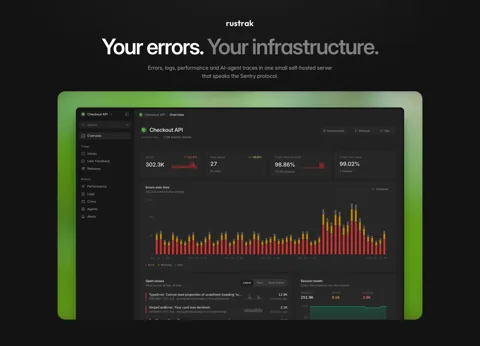
Rustrak is an observability tool for development teams that want application errors and execution traces on their own server. It accepts errors, logs, transactions and AI agent traces from Sentry SDKs and displays them in a dashboard. Its architecture documentation separates ingestion from database processing, temporarily storing accepted data before background processing. The inspected ingestion route checks authentication, input format and quotas before handing data to a processing pipeline. SQLite is the default storage, with a PostgreSQL configuration also available. Operation requires a server, persistent storage, project DSNs and access controls. AI tracing covers model and tool calls and token counts, but the project explicitly omits spending calculations based on its own price table. This review did not execute SDK compatibility or throughput tests, so actual environment events remain necessary for validation.
License
AGPL-3.0 Network copyleft. Offering a modified version as a service also requires releasing the source. Review before any product use.
More in this category
- SonicloudTech/mouse-sdk
This repository distributes an SDK for connecting compatible smart-mouse buttons and audio to applications. For hardware makers and app developers, it accepts USB HID and BLE data and delivers button events, JSON device state and PCM audio. A public C ABI supports multiple languages, while custom hardware protocols require adaptation through RAW mode. The inspected header and C sample show callback registration, initialization, event reception and shutdown. Documentation requires copying callback data within its lifetime and moving slow work to a separate processing flow. Use needs compatible hardware and binaries and companion libraries matching the operating system and architecture. Public downloads target Windows x64 and macOS ARM64, with other platform packages obtained separately. Full SDK internals are not published, the MIT samples do not license all binaries or proprietary protocols, and applications must implement speech recognition and business actions. - mdiri-ai/SoduWork
SoduWork is a self-hosted team workbench that connects requests, agent execution, deliverables, acceptance and reusable methods instead of leaving results in isolated chats. Users supply a goal, working materials and acceptance criteria, assign work to a person or agent, and receive versioned deliverables with review records. Its documented architecture separates a shared Hub, desktop interaction and local or remote runners, while harness adapters connect different agent runtimes rather than replacing them. Plugin documentation separates immutable method versions from environment bindings and declares the inputs and outputs needed when workflow steps exchange results. The inspected task-status implementation checks delivery facts before normal completion, including artifacts, execution outcomes, applicable approval conditions and required workflow receipts. The AI acceptance implementation binds review to an approval request, deliverable version and requirement version, and validates one evidence-bearing result for every acceptance criterion before recording a decision. The README's human-final-call language needs qualification because an authorized AI acceptance request can itself record approval and close the task without another manual confirmation, while its validator checks report structure and consistency rather than independently proving evidence true. Source setup requires Python 3.12 or later, Node.js 22.19 or later, Git, configured model access and the relevant runners, and some harnesses require separate accounts. The project remains public beta, runners are not a general sandbox, configured external services receive submitted prompts or files, and the public release does not include private business plugins or deployment operations. These findings come from documentation and selected implementation paths, not an executed installation, interoperability trial or independent reliability test. - m1guelpf/Exo
Exo is a Gmail client for macOS users who want a local desktop mail interface. It reads Google mail, calendars and contacts and sends requested changes back through Google APIs. Inspected code opens a SQLite cache for each account. A synchronization module applies Gmail history and rebuilds expired history while preserving queued changes. An outbox records user changes, waits for server acknowledgment and handles retries or rollback of local display changes. Authentication uses the system browser and a local callback rather than an Exo account server. Setup requires a personal Google sign-in client and enabled Gmail, Calendar and People APIs, with default sign-in requesting mail modification and sending, mail settings changes, calendar management, contact and organization directory reading, and account identity access; refusing any requested permission fails sign-in, while calendar-only accounts request only calendar access and the email address. Local storage does not remove dependence on Google, and the author warns that generated code has not received human correctness or security review. - BLCK-N/Assignment-Reviewer-AI
Assignment Reviewer AI is a terminal teaching example for scoring one answer to a fixed question about supervised and unsupervised learning. It targets learners studying how model evaluation, structured outputs and conditional workflow branches fit together rather than schools needing a complete grading product. A user enters a single line, and the program sends the answer and rubric to a Groq hosted model through LangChain. A Pydantic schema constrains four component marks, whose total produces a suggested score out of ten and feedback. The inspected LangGraph routes totals from four through six to a teacher review node and all other totals to a finish node. Teacher review only sets a displayed status string and does not create a saved queue, wait for a teacher or record a decision. The README specifies Python 3.11 or 3.12, the requirements include LangChain, LangGraph, LangSmith and dotenv, and a Groq key plus network access is required for inference. Optional LangSmith tracing can record prompts and answers, and although HTML templates remain in the tree, the inspected app has no web server or file upload route and the README does not claim live API testing in its packaging environment. - nickrunning/wechat-selkies
WeChat Selkies packages the official Linux WeChat client and optionally QQ inside a Docker container for browser access. It targets people who need a remotely accessible messaging desktop rather than another local client installation. Selkies streams the desktop through WebRTC and passes browser interaction to the applications, so this is not a replacement messaging protocol or business API. The documented desktop includes Chinese input support, file transfer and persistent configuration and chat data. Telegram is an optional third party application installed through the desktop's application facility, not a guaranteed bundled client. Operation requires a Docker host, a compatible browser, storage and access to the original messaging services with valid account authentication. The inspected automatic login helper presses a visible login button and asks for phone QR authentication when required; it does not establish a verification bypass. Although the LICENSE file says MIT, the README limits use to personal research and prohibits commercial use, while the Docker image label says GPL-3.0-only, so the terms are inconsistent. This review read documents and configuration without running the container, and public exposure, account safety, backup behavior and the conflicting usage terms remain unverified.
Only repositories in the ranked Trendshift lists are included, and the lists are used only to find candidates. We do not copy their ranks. Descriptions, licenses and star counts come from each GitHub repository. The notes are our own reading. We have not tested these projects, and a place on a trending list does not prove quality.