rociiu/talorys
- Source
- GitHub
- First trending
- Category
- Agents
- GitHub stars
- 690
- Main language
- TypeScript
This page introduces an external open-source repository. It is not an HDATF product.
What it does
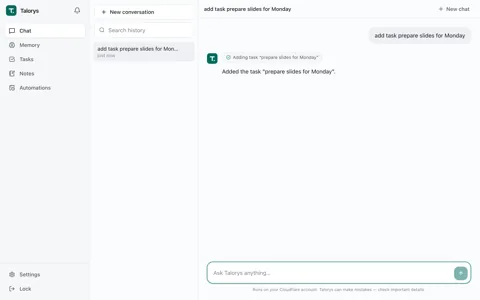
Talorys is a personal AI assistant that one owner deploys into their own Cloudflare account, bringing chat, memory, tasks, notes, projects and reminders together in one browser app, and the repository describes version 0.1.4. There is no signup, the owner password is hashed locally with PBKDF2-SHA256 and stored as a Cloudflare secret, and the public pages.dev address is protected by that password, a SameSite=Strict session cookie and login lockouts. Requests go from a Cloudflare Pages app with a React screen to a private Worker without a public URL, one Durable Object built on the Cloudflare Agents SDK keeps conversations, memories, tasks, notes, projects, automations, settings and usage in SQLite, and the owner can download a backup file that leaves out sessions and credentials. The input is text typed into the chat, and the reply streams back as Markdown from Workers AI, by default @cf/zai-org/glm-4.7-flash, while the screen shows which tools are being called. Memories are facts and preferences the owner can view, edit and delete, at most 8 go into each turn with full-text matches first and up to 4 recent preferences filling the rest, and semantic recall with @cf/baai/bge-m3 is off by default and has a default cap of 500 embeddings a day when turned on. Tasks, notes and projects can be edited on screen or from chat, and a chat request to delete a task, note or memory becomes a proposal that runs only after the owner presses Approve in the app. Automations include one-time and recurring reminders, a task digest of due and overdue tasks made without AI, and AI prompt runs limited to read-only tools and 200-word answers, repeating daily, on chosen weekdays, monthly or every 15 minutes to 31 days on Durable Object alarms, and results arrive in the in-app notification center, with no push or email delivery found in the code that was read. Default limits are 1,024 output tokens, 6 tool calls and 6,000 context tokens per turn with older history summarized, plus 200 AI requests and 6 scheduled AI runs a day, each adjustable up to a set ceiling, and tasks, notes, memories and reminders keep working after the AI quota runs out. Deployment runs npx create-talorys@latest on Node.js 22 or later with Cloudflare's browser login or an API token holding Workers Scripts Edit, Cloudflare Pages Edit, Workers AI Read and Account Settings Read, and data stays in the owner's account without telemetry while Cloudflare processes chat messages and the memories in prompts for Workers AI inference. The README says the design fits the Workers Free plan under quotas that Cloudflare sets and can change, and at the time of writing Cloudflare gives 10,000 Workers AI Neurons a day, so on the free plan chat stops after that until the 00:00 UTC reset, while a paid plan has a $5 monthly minimum and bills extra Neurons at $0.011 per 1,000.
License
MIT Permissive. Commercial use and changes are allowed if the copyright notice is kept.
More in this category
- FeiZhuLulu/DeepSeek-Bot
DeepSeek-Bot (DS Bot) is a bot plugin installed into DeepSeek Harness (DSH) that adds the ability to create several bots with their own names and roles, talk with them, and hand work to them as a group. It is aimed at DSH users who want to split work among several AI bots, and the repository states that it is an independent community project separate from official DeepSeek products. Each bot is a DSH session with its own name, role, instructions and model, the bots exchange messages through the message_bot, create_bot, update_bot and ask_user tools, and a default bot called Chief manages the others. In group chats the admin bot answers by default, a mention passes the turn to another bot or a PASS marker skips a turn, and each member keeps a hidden session per group. Instead of DSH's conversation compaction, a bot writes a checkpoint through a separate call to a small model when context usage reaches 0.8. Memory is split into per-bot and team scopes and managed through the remember, forget and recall tools and a review after every turn, with limits such as 300 characters per entry and 4,000 characters for MEMORY.md, and content that looks like a secret is rejected. Web search tries the provider set in the profile, then search through the model route, then public Bing and DuckDuckGo result pages, and the bot browser in Desktop reads pages as Markdown in a read-only view separated per bot, skipping password and card fields. request_secret is described as passing a value received through a user input card only as a shell variable and keeping it out of state.json and logs, but only exact copies are masked, so encoded or split values can leak, file mode 600 has no effect on Windows, and values are sent in clear text on a page opened over http. Installation is done through Add plugin in the Plugins menu of DSH Desktop (Windows, macOS), or by assembling a configuration bundle in DSH Web with Node.js 22.19 or later and pnpm, and installing DSH and connecting the plugin are separate steps. The documentation says this is an early v0.1 release whose features, tools and storage format may change and that it was tested with dsh 0.2.1-alpha.1 on Linux, data is stored by default under .dsh/bot in the user folder, and the usage screen shows tokens only, without cost. - docker/docker-agent
docker-agent is an AI agent runtime from Docker that defines agents in a YAML file and runs them with the docker agent command. The YAML lists the model, instructions, toolsets, sub-agents, fallback models, an iteration limit and skills. Tools are attached as MCP servers through the Docker MCP Gateway, local stdio or remote HTTP, alongside built-in tools such as think, todo and memory. Memory is kept in a SQLite file in the user's home folder, and RAG supports search that mixes BM25 with embeddings, plus reranking. Models come from external providers such as OpenAI, Anthropic, Gemini and Bedrock or from local models in Docker Model Runner, and the user sets the API keys. It installs as a plugin bundled with Docker Desktop 4.63 or later, or through Homebrew and release binaries. By default it asks the user before running tools with side effects, and permission rules can be applied in deny, allow, ask order. The --yolo option approves every tool automatically, sandboxed runs need Docker Sandboxes installed separately, and the working folder is mounted with write access. It also hands work to CLIs on the PATH such as claude and codex, serves a REST API with a session database, shares agents through OCI registries and evaluates by replaying saved sessions. Telemetry is on by default, and the documentation says not to assume the collected data is free of secrets or personal information. - omnirush-ai/omnirush-gui
OmniRush is a desktop application for asking a coding agent to work on a selected project. Prompts and project files become inputs, while edited files, command results and Git work become outputs. An Electron shell starts a local server and a bundled OpenCode engine that exposes skills and MCP tools to the selected model. MCP is a common interface through which agents call external tools. The application requires an approved OmniRush account and device sign-in before it runs prompts, and the available model catalog comes from that account. Published desktop builds target Apple Silicon macOS and Linux, not a native Windows desktop release. Free access is offered by the service itself, but its privacy policy permits collecting session traces and project uploads for model development and research partners. The desktop code is largely MIT-licensed, while the enterprise directory has separate terms, so neither local execution nor public source means private processing or unrestricted enterprise reuse. - morluto/rea
Gives agents tools to investigate application behavior and native binaries. Records evidence and distinguishes static inference from runtime observation. - CopilotKit/OpenDots
OpenDots is a self-hostable template for persistent AI agents with individual computers, spanning text, calls and Slack. Its early-stage workspace includes working-document Spaces and in-chat computer views and human review cards.
Only repositories in the ranked Trendshift lists are included, and the lists are used only to find candidates. We do not copy their ranks. Descriptions, licenses and star counts come from each GitHub repository. The notes are our own reading. We have not tested these projects, and a place on a trending list does not prove quality.