rddmwmddr/android-ad-cleaner
- Source
- GitHub
- First trending
- Category
- Other
- GitHub stars
- 5,900
- Main language
- Python
This page introduces an external open-source repository. It is not an HDATF product.
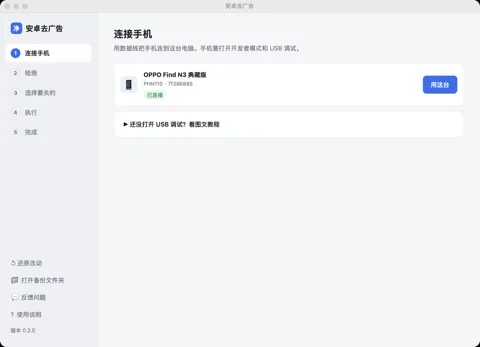
What it does
This tool adjusts advertising and marketing-notification settings on selected Android phones from Chinese manufacturers. It identifies a connected device and its OS, then presents proposed changes and outcomes using settings screens and notification-channel information. It changes exposed vendor-app switches, while suspending advertising components requires the device owner's consent. This is distinct from rooting, unlocking a bootloader, or deleting system apps. ADB connectivity and USB debugging are required, with desktop, AI-assisted, and manual-guidance options. Desktop packages do not require a separate Python installation or AI tool, but device connection and selecting changes remain necessary. Backups and partial restoration are provided, while switches inside apps must be restored manually following the guidance. Paths and validation coverage vary by model and OS version, so universal Android support or complete ad removal is not guaranteed. The README distinguishes packaged fixes from source-only changes, making release contents important to check.
License
MIT Permissive. Commercial use and changes are allowed if the copyright notice is kept.
More in this category
- designfuchen/word-atlas
Word Atlas is a web app for learning IELTS vocabulary through pictures and sound, with a reusable structured dataset. Learners answer recognition and spelling questions using word cards and examples, producing progress records and future review dates. Definitions, examples, British and American audio, and illustrations are connected through FSRS scheduling. Typing and dictation practice keep separate statistics without changing memory state. No account is required, progress stays on the device, and files support backup and restoration. Previously viewed material can be cached for offline review, but not every image or audio file is downloaded initially. Self-hosting requires Node.js 20 or later to build a static site, while JSON and CSV can be used separately. AI-generated material has automated checks but not complete human proofreading, and it is neither an official IELTS list nor a score guarantee. Code and learning content have different licensing terms, including attribution requirements for reused content. - ludovic111/horizon
Horizon is an unofficial game project reimplementing Minecraft Java Edition behavior in Rust. It prepares legally owned game files and worlds as inputs and produces gameplay and saved state through its native client. A launcher handles installation, updates, and resource preparation, but the project does not supply original game code or assets. Use requires the specified Minecraft version, a JDK for initial preparation, and appropriate graphics support for the OS. Its own mod system does not run Java mod files unchanged, and servers requiring Microsoft account authentication remain limited. For agents, horizon-ctl reads game state as JSON and returns results after movement or interaction, with a separately connected MCP mode. Control requires a running game and local communication, so installation does not automatically connect other AI products. Project-provided differential tests cover compared behavior, not proof of complete equivalence in every situation. This was document research, not independent execution, compatibility, or hardware-performance validation. - LiberNT/LiberNT
LiberNT is a ReactOS-derived operating system targeting Windows 11 compatibility for operating system and driver developers. NT means the kernel, driver model and system services behind Windows. Users supply applications and device inputs, while the system manages processes, files and display output. The source separates the kernel, hardware abstraction, drivers and user libraries, and its CreateProcessW implementation delegates process creation to an internal function. The README lists amd64, arm64 and riscv64 images, but compatibility is a development target, not evidence that arbitrary Windows software works. Testing starts with an ISO or preinstalled disk in a virtual machine or on spare hardware. Source builds use RosBE, CMake and Ninja on Linux, macOS or Windows through WSL2, with menuconfig selecting architecture and features. Connections are operating system interfaces rather than an AI service API, and the distributed Debug prereleases are explicitly unsuitable for a computer relied on for daily work. - OpenMili/aimili-vpngate
AimiliVPN manages VPNGate nodes on a Linux virtual private server and provides a proxy gateway. A proxy gateway relays internet connections through another server. It retrieves node lists, checks availability and lets users switch connections. A web dashboard provides node and connection management. HTTP, HTTPS website access through CONNECT and SOCKS5 share one proxy port. The Python application uses the standard library, while tunnel operation requires OpenVPN and Linux networking components. The default proxy listener is limited to the local machine. The README recommends an SSH tunnel for access from another device rather than exposing that listener publicly. Volunteer-operated exit nodes have no guaranteed availability, speed, privacy or logging behavior. - Renhuai123/ziwei-doushu
ziwei-doushu is a TypeScript engine and demonstration website for generating Zi Wei Dou Shu charts, a traditional Chinese divination system, with reference material based on Ni Haixia's Tian Ji teaching. It accepts a Gregorian birth date, a time-branch index and gender, with birth-location and time-correction information handled by related modules. The engine combines iztro and lunar-javascript with its own rule adjustments to produce a structured chart of palaces, stars and life periods. Supporting modules cover apparent solar time, leap-month conventions and configurable star-brightness schools, while the demo displays charts and classical texts. A Next.js environment with Node.js and npm is used, and ordinary chart generation runs in the browser without an AI API key. AI interpretation and compatibility-analysis API routes are not included, so adding a model key alone does not enable them. Interpretation datasets are distributed separately, but the production interpretation rule database, prompts and commercial interface are not included, and the checked database file is a placeholder. The README also notes differences between dataset and current engine conventions, and the materials inspected do not establish the scientific predictive validity of the divination interpretations.
Only repositories in the ranked Trendshift lists are included, and the lists are used only to find candidates. We do not copy their ranks. Descriptions, licenses and star counts come from each GitHub repository. The notes are our own reading. We have not tested these projects, and a place on a trending list does not prove quality.