jwangkun/claude-for-financial-services-cn
- Source
- GitHub
- First trending
- Category
- Skills
- GitHub stars
- 792
- Main language
- Python
This page introduces an external open-source repository. It is not an HDATF product.
What it does
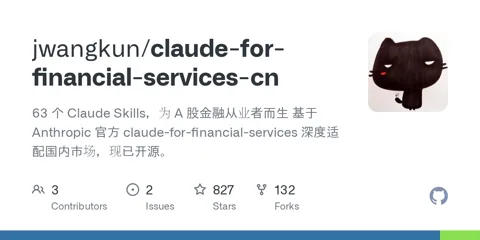
A set of Claude skills adapted for China's A-share financial market. It covers company valuation, financial statement models and research reports using local data sources, accounting standards and report formats.
License
Apache-2.0 Permissive, with a patent grant. Commercial use is allowed; keep the notices and state your changes.
More in this category
- AlphaGBM/skills
AlphaGBM Skills packages financial-research instructions and selected Python runners for use inside compatible AI workspaces. Users request stock research, options comparisons, news interpretation, report breakdowns, or comparison of supplied research snapshots. These packages are not one trading application, and method-reference packages do not expose a live data API. Callable packages include a Python 3.9 or newer runner, so skill installation and runtime preparation are distinct from connecting an AlphaGBM account. Published research reads can be public, while account-backed stock and options analysis requires a personal API key, permission to use the allowance, and applicable subscription access. Installing a package does not grant extra quota or access to private reports, and some workflow interfaces require a staged backend contract. Investment Review compares explicitly supplied, compatible versioned JSON snapshots locally without a key, network request, upload, or account-history access. Its output separates comparable changes, missing evidence, and judgments needing review; differing identities, versions, dates, or units can prevent meaningful comparison. Demo fixtures are not captured paid responses, research scores are not return guarantees, and these workflows do not place trades. - danyuchn/asd-ste100-skill
This Claude Code skill applies ASD-STE100 Simplified Technical English rules to ambiguous agent-facing English. It focuses on short sentences, consistent word meanings and one instruction per sentence. - earthtojake/text-to-cad
text-to-cad gives existing coding agents skills and a local runtime for creating mechanical CAD models. Users provide descriptions, dimensions, pictures, drawings or existing CAD files, and the agent writes editable Python design code. The code uses build123d and an Open CASCADE-based geometry kernel rather than a bundled text-to-3D model. Outputs include STEP for CAD exchange and GLB, STL or 3MF for viewing and downstream fabrication workflows. The plugin also supplies a viewer, engineering drawing workflows and guided design-for-manufacturing checks. Starting requires a compatible agent, uv and downloaded Python dependencies, with plugin and viewer requirements depending on the chosen client. Generation quality depends on the agent, and the manufacturing checks are guidance rather than certification. Re-exporting STEP can lose manufacturing annotations and geometric tolerances, while references to selected faces are valid only for the saved model version from which they were obtained. - nanaism/yomiyasu
An agent skill that rewrites AI generated Japanese into Japanese that reads naturally and carries more information per line. It targets practical documents such as technical articles, design and specification documents, pull request descriptions and internal reports, and is loaded into coding environments such as Codex, Claude Code and Cursor. The README argues that replacing banned words alone leaves the typical awkwardness in place. - chengyi-ai/native-subtitle-quote-image
This Agent Skill and its Python tools help content editors turn real video frames into quote images without confusing original subtitles with later additions. Inputs are an authorized local video or YouTube URL, selected timestamps, and optionally reviewed lines in JSON. Native mode crops and joins subtitles already burned into the video pixels rather than redrawing recognized text. Script mode draws approved lines on real frames and must be identified as added subtitles. Outputs include JPG images, the corresponding timestamp or line JSON, and a contact sheet for multi-image work. The workflow samples candidate frames, checks subtitle boundaries, composes the image, and requires visual review of each result. Getting started requires installing the skill in a compatible agent and separately preparing Python 3.10 or newer, Pillow, and imageio-ffmpeg or FFmpeg; the scripts can also run without an agent. YouTube acquisition additionally needs yt-dlp and a supported JavaScript runtime, while Chinese, Japanese, or Korean scripted text needs suitable fonts. Switchable subtitle tracks cannot become native subtitle pixels, and neither enlargement nor the MIT code license supplies better source detail or rights to third-party footage.
Only repositories in the ranked Trendshift lists are included, and the lists are used only to find candidates. We do not copy their ranks. Descriptions, licenses and star counts come from each GitHub repository. The notes are our own reading. We have not tested these projects, and a place on a trending list does not prove quality.