jamwithai/production-agentic-rag-course
- Source
- GitHub
- First trending
- Category
- RAG and search
- GitHub stars
- 10,206
- Main language
- Python
This page introduces an external open-source repository. It is not an HDATF product.
What it does
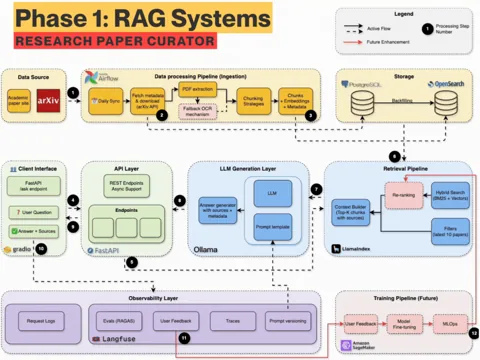
This course teaches engineers to build a research assistant using RAG, which answers questions with retrieved documents. It fetches arXiv papers and parses their PDFs with Docling. PostgreSQL stores paper information, while OpenSearch indexes searchable content. Retrieval combines BM25 keyword matching with vector search based on semantic similarity. LangGraph coordinates scope checks, document relevance grading and query rewriting before another retrieval attempt. Ollama generates answers from retrieved passages, with API, streaming, Gradio and Telegram access paths. The learning environment uses Python and Docker Compose with services including Airflow, Redis and Langfuse. Although generation uses a local model, Jina embeddings send passages and queries to an external API, and Telegram access uses an external service. This is a teaching implementation, and neither its relevance checks nor its development configuration establish production security or answer accuracy.
License
MIT Permissive. Commercial use and changes are allowed if the copyright notice is kept.
More in this category
- Immortal-Protocols/lastbook
Lastbook is an offline desktop knowledge library for people who need survival and rebuilding information when internet access is unavailable. It accepts a downloaded library pack or an existing data folder and offers curated guides, document browsing, search and questions grounded in that library. Its content can include PDF manuals, videos with transcripts, ZIM encyclopedias and offline maps, with page or timestamp links back to the underlying material. The assistant source combines keyword retrieval with optional semantic retrieval, fuses their rankings and limits repeated passages from the same document. Retrieved passages receive citation identifiers, and the answer handler checks that cited identifiers and referenced pages exist, which is not the same as proving that every statement follows from the source. The desktop application connects its web view to the Python engine through an in-memory bridge rather than a listening server port, while a separate library-server mode can serve a browser. Optional local AI needs a separately downloaded model and sufficient memory, and semantic search support differs by platform. The README describes macOS, Windows and Ubuntu builds, but the code repository does not include the third-party library, model files or complete map datasets. Downloaded material retains its own licensing terms, maps and manuals can become outdated, and local citations alone do not establish that advice is safe or complete. - NVIDIA/auto-ontology
Auto Ontology builds a shared meaning layer over enterprise databases so agents can interpret business terms before querying data. Developers connect source databases and ingest their table and column metadata. Business terms, relationships, and SQL expressions form a semantic catalog stored in Postgres with vector search support. Users ask questions in natural language, and the application generates SQL and executes it against connected sources. Results can include an answer, the SQL, and returned rows. The MCP interface exposes glossary lookup, answerability checks, and question answering through a restricted tool set. Deployment combines a web gateway, Python services, Postgres, and configured model endpoints. Starting requires database access, authentication settings, and inference credentials or equivalent configured endpoints. Generated SQL and answers still require validation, and database credentials added through the UI remain unencrypted in Postgres unless Vault is fully configured. - patchy631/ai-engineering-hub
AI Engineering Hub collects tutorials and example code for developers learning LLMs, document retrieval and agents. It is a collection of projects grouped by difficulty and topic, not one finished service or a proprietary model. Examples cover document question answering, image text extraction, chat interfaces and MCP connections. The inspected Simple RAG example reads documents from a folder, builds a retrieval index and generates an answer from relevant passages. Its notebook connects LlamaIndex, llama3.2 through Ollama and HuggingFace embeddings, then streams an answer based on two retrieved passages. That example requires Python 3.10 or newer, Ollama, a notebook environment and separately supplied documents. Other projects use different models, external services and credentials, so their individual documentation and configuration must be checked. Downloading the repository does not activate every feature, and this review does not establish production readiness or retrieval quality. - StarTrail-org/LEANN
LEANN is a vector index and retrieval toolkit for users who want to search local documents and records without retaining a full stored embedding for every text chunk. It supports retrieval augmented generation, which means finding relevant source passages before asking a language model to answer. Inputs include documents such as PDF, text, and Markdown files, or records handled by the supplied source specific examples; outputs include matching passages and optional model generated answers. The document example reads files recursively with LlamaIndex and splits their contents into chunks before indexing. Its low storage approach uses a pruned graph and selectively recomputes embeddings, numerical representations of meaning, when the search needs them, with HNSW and DiskANN backend options. It requires a Python environment, an embedding model or endpoint, and a generation model for answers; native builds and optional scanned PDF extraction add platform and OCR dependencies. Models can run locally or through cloud APIs, so privacy depends on both the embedding and answer generation settings rather than the location of the index alone. Recomputing embeddings trades storage against computation and query latency, while extraction failures and model choice can affect what is actually found. The README's storage savings are author reported results under particular comparisons, not a guarantee for every collection or evidence of performance on our data. - metadist/synaplan-nextcloud
Synaplan Integration is a connector app that adds document summaries, translation and knowledge search chat to the Nextcloud file interface. It targets organizations already storing documents in Nextcloud and hosting providers operating those environments. It sends a selected file or question to a connected Synaplan server and displays a summary, translation or streamed answer. Uploading files into knowledge groups makes them available for RAG, which retrieves relevant documents to inform answers. Text extraction from binary documents such as PDF and Office files is handled by Synaplan's Tika functionality rather than by this app itself. Getting started requires a supported Nextcloud version from 33 through 35, PHP 8.2 or later, a running Synaplan instance and a valid API key. Operators can share one account, provision individual accounts or link existing Synaplan accounts, with individual mode keys stored encrypted on the server. Personal memories and image or video generation depend on the corresponding services and model configuration on the connected server. Changed files require a manual update through the dialog, while documentation and source distinguish automatic watched-folder processing as not yet implemented.
Only repositories in the ranked Trendshift lists are included, and the lists are used only to find candidates. We do not copy their ranks. Descriptions, licenses and star counts come from each GitHub repository. The notes are our own reading. We have not tested these projects, and a place on a trending list does not prove quality.