yetanotherbrowser/yab
- Source
- GitHub
- First trending
- Category
- Agents
- GitHub stars
- 309
- Main language
- Swift
This page introduces an external open-source repository. It is not an HDATF product.
What it does
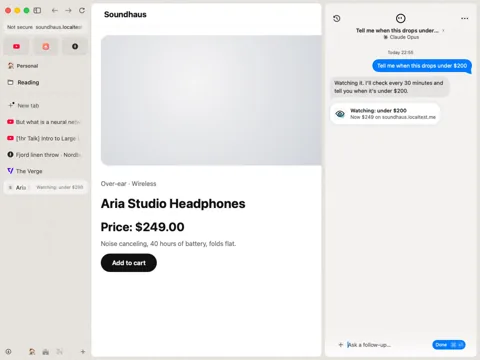
Yab is a browser for macOS with a companion iPhone app and agents that work in their own tabs. WebKit is the default page engine, while Apple silicon Macs can select Chromium per tab or site. A shared page interface hides engine differences, and Chromium pages run in a separate CEF helper process. Agents can use existing site sign-ins, but private tabs are excluded from their visibility and actions. Actions such as sending messages, uploading files and paying can require a person's approval, with eligible requests shared to other synchronized devices. Approval records bind answers to a request digest and expiry, rather than treating any later yes as valid. Optional synchronization stores encrypted records on the server, but pages read by an agent are sent to its model provider under that provider's terms. The README requires macOS 15.4 or later, and the architecture notes that some WebKit-only features have no Chromium path.
License
Apache-2.0 Permissive, with a patent grant. Commercial use is allowed; keep the notices and state your changes.
More in this category
- ysunyang4/Nexus
Nexus connects external AI clients to a local execution system through MCP, a protocol for calling tools. The repository retains LocalBridge names for internal packages and services. A desktop control center, HTTP server, and authenticated runner divide configuration, requests, and local execution. Its tools cover project files, Git, commands, browser operations, memory, and knowledge. Access settings distinguish read-only from read-write projects and separately control execution. The implementation separates MCP client, runner, and local management token types, while authorization must still be checked for each ingress route. An action ledger records execution and verification states for recovery, without establishing that every external side effect is reversible. The inspected decision-provider type offers disabled or Laya advisory operation, not arbitrary selection among hosted chat models. Documentation differs across the core server, bridge, and cloud gateway, and full-control mode expands the risk of local changes. - homeassistant-ai/ha-mcp
HA-MCP exposes Home Assistant management operations to AI clients through MCP, the protocol used to describe and invoke application tools. An AI client turns a user's request into structured tool arguments, and the server returns device states, histories, configuration data or operation results from the connected Home Assistant instance. Its tool registry covers device control as well as automation, script and dashboard editing and diagnosis from logs and execution traces. The inspected server initializes a FastMCP tool surface with visibility filters, optional search-based discovery and per-call enforcement rather than relying only on a model instruction to be careful. The recommended in-process integration requires a compatible Home Assistant installation, with the documented server setup floor at Home Assistant 2026.8.0, and an administrator account's access credential. Local and remote connection options differ, and a secret connection URL can itself be a credential that must be protected. Read-only connections hide and block writes, but the same credential can still access the normal endpoint, so this mode is not a separate credential-level permission boundary. Direct file and YAML editing are opt-in beta features, and backups and configuration checks do not eliminate semantic errors or the need for independent recovery access. Running the server locally does not guarantee local AI processing, because the selected MCP client can process Home Assistant data under its own privacy policy. This is a Home Assistant administration tool, not evidence of compatibility with industrial control systems or a guarantee that generated automation is safe. - Ebony-Vinyl/EAC-Desktop
EAC-Desktop is an application that packages DeepSeek Harness as a desktop workspace. It targets users who want conversations, project-file work, tool execution and plugin management around a project directory. Task requests, project files and model configuration feed a workflow in which Harness runs conversations and tools and the interface exposes file changes and results. Its documentation separates a Tauri window and tray shell, a Node sidecar for startup and environment orchestration, and a Harness agent kernel. Described capabilities include reviewing and reverting file changes, conversation compaction, model configuration and plugin-management entry points. Distribution packages prepare runtime resources, but model calls depend on the configured provider, while plugin activation and extra dependencies vary by package. The inspected environment adapter calls DPX environment creation, path and runtime-variable APIs to separate default data locations by release channel. This is not a filesystem sandbox: absolute-path access still depends on operating-system permissions, and third-party component licenses require separate checking. - metadist/synaplan-desktop
Synaplan Desktop connects a user's computer to a Synaplan workspace so that chat can lead to local file work. It takes requests, permitted files and installed Agent Skills and produces local artifacts such as reports, tables, calendar files and unsent email drafts. The native client uses Tauri and Vue and communicates with the server through pairing APIs and an Anthropic-compatible Messages gateway. A scoped pairing key is normally kept in the operating system's secret store. Local execution uses approved interpreters and structured program arguments, rejecting shells, network command-line tools and inline code. Skills needing unrestricted shell or network access do not run unchanged, and local Python or other required tools must already be available. The release is an unsigned preview for Windows, macOS and Linux, with signed public installers not yet published according to the README. Source inspection also shows that Windows timeout handling terminates the direct child rather than guaranteeing termination of its descendants, so isolation claims require separate validation. - skaft-software/octet
octet is a terminal coding agent for developers who want a native Rust runtime with cloud or local models. It takes prompts, source files and optional media and returns answers, file edits and command results. One process manages the agent loop, sessions, policies, persistence and terminal interface. Tools can be added through subprocess extensions, while MCP and subagents are optional integrations. Its first Pi-compatible release supports parts of the Pi extension ecosystem, but compatibility has documented gaps and arbitrary Pi transcripts are not imported. Sessions use append-only JSONL records with branches and checkpoints, and interrupted mutating calls are not automatically replayed. Model credentials and the chosen provider or local model must be prepared, and Windows support is still a preview. Full operating-system access is the default, and its approval-based safe mode is not a sandbox for commands or trusted extensions.
Only repositories in the ranked Trendshift lists are included, and the lists are used only to find candidates. We do not copy their ranks. Descriptions, licenses and star counts come from each GitHub repository. The notes are our own reading. We have not tested these projects, and a place on a trending list does not prove quality.