Usagi-org/ai-goofish-monitor
- Source
- GitHub
- First trending
- Category
- Data collection
- GitHub stars
- 18,180
- Main language
- Python
This page introduces an external open-source repository. It is not an HDATF product.
What it does
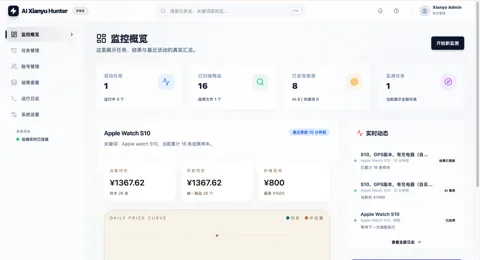
ai-goofish-monitor is a Web-managed system for monitoring listings on the Xianyu secondhand marketplace. It accepts search terms, prices, regions, schedules, account login state and either natural-language requirements or keyword rules. Playwright gathers listings, item details, seller information and images, while the analysis path applies a multimodal AI model or keyword matching. It stores tasks, results and price history in SQLite and can notify configured channels about recommended items. The Web interface manages tasks, accounts, criteria, logs and result browsing, with multiple tasks and scheduled runs. It needs a Python and browser environment or the provided container, plus an external image-capable model endpoint for AI analysis. Login cookies require protection, and AI analysis can transmit item and seller information to an external provider. Account and proxy rotation and automation-concealment behavior require platform-policy and security review, and neither reliable continued collection nor the accuracy of recommendations has been independently verified here.
License
MIT Permissive. Commercial use and changes are allowed if the copyright notice is kept.
More in this category
- developeryj1992/ai-trend-studio
AI Trend Studio is a local browser dashboard for people tracking AI topics and turning videos or live discussions into notes. It reads public Douyin, Bilibili, Weibo, and Zhihu signals, filters them by configurable keywords, and supports Bilibili keyword search. Users import descriptions, comments, transcripts, or SRT and VTT subtitles, and available public Bilibili subtitles can be fetched. Live sessions store user-entered speaker events rather than automatically recognizing audio or identifying speakers. Outputs include conclusions, key points, actions, risks, keywords, and a JSON workspace export. A Chinese extractive summarizer scores sentences locally, while an optional OpenAI-compatible Chat Completions endpoint can generate summaries and receives the submitted content. The Python 3.10 or newer standard-library server and static frontend start on localhost port 8765 and store state, including configured API keys, in data/db.json. Public interfaces can fail or change, protected content requires authorized input, and exposing the server requires additional authentication and transport protection. - punitarani/fli
Fli is a library for querying Google Flights information from software. Its main users are developers building travel search and conversational assistants. Inputs include origin and destination airport codes, dates, passenger counts, cabin class and stop preferences. It returns prices, durations, airlines and departure and arrival details for individual legs. It provides a Python library, a command line interface and an MCP server, using the standard through which AI calls external tools. Although the introduction emphasizes direct API access, the current implementation fetches search pages and decodes the flight data embedded in them. Getting started requires Python 3.10 or later and the flights package, with separate optional dependencies for MCP. The current transport cannot perform multi-city searches or retrieve booking options, and some filters, including baggage, are unsupported. Date searches fetch one page per date and cover at most 93 dates per call, so an empty result does not establish that no flights exist. - Thysrael/Horizon
Horizon is an MIT-licensed Python tool that collects news and posts from many sources, has an AI model score and filter them, and writes a daily Markdown briefing. It is for people who want only the items worth reading from many feeds, forums and timelines, with background and community discussion attached. Sources include RSS, Hacker News, Reddit, Telegram, X, GitHub, GDELT and Google News, and collecting X needs an Apify account and token or, in Playwright mode, exported login cookies. Each item goes to a profile such as tech-news or tech-blog, whose Markdown prompt gives it a score from 0 to 10 against a rubric. Items below the threshold are dropped, repeated topics are merged within a profile, and category limits keep one topic from taking over. Selected items get background and summaries through a web search tool (the ddgs library) and a local BM25 search over past briefings, and cited sources must come from tool results. Models can come from Anthropic, OpenAI, Gemini, DeepSeek, a local Ollama server and others, and keys are read from environment variables. Output is English when no language is set, the setup wizard proposes Chinese and English, and briefings go to GitHub Pages, email, webhooks such as Slack, or WeChat. Getting started means installing with uv or Docker, setting up with horizon-wizard and running uv run horizon, and a stdio MCP server provides the pipeline stages, run records and webhook sending as 13 tools (the README table lists 12). The past briefing search indexes only Latin-script words and two-character Chinese tokens, so Korean words are not matched, and there is no GitHub release or PyPI package yet. - psf/requests
A Python library for HTTP requests. It supports JSON data, authentication, persistent cookie sessions, file uploads and connection timeouts. - bojieli/greenbubbles
A Mac command line tool that reads the owner's own WeChat history from the database files WeChat already keeps on that Mac, so a coding agent can search those chats or turn chosen conversations into notes that cite the original messages. Setup copies a key out of the user's own WeChat app and needs administrator access. The README calls the project a research alpha and states that it requires Apple silicon and macOS 14 or later.
Only repositories in the ranked Trendshift lists are included, and the lists are used only to find candidates. We do not copy their ranks. Descriptions, licenses and star counts come from each GitHub repository. The notes are our own reading. We have not tested these projects, and a place on a trending list does not prove quality.