Tencent/LoopForge
- Source
- GitHub
- First trending
- Category
- Workflow
- GitHub stars
- 3,803
- Main language
- Go
This page introduces an external open-source repository. It is not an HDATF product.
What it does
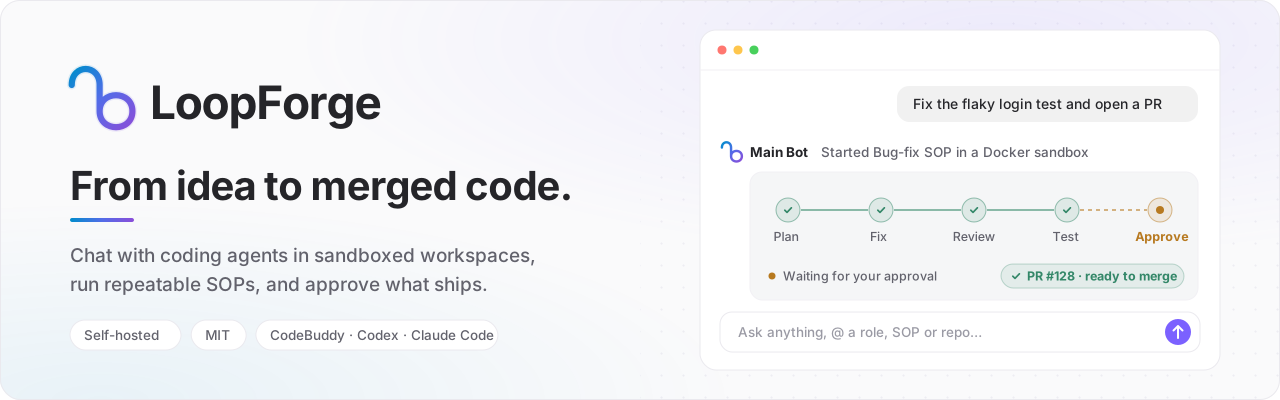
LoopForge is a self-hosted workspace that coordinates coding agents, scripts and human approval for software delivery. Users provide requirements through chat or reusable SOPs, meaning standard workflows with defined roles and checkpoints. Main Bot can prepare a repository workspace and delegate work, while SOP nodes organize agent execution, deterministic scripts, approvals and nested workflows. Outputs include documents, code, pull requests, logs and artifacts associated with each requirement and run. The Go platform separates graph execution and sandbox lifecycle from MySQL persistence, executor adapters and the embedded web interface. The inspected graph code starts pending nodes only after their dependencies succeed, retains workflow snapshots and rejects cyclic dependency graphs while allowing designated rework paths. Platform operation uses Docker and configured model credentials, with repository authorization needed for delivery to a Git host, while the separate Local edition provides built-in workflows inside coding assistants. The documentation limits the default installation to trusted teams because Docker socket access controls the host daemon and signed-in users can read project data across the instance.
License
Custom license Custom or non-standard license. Read the license file before any reuse.
More in this category
- CzzzzzzJ/mdldm-maitian
Maitian is a publishing and analytics workbench for creators distributing the same video across multiple social platforms. It reads a publishing project containing a video, covers, platform-specific copy and a schedule. A separate Chrome extension fills platform forms through an already logged-in browser, while the hub records tasks and publication links in SQLite. The README covers Bilibili, Douyin, Xiaohongshu, WeChat Channels, YouTube, X and Instagram, plus an optional owner-operated site. In the default configuration, the four Chinese platforms stop after form filling and require the user to click final publication, and the hub source confirms the awaiting_user branch. Supported automatic channels have separate submission and duplicate checks, so it is not unrestricted automatic posting to every platform. It also collects account metrics, provides a dashboard and sends Feishu notifications, while site conversion data requires custom interfaces. The main environment is an always-on Mac with Node.js 22.5 or newer and Chrome, with a contributed Windows path lacking startup integration, and browser sessions, extension updates and platform changes remain operational dependencies. - getarcaneapp/arcane
Arcane is a self-hosted web interface for operators who want to manage Docker containers and Compose projects without handling every operation through a shell. It takes Docker host connections, Compose YAML, environment variables and project files as inputs and displays resource state, operation results and container logs. Its container client exposes creation, start, stop, restart, update and log download operations against an environment-specific API. A Compose project is treated as a directory containing the Compose file and related files, which the interface can save and deploy together. The inspected Go backend builds a Docker CLI client and a Docker Compose service, supplies registry credentials and routes operation output to progress logs. The documented deployment needs Docker Engine and Compose, access to the Docker socket or a restricting socket proxy, persistent application storage and correctly mapped project directories. Application metadata uses SQLite by default with an external Postgres option, and the documentation also describes remote agents for other hosts. The README identifies the main branch as version 3, so branch features should not be assumed to match an older release, and container control does not by itself provide a security boundary against the Docker host. - trypostit/trypost
TryPost combines a social publishing web application with interfaces for agents and automation scripts. It targets teams managing several brands or channels that need drafts, a publishing calendar, queues and review before publication. Inputs include post text, media, a connected social account, content type and a schedule or queue choice, with structured post records and publishing states returned to callers. The inspected MCP create tool validates the current workspace, applies shared posting rules and delegates creation to the same application actions. Policies check workspace boundaries and approval permissions, and queued jobs hand publication to platform specific processing. Official documentation distinguishes workspace bound OAuth for MCP from administrator API keys for REST, whose posts are not held for member approval. The PHP application depends on Laravel and related queue and authentication components, while actual publication also needs connected network accounts and their APIs. The documentation explicitly says MCP and REST do not generate post text themselves, so the README's broad parity claim does not mean every web feature or channel setup action is exposed to agents. - bex-co/beancount-io
Beancount.io builds accounting workflows around plain-text Beancount ledgers, using double-entry records that balance corresponding account movements. The repository contains a web dashboard, mobile clients, a command-line interface, backend services and agent skills. Local command-line and skill workflows do not require its hosted service. Agent guidance covers statement import, duplicate review, reconciliation, financial queries and month-end close. MCP exposes ledger queries and editing to external AI clients through a standard tool interface. The inspected tool registry distinguishes read-only queries from writes and includes preview and post-write validation paths, but some operations apply immediately. Its first-month example separately checks approval refusal, repeat imports, missing statements and unresolved discrepancies. That example uses a synthetic ledger, so successful file validation alone does not establish agreement with a real bank statement or compliance with a particular accounting regime. - BLCK-N/Assignment-Reviewer-AI
Assignment Reviewer AI is a terminal teaching example for scoring one answer to a fixed question about supervised and unsupervised learning. It targets learners studying how model evaluation, structured outputs and conditional workflow branches fit together rather than schools needing a complete grading product. A user enters a single line, and the program sends the answer and rubric to a Groq hosted model through LangChain. A Pydantic schema constrains four component marks, whose total produces a suggested score out of ten and feedback. The inspected LangGraph routes totals from four through six to a teacher review node and all other totals to a finish node. Teacher review only sets a displayed status string and does not create a saved queue, wait for a teacher or record a decision. The README specifies Python 3.11 or 3.12, the requirements include LangChain, LangGraph, LangSmith and dotenv, and a Groq key plus network access is required for inference. Optional LangSmith tracing can record prompts and answers, and although HTML templates remain in the tree, the inspected app has no web server or file upload route and the README does not claim live API testing in its packaging environment.
Only repositories in the ranked Trendshift lists are included, and the lists are used only to find candidates. We do not copy their ranks. Descriptions, licenses and star counts come from each GitHub repository. The notes are our own reading. We have not tested these projects, and a place on a trending list does not prove quality.