Orkas-AI/Orkas
- Source
- GitHub
- First trending
- Category
- Agents
- GitHub stars
- 7,708
- Main language
- JavaScript
This page introduces an external open-source repository. It is not an HDATF product.
What it does
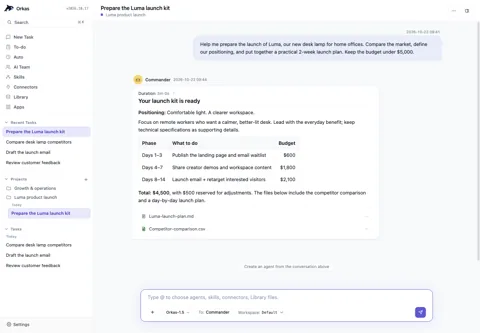
Orkas is a desktop application for people who want AI agents to carry ongoing project work from a goal to reviewable results. It takes requests and project files and produces work such as reports, office documents and code. A Commander can delegate to named specialists, hand over a reply, or request an isolated anonymous worker. The inspected source defines separate concurrency limits and session locks rather than allowing unrestricted simultaneous execution. Project context persists across conversations, while the Library exposes file listing, passage search and source reading for global or project documents. The source setup requires Node 22.12 or later and a supported desktop system, with Python and a C/C++ toolchain needed for some native dependency builds. Users connect their model provider credentials or a local compatible endpoint, and external CLI agents require their own installed environments. Local storage does not mean cloud model requests stay on the computer, and collaboration, cloud synchronization and web publishing are not included in the open-source build.
License
MIT Permissive. Commercial use and changes are allowed if the copyright notice is kept.
More in this category
- nightly-labs/openbot
This OpenBot is a local-first desktop workspace for people coordinating persistent AI teammates, and is unrelated to the CopilotKit OpenBot foundation used by OpenDuet. User requests and attached files enter separate agent conversations and workspaces, producing replies, files and delegated work. It connects local Codex and Claude runtimes and additional providers through ACP, a common protocol for connecting agent clients and runtimes. Electron owns the local processes and browser host, a SolidJS interface presents work, and SQLite stores the command log and derived views. Persistent message queues, agent messaging, managed file transfers and shared channels support continued work beyond a single chat turn. Queue control code distinguishes ordinary waiting messages from channel-owned tasks, and checks the active session before steering a message into running work. Packaged releases support macOS, Windows and Linux and use a supported provider runtime and its authentication, while source development additionally requires Bun 1.4.2 and Node.js 24. Local-first does not mean offline, because provider requests, visited pages and optional services can use external networks. The README and security policy describe a development preview with unrestricted agent execution and no routine per-action confirmation after initial consent, so separate workspace folders do not establish host isolation. The current license is PolyForm Noncommercial 1.0.0, and the README states that commercial use requires a separate license, making company adoption a permission review rather than an assumed open-source entitlement. - ryoiki-tokuiten/Deepthink
Deepthink is a multi-agent exploration application for researchers and developers who want to compare different approaches to a difficult problem rather than accept one generated answer. It takes a problem and optional attached files, then produces candidate solutions, critiques and a selected final result. A strategy generator exchanges proposals with a proximity reviewer to reduce overlap before branches start. The implementation runs branches in parallel, waits at iteration boundaries, and repeats solution correction followed by separate critique. Optional periodic module work isolates smaller uncertainties, gives them to independent tester agents and routes their findings to relevant branches. Global updates can retain, evolve, roll back or replace branches, while compact memories preserve lessons and a final judge compares surviving results. A separate Adaptive Deepthink mode lets an orchestrator choose the next work pass without the fixed schedule or separate final judge. The repository supplies a Node.js based React and Vite application, provider configuration for API credentials or compatible endpoints, and an optional execution backend with sandbox settings that must be prepared separately. Its Vite configuration substitutes provider environment values into client definitions, so secret handling and exposure require review before shared hosting. More branches and iterations mean additional model calls, and neither a model judge nor the documented sandbox establishes independently measured accuracy or production security. - CopilotKit/OpenDuet
OpenDuet is a self-hosted proactive assistant template for people who need help prioritizing mail, preparing their day and following up on work. Connected mail, calendar information and user requests become morning briefs, task cards, drafted materials and actions submitted for approval. It builds on CopilotKit's OpenBot platform, not the unrelated nightly-labs/openbot desktop project. The server combines triage and routines with the CopilotKit runtime, and can connect agents through AG-UI, a protocol for exchanging agent interaction events. Each agent can use a container with its own browser, files and shell, while granted MCP connectors provide access to external applications. The documented gateway checks policy and records actions, and the policy source resolves conflicting rules toward stricter handling and requests approval when automatic review fails. The same source requires human handling for recognized credential changes, security changes and payments, so an approval screen does not mean unrestricted automatic execution of sensitive work. The documented starting environment needs Docker, Bun 1.3 or newer, Node.js, a model key, PostgreSQL infrastructure and a required CopilotKit Intelligence project for conversation threads and memory. Gmail and Calendar additionally require administrator OAuth configuration and each person's account connection, while agent instructions, skills and model settings live in a tenant package. This is an early project without a published OpenDuet hosted deployment guide or image, and self-hosting does not remove its required Intelligence service dependency or independently establish security. - google-gemini/gemini-cli
Gemini CLI is a terminal based AI agent for developers working with code and operational tasks. It receives natural language prompts and project context, then can return explanations or use tools to inspect files, change code and invoke shell commands. MCP servers can supply additional tools, while GEMINI.md files provide persistent project instructions. Headless mode returns text, a JSON response with usage statistics, or streamed events for tool requests and results. The package requires Node.js 20 or later and a supported Google login, Gemini API or Vertex AI authentication setup. Sandboxing can restrict execution, but requires platform appropriate setup and does not eliminate every risk. The current README says unpaid tier and Google One users moved to Antigravity CLI on June 18, 2026. It also warns that Gemini CLI is not optimized for the latest Gemini models, specifically Gemini 4 Argon, and directs those users to Antigravity instead. - milind-soni/OpenMausBot
OpenMausBot is a local-first agent application that manages several AI runtimes through one chat interface. Developers and individual users assign models and working folders to bots and request work in natural language. Conversations display file work, runtime events, approval questions and results. Official documentation describes a local harness server that owns agent processes and normalizes their events. Desktop releases embed that server, but agent CLIs and their authentication must be set up separately. Source execution requires Node.js 24 or newer and pnpm, with engines such as Claude, Codex or Grok connected. Boat cloud computers and Composio app connections require their own accounts or configuration and are not all activated by installation. An external MCP client can inspect teams and dispatch work but cannot grant approvals, delete data, change credentials or manage computer lifecycles. Local storage does not mean processing without external transmission, and Ubuntu Wayland host control is disabled. The main code uses Apache-2.0, while the enterprise directory has separate terms.
Only repositories in the ranked Trendshift lists are included, and the lists are used only to find candidates. We do not copy their ranks. Descriptions, licenses and star counts come from each GitHub repository. The notes are our own reading. We have not tested these projects, and a place on a trending list does not prove quality.