MapleTechLabs/maple
- Source
- GitHub
- First trending
- Category
- Workflow
- GitHub stars
- 1,875
- Main language
- TypeScript
This page introduces an external open-source repository. It is not an HDATF product.
What it does
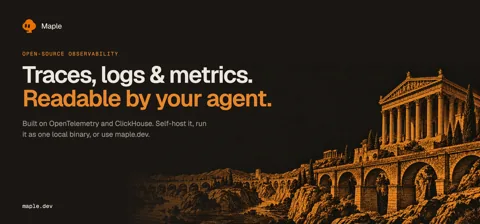
Maple is a platform for developers and operators investigating service failures and slow requests. It accepts traces, logs and metrics through OpenTelemetry, a standard for collecting application execution data. Users can inspect request waterfalls, search logs and explore metrics together. Hosted MCP access also lets compatible AI clients query telemetry. Its local mode combines an ingest server, query API and dashboard in a Bun binary that loads the embedded ClickHouse library chDB. Starting locally requires a supported macOS or Linux bundle and its companion library, while sending data requires an instrumented application or collector. Local mode is single tenant, and an unclean shutdown can require restoring a checkpoint with loss of later telemetry. The current license is FSL-1.1-ALv2, which restricts competing commercial services and provides a future Apache 2.0 grant rather than unrestricted Apache licensing today.
License
Custom license Custom or non-standard license. Read the license file before any reuse.
More in this category
- hugoj0s3/NaturalCron
NaturalCron is a C# library for defining recurring schedules in readable expressions. It targets developers adding periodic jobs or recurring reminders to .NET apps. Inputs are its defined English-like scheduling syntax or a builder that assembles conditions through code. It parses expressions into time-unit rules and calculates the next occurrence or multiple occurrences after a reference time. It supports weekdays, time ranges, exclusions, IANA time zone identifiers and developer-defined conditions such as holidays. The library only identifies execution times, so actual job execution, persistence and retries belong to a separate hosting service or scheduler. Getting started requires a compatible .NET project and the NaturalCron package, whose project targets .NET 8 and .NET Standard 2.0 and depends on TimeZoneConverter. An optional package generates traditional cron strings, but time zones, exclusions and custom keywords cannot be fully converted. It is not an AI that understands arbitrary Korean requests, and official documentation also forbids concurrent use of the same parsed expression instance across threads. - AhmadHassan-BTed/Jantt
Jantt is a TypeScript project timeline engine for teams and AI-assisted planning tools that exchange plans as JSON. Inputs describe tasks, dates, categories, dependencies and optional progress, milestones or baselines. It renders an interactive Gantt chart and returns changed plan data when a user commits an edit. The validator checks dates, identifiers, dependency references and cycles, while a separate resolver shifts successor dates according to prerequisite finish dates and gaps. In the inspected implementation, date propagation uses a bounded repeated pass and leaves locked tasks unchanged. React and standalone browser surfaces are provided, and a separate Node.js CLI supports local JSON file interaction. Starting requires a valid plan document and a compatible host surface, while cloud collaboration adds separate authentication and infrastructure requirements. JSON generation does not guarantee a feasible business plan, and the inspected core package declares fflate despite the README claiming zero runtime dependencies. - ai-job-search-dev/ai-job-search
AI Job Search is a file-based job application workflow built around Claude Code for individual job seekers. Inputs are a verified career profile, supporting documents and a job posting supplied as a URL or text. Portal skills collect opportunities, and evaluation criteria compare postings with the candidate before drafting begins with approval. A drafting agent produces tailored application documents, while a separate reviewer critiques them before revision. The workflow compiles CV and cover-letter PDFs and inspects layout and extractable text instead of stopping at source files. Local files also hold application status and submitted materials for later outcome tracking and interview preparation. Starting requires agent access, Python, Bun and the relevant document compilation tools, while the bundled portal integrations focus mainly on Denmark. Sensitive profile data can enter tracked files, local execution still involves model services, and the documented prompt-injection defenses are not a sandbox. - twentyhq/twenty
Twenty is a customizable CRM, meaning software for organizing customer relationships and related business records. It targets technical teams that need to adapt customer data models and workflows as their business changes. Users enter and maintain business records, while developers can define objects, typed fields, views, and other app components in TypeScript. Its app workflow turns source definitions into changes on a running Twenty server, making those definitions visible in the workspace interface. The repository describes workflows and agents alongside CRM features and supplies dedicated skills for app development and workspace access. Self-hosting uses separate server and worker services with PostgreSQL and Redis, rather than only a browser interface. App development requires a running instance, authorized workspace access, and the documented Node.js and Yarn environment, with Docker needed for the local server route. Existing CRM capabilities do not establish ready-made MES or ERP integration, and operating the service still requires attention to access control, data changes, backups, and applicable license terms. - omacom/gliff
gliff is a remote desktop product for viewing and controlling another machine's Hyprland session over SSH. It targets Linux users and developers running Hyprland at both ends. Remote screen content is displayed locally while keyboard and pointer input travels back to the host. It can mirror an existing display or create a private display lasting for the connection, and it supports clipboard transfers of text, images, and files. The architecture describes splitting colour information across two H.264 streams and recombining it to preserve coloured text detail. AMD and Intel systems with Vulkan and VA-API use a GPU path; unsupported environments and NVIDIA use a CPU path whose default colour quality can differ. Both ends need installation, SSH access, and a running remote Hyprland session, but no separate relay service. It adapts quality on slow links without eliminating TCP stalls on high-latency, lossy connections. The direct development connection mode lacks authentication, and displays wider than 4096 pixels may be streamed at reduced size.
Only repositories in the ranked Trendshift lists are included, and the lists are used only to find candidates. We do not copy their ranks. Descriptions, licenses and star counts come from each GitHub repository. The notes are our own reading. We have not tested these projects, and a place on a trending list does not prove quality.