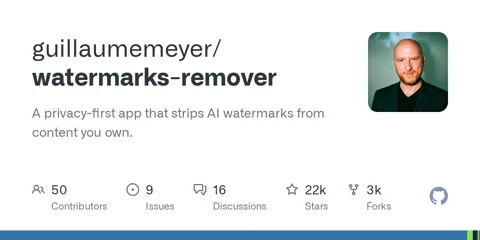
guillaumemeyer/watermarks-remover
- Source
- GitHub
- First trending
- Category
- Security
- GitHub stars
- 22,181
- Main language
- Python
This page introduces an external open-source repository. It is not an HDATF product.
What it does
An agent skill plus a Python service that strips AI provenance marks from content you own, such as invisible Unicode characters, statistical text watermarks and C2PA, EXIF or XMP metadata in files. The skill calls the service over HTTP.
How it helps ATF
The split between a thin agent skill and a separate HTTP service could be a reference for how Harness packages skills. The watermark removal itself is only loosely related to our products.
License
MIT Permissive. Commercial use and changes are allowed if the copyright notice is kept.
More in this category
- NationalSecurityAgency/ghidra
Ghidra is a software reverse engineering framework created and maintained by the NSA Research Directorate. It analyzes compiled code with disassembly, decompilation, graphing and scripting, and supports many processor instruction sets and executable formats. - openai/codex-security
Codex Security is a CLI and TypeScript SDK from OpenAI for defining security policy and for finding, validating and fixing vulnerabilities in code. It can also draft a SECURITY.md to guide later scans. - cloudflare/security-audit-skill
A coding-agent skill that runs a six-phase security audit of a repository. Isolated agents map the architecture, hunt for issues and try to disprove each candidate, and results are written as schema-validated findings and reports. - usestrix/strix
Strix runs AI agents that test an application the way attackers would: they execute the code, look for vulnerabilities and confirm them with working proofs of concept. It offers a CLI, multi-agent orchestration, suggested patches, reports and CI/CD use. - scadastrangelove/awesome-ai-security-tools
A curated catalog of public-source, research, and commercial tools for AI security and AI-assisted cybersecurity. Topics include agent security, supply-chain security, scanners, runtime protection, and evaluation frameworks.
Only repositories in the ranked Trendshift lists are included, and the lists are used only to find candidates. We do not copy their ranks. Descriptions, licenses and star counts come from each GitHub repository. The notes are our own reading. We have not tested these projects, and a place on a trending list does not prove quality.