google/elephant-goldfish-model
- Source
- GitHub
- First trending
- Category
- Skills
- GitHub stars
- 11,303
- Main language
- Python
- Website
- egm.dev (opens in a new tab)
This page introduces an external open-source repository. It is not an HDATF product.
What it does
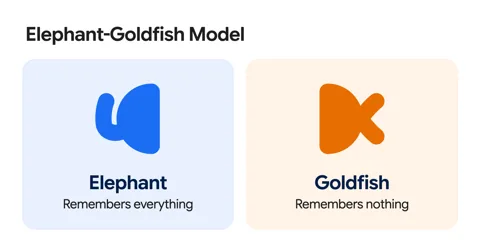
Elephant-Goldfish Model is a coding-agent plugin for teams that need to clarify design decisions before implementation, not a new language model. It takes requirements, design drafts and referenced source material and produces concept briefs, specifications and review reports. An Elephant keeps the project context, while Goldfish reviewers examine supplied documents without the earlier conversation. Review instructions separate broad architectural concerns, comprehension, design criticism and implementation readiness, with people deciding which findings to address. A separate skill compares design documents with referenced code and reports differences rather than silently repairing them. The plugin uses its host's models and permissions and requires the complete skills, reviewer personas and document standards, not just a copied skill file. Supported sessions must actually expose fresh subagent contexts for review, and the review stops when that capability is absent. The published verification record distinguishes tested local workflows from unresolved cloud trace checks, and the project explicitly does not replace tests or human judgment or constitute an officially supported Google product.
License
Apache-2.0 Permissive, with a patent grant. Commercial use is allowed; keep the notices and state your changes.
More in this category
- unclebob/ub-mode
ub-mode is an instruction skill for developers using coding agents, not a standalone application or model API. It addresses code changes that appear complete without demonstrating behavior, controlling complexity or examining weak tests. Inputs are a change request and repository context, while intended outputs are verified small changes and an explanation of the work. Its workflow starts with a failing test and a minimal working change, then calls for root-cause repair and behavior-preserving restructuring. The skill links separate tools for complexity and coverage, structural duplication, and mutation testing, which deliberately changes code to see whether tests detect the change. The skill's CRAP limit combines complexity and test coverage, and its duplication rule is a project policy rather than proof that similar code is wrong. Use requires a compatible agent skill loader plus separately available tools and the target project's test environment; the companion mutator declares Python 3.11 or later. Loading the text alone does not install or execute those tools, and neither metric thresholds nor agent instructions establish correctness or safe permission handling. - t3dotgg/tstack
tstack is a collection of skills for coding agents that organize the work between a requested change and a reviewed GitHub pull request. It targets Claude Code and Codex users who want repeatable review, handover and PR monitoring procedures rather than a separate hosted service. Inputs are a change request or an existing branch or PR, and outputs include the changed code, verification evidence, review results and a PR handover or authorized merge. full-send links implementation, proof, sol-loop review, PR creation and CI monitoring, whereas full-stop ends with an open, unmerged PR for a person to handle. The documented merge gate checks the latest commit's evidence, required checks, review findings, branch freshness and mergeability. babysit-pr distinguishes T3 Code's watcher from the alternative pr-wait tool and requires bot findings to be checked against source before changing code. The README requires authenticated GitHub CLI access, python3 for pr-wait and access to other providers' models for council or sol-loop. These are editable workflow instructions, and model agreement or a watcher notification is not proof of correctness or permission to override an organization's approval policy. - huaizhuanghub/dsh-persona-dafeiyu
This is a persona library plugin for DeepSeek Harness, not an independent AI model. Users choose bundled personas or import their own through Markdown, text files or pasted text. The selected body becomes a separate system prompt section, with changes taking effect on the next request. It supports profile-wide, workspace and session scopes, preferring more specific selections. Settings offer renaming, enabling, deletion, export and body inspection, with editing and deletion restricted for bundled entries. Bodies are fetched individually on demand rather than included in normal status metadata. It requires Node.js 20 or newer and DSH, with the npm package added to the intended profile. Global and workspace choices persist, but session choices stay in memory and disappear after restart. Switching personas needs no restart, while plugin code updates require restarting or refreshing the client. It does not manage execution permissions, and UI slot compatibility depends on the host version. - morganlinton/BeautifulRust
BeautifulRust provides three skills and lint configuration for coding agents writing, reviewing, or porting Rust. It is an agent-guidance plugin, not a standalone compiler or Rust model. Inputs include implementation requests, existing files or diffs, and source code with tests from another language. Outputs include Rust implementations, prioritized review reports with rule references and locations, or porting records mapping tests and deliberate differences. Review guidance separates error handling, public API design, ownership, and safety issues and supplies concrete fix examples. Porting guidance moves existing tests first to check behavioral differences. It must be connected as a Claude Code plugin or installed in a supported agent's skill location; installing skills does not enable project CI checks. Separate lint configuration must be incorporated into Cargo and run with a Rust toolchain to enforce machine-checkable rules. Small project-run evaluations do not guarantee correctness or defect removal across projects, so generated output and real tests still need review. - github/lever
Lever is a Copilot plugin and skill collection for measurable improvement loops in coding agents. Developers describe problems such as slow tests and receive a planning card. A Loop Card records metrics, measurement instruments, unchanged-run noise, baseline values, acceptance criteria and stop rules. Other skills cover experiments against controls, runnable briefs, divided refactoring work, PR review and progress reporting. It is installed in Copilot, with read-only card creation available in a new session. Personal and repository settings define autonomy and model-spend levels, subject to repository protections. Moving repeatable work into automations requires GitHub MCP tools; automations are created paused and tested before activation. Installation does not itself start universal automatic merging or scheduled execution. The project identifies itself as early, and useful improvements and safe delegation still depend on real instruments and permission settings.
Only repositories in the ranked Trendshift lists are included, and the lists are used only to find candidates. We do not copy their ranks. Descriptions, licenses and star counts come from each GitHub repository. The notes are our own reading. We have not tested these projects, and a place on a trending list does not prove quality.