Folkbench/folkbench
- Source
- GitHub
- First trending
- Category
- Coding tools
- GitHub stars
- 3,633
- Main language
- TypeScript
This page introduces an external open-source repository. It is not an HDATF product.
What it does
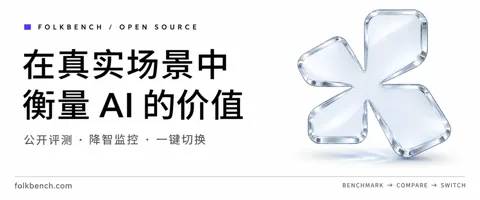
This project combines public comparison material and connection configuration tools for developers choosing AI API relays. Its website publishes model-specific snapshots of availability, stability, response latency and cost. The separate Switch desktop app takes service URLs and API keys and applies them to local settings for tools such as Claude Code, Codex and Gemini CLI. Users can preview configuration differences and save named combinations of connections across tools. The public profile types also show per-tool service selections and applied or skipped results. Use requires the target tools and relay accounts, while the comparison website and service requests require network access. The README states that rankings include partnership levels and operational weighting and that some data is illustrative. Public rankings therefore are not independent performance verification, and not every website evaluation feature belongs to the app.
License
Custom license Custom or non-standard license. Read the license file before any reuse.
More in this category
- INK-Q/agy-fast
agy-fast is a local MCP plugin for developers who want to batch repeated code exploration and editing calls in Antigravity. Its tools accept multiple searches, partial file reads, edits and checks and return compact results. A startup snapshot summarizes the workspace, and a persistent standard-input/output server handles composite operations. The inspected editing source validates multi-file plans in memory before writing and distinguishes its default mode from partial-success mode. It reports verification commands separately, so successful writes are not treated as passing tests. Preparation requires Antigravity and Node 20 or later, with ripgrep documented as optional. The README describes official plugin interfaces without changing native UI or safety checks, but the complete runtime behavior was not tested here. Advertised token and latency reductions come from the author's particular session comparisons rather than general guarantees. - moznion/cccc
cccc is a Rust tool and library measuring cognitive and cyclomatic source-code complexity. It targets developers prioritizing review of complicated functions. Files or directories become per-function scores, source locations and aggregate summaries in JSON or tables. Language parsers lower code into a common intermediate representation, and the core engine scores branching and nesting. Nested functions are measured separately, and configured thresholds can cause a failing exit. It uses supported-platform binaries or a Rust build environment, without requiring an external AI service for measurement. Official examples show mixed-language directory analysis and CI thresholds. Files with parse errors may still produce partial measurements, so error totals must also be read. Scores alone do not establish bugs, security or actual maintenance cost, and speed comparisons were not reproduced here. - mjwsolo/localcode
LocalCode is a coding agent for developers who want models to process project code on their own Mac. A project directory and a natural-language request lead to file edits, command execution and reported inspection results. A Python launcher connects a local model server to a modified opencode interface and tool environment. Models are downloaded from Hugging Face and loaded locally, and an OpenAI-compatible endpoint can also serve another local application. Plugins retain unfinished tasks, detect incomplete edits and interrupt repetitive failures to support smaller models. The inspected server plugin enables its own automatic build and test execution only when LOCALCODE_AUTO_CHECK=1, rather than making every documented check unconditional. The supported environment is an Apple Silicon Mac with macOS 13 or later, at least 16 GB of unified memory, Python 3.10 or later and space for the selected model. Local inference does not prevent networking through downloads, search, page fetching, MCP connections or shell commands, and command permissions are not a sandbox. Performance claims were not reproduced, and model licenses require separate review, particularly the documented noncommercial terms for OpenJev. - erkamyaman/rust-anything
rust-anything helps developers migrate source code to Rust while comparing its behavior with the running original. It supports incremental work on command-line applications, HTTP servers and libraries in languages including TypeScript, Python, C, Go, Ruby and Java. Inputs include the original source, runnable workloads and recorded or supplied cases, while outputs include migration plans, binding scaffolds, behavior recordings and mismatch reports. It profiles workloads, generates a bridge so existing callers can reach Rust, and replays the original's results against the new implementation. The developer or coding agent writes the Rust implementation; this tool is not an automatic code translator. A validation gate combines formatting, Rust code checks, tests, implementation checks and replay of recorded behavior. It runs locally with Rust and the original language's runtime, while dependencies may be downloaded and an optional coding agent's model provider has its own data policy. Passing covers only recorded behavior, not unobserved database or network effects, concurrency under load or other platforms, and crossing the language boundary can make small functions slower. - EL4CTEO/fast-anything
fast-anything coordinates a coding agent's selective rewrite of slow functions in Rust rather than rewriting a whole application. It profiles an application command and ranks functions by measured time share and portability. The port stage records real calls and prepares a small Rust crate plus a task document for manual handoff or an external coding agent such as Claude Code or Codex. Verification builds the port and compares recorded calls and generated edge inputs with the original function as its reference. Enable normally blocks unverified, stale or slower ports, but an explicit force option can bypass these checks. Benchmarking alternates original and optimized application runs and produces timing evidence and a report. Local Rust and language runtimes are required, with Python using PyO3, JavaScript using napi-rs and other supported backends using a JSON-based C interface. It targets deterministic functions with recordable data, and sampled comparisons are not proof of equivalence on every input. The deduplication reference also changes algorithms and adds parallelism, so its published gains cannot be generalized as the effect of translating any function to Rust.
Only repositories in the ranked Trendshift lists are included, and the lists are used only to find candidates. We do not copy their ranks. Descriptions, licenses and star counts come from each GitHub repository. The notes are our own reading. We have not tested these projects, and a place on a trending list does not prove quality.