erkamyaman/safe-anything
- Source
- GitHub
- First trending
- Category
- Security
- GitHub stars
- 493
- Main language
- Rust
This page introduces an external open-source repository. It is not an HDATF product.
What it does
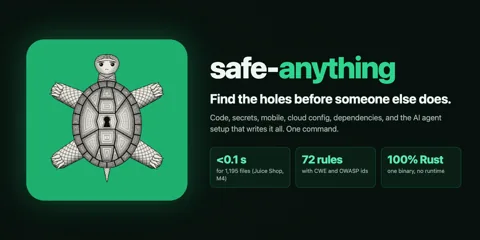
safe-anything is a Rust scanner for developers reviewing security problems in local repositories. Its inputs include source code, credentials, configuration, dependency files and AI agent settings. The engine walks files in parallel and combines compiled pattern matching with selected structured parsers without executing the inspected code. Agent rules examine excessive permissions, unpinned MCP packages and suspicious skill or hook instructions. Findings identify the file, line, severity, reason and suggested fix, with terminal, JSON, SARIF and MCP interfaces. Native builds target macOS, Linux and Windows without requiring a scanner account. Online dependency checks send package names and versions to OSV, while offline mode skips that check. It does not trace data flow, skips some files and paths, and a clean result neither proves safety nor resolves the documented gaps in real agent and CI integration testing.
License
MIT Permissive. Commercial use and changes are allowed if the copyright notice is kept.
More in this category
- ChiefGyk3D/Clouds-Against-Humanity
Clouds Against Humanity is a cloud security teaching project whose repository supplies the reference environment used by its lessons. It targets learners with basic computer and networking knowledge who want to extend a home lab into the cloud. Users supply regions, network identifiers, administrator public keys and access targets, while Doppler supplies account secrets. OpenTofu turns that configuration into infrastructure, and the inspected access layer defines two DigitalOcean servers, Twingate connectors, administrator groups and SSH resources. Twingate connects authorized users to permitted resources through outbound connectors rather than opening public inbound access ports. This is not a communication-free environment, because restricted internal SSH and outbound traffic remain allowed. GitHub Actions performs checks, while Spacelift handles infrastructure plans and application with human approval. Hands-on use requires DigitalOcean, Twingate, Spacelift and Doppler accounts and provider charges, while the documentation names OpenTofu, Python and OPA for local checks. The README marks monitoring and workload infrastructure as not applied and AWS work as mock-provider tested, so the repository is not evidence of a fully operated multicloud production service. - sebaandrada-cell/PcapAnalyzer
PcapAnalyzer helps network troubleshooters investigate captured traffic. It accepts pcap and pcapng files, including gzip captures. It returns traffic statistics, conversations, suspected faults and reports. The engine reads tshark output and applies detection rules to collected connection state. The SYN and RST rule identifies rejected connections but cannot distinguish every firewall rejection from a closed port. Its tools apply Wireshark display filters and restrict returned fields and result size. Setup requires Docker Compose or a Python, Node.js and tshark environment. Optional AI investigation sends tool results to Anthropic, while demo mode does not use a real model. Incomplete captures limit conclusions, and the project remains beta. - bol-van/zapret
zapret is a network censorship circumvention tool for users facing traffic filtering. DPI means equipment that inspects traffic to identify sites or protocols. The tool accepts selected traffic and processing rules, then changes how that traffic is transmitted. Its packet and TCP handlers exploit differences between an inspection device and the destination server's interpretation. It does not inherently require an external relay server. Linux and OpenWrt are major environments, while the Windows packet handler winws requires WinDivert and administrator rights. The documentation describes limits against direct IP blocking and fully reconstructing filters. This version is marked end-of-life, and its effectiveness was not tested here. - ybblab/Jiumi
Jiumi is an Android application for device owners or authorized users who want to inspect other apps' permission access and network activity. Its inputs are system-generated signals such as AppOps permission events, connection-table snapshots, Perfetto traces and process-start logs, not chat text or captured passwords. A shell-identity probe collects available signals and the app classifies them with configuration rules, stores them locally and presents timelines, attention items and per-app details. The source confirms read-only connection polling and an export writer producing a ZIP containing readable timeline CSV, raw records and session coverage information. Users can separately initiate permission changes, network restrictions on supported devices, disabling and supported removal actions, with documented protection and confirmation boundaries. It requires Android 11 or later and an authorized wireless-debugging, root-assisted or Shizuku route to start the shell probe; building also needs Android development tools. Optional domain recording uses a local VPN for DNS queries only, occupies Android's VPN slot and may miss encrypted or private DNS traffic. System and manufacturer restrictions, missed short connections, Android 14 requirements for supported per-connection byte statistics and additional battery use prevent it from being a complete traffic-content monitor or universal app audit. - bitwarden/agent-access
Agent Access provides a protocol, command line tool and Rust SDK for giving remote agents individual credentials instead of an entire password vault. Its users are automation developers and people who want to mediate access to accounts stored in a password manager. A remote client pairs with a credential provider and requests an item by domain or vault item identifier. The protocol describes a Noise encrypted session carried through a WebSocket relay, with user mediation on the provider side. The Bitwarden adapter invokes the existing bw command line tool, so that integration depends on an installed client and an unlocked vault. The inspected run implementation maps selected credential fields into a child process environment, while connect can return credential JSON. Examples cover PostgreSQL environment injection and Rust, Python and browser clients, and the README lists Windows, macOS and Linux distributions. This is an early preview with a draft protocol, and encryption does not protect secrets from the receiving process or make the documented rendezvous pairing caveats disappear.
Only repositories in the ranked Trendshift lists are included, and the lists are used only to find candidates. We do not copy their ranks. Descriptions, licenses and star counts come from each GitHub repository. The notes are our own reading. We have not tested these projects, and a place on a trending list does not prove quality.