Tech article
Alternative models to Jev: architecture, performance comparison and training your own
- Published
- Written by
- HDATF

Decision models and Jev
A decision model takes a question and a set of options and returns a probability for each option. A generative model writes its answer as a sentence, and a program then has to find the answer in that sentence again. A decision model has no sentence-writing step, so it responds quickly, and the program uses the probability numbers directly.
JevBench and S1Bench both use the score of Jev 1.13.0 as the baseline and compare other models against it.
There are three reasons alternatives are appearing. Jev is offered as an API and its weights have not been released. Jev classifies text only. And on some benchmarks, models have appeared that score higher than Jev.
Two benchmarks and three releases
JevBench: each model makes 1,500 judgements and gets a score
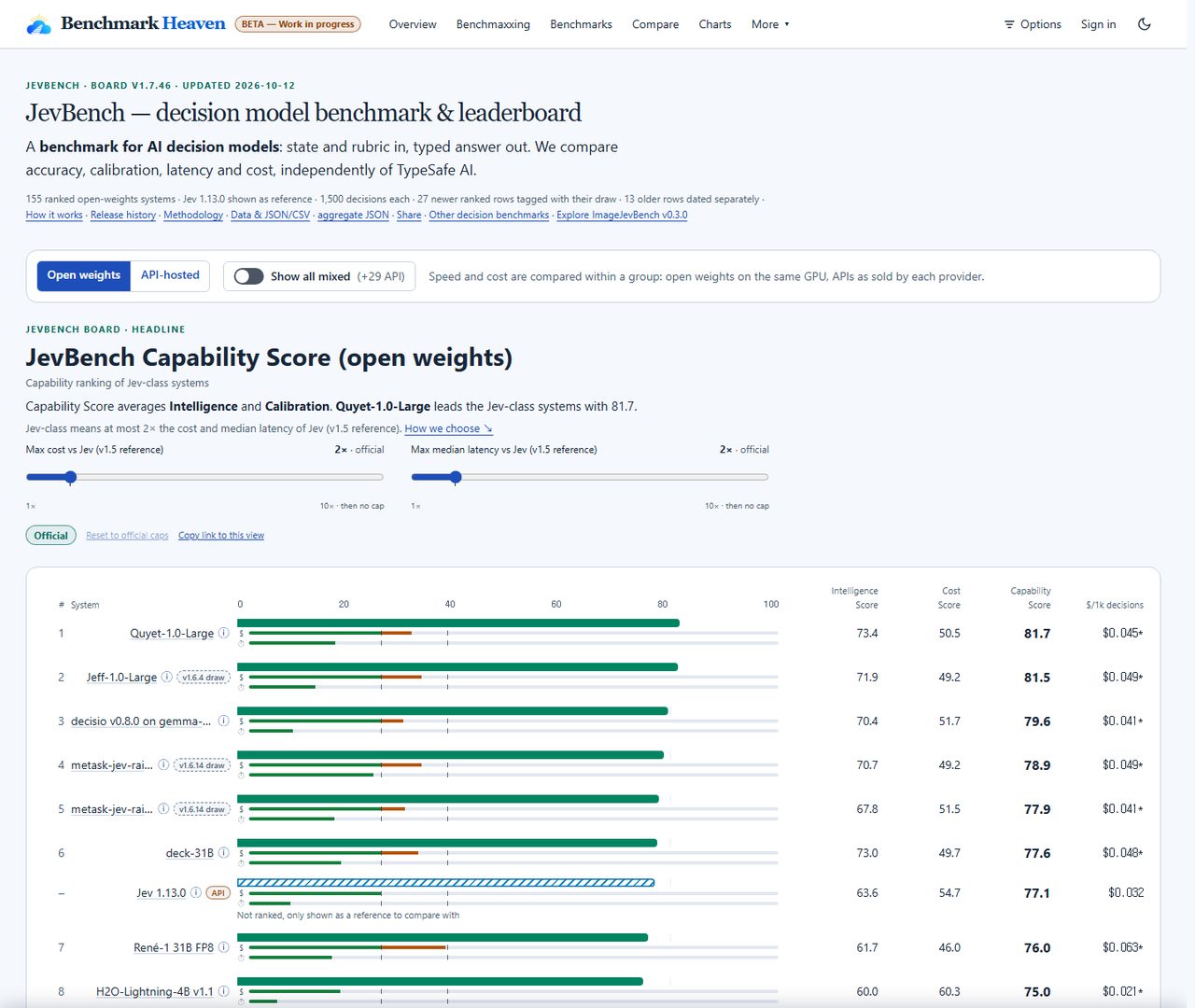
JevBench is a benchmark for decision models only, run by benchmarkheaven.com. It gives the model a situation and scoring criteria and takes back an answer in a fixed format. Each model makes 1,500 judgements, and the Capability Score (0 to 100) is the average of an Intelligence score, which looks at accuracy, and a Calibration score, which looks at whether the probabilities match the actual rate of correct answers.
The leaderboard updated on 12 October ranks 155 open-weight models, and first place is Quyet-1.0-Large (81.7 points). Jev 1.13.0 scores 77.1 points and is shown only as a reference, without a rank. Six open models score higher than Jev.
S1Bench: six public evaluations with the same prompt as Jev
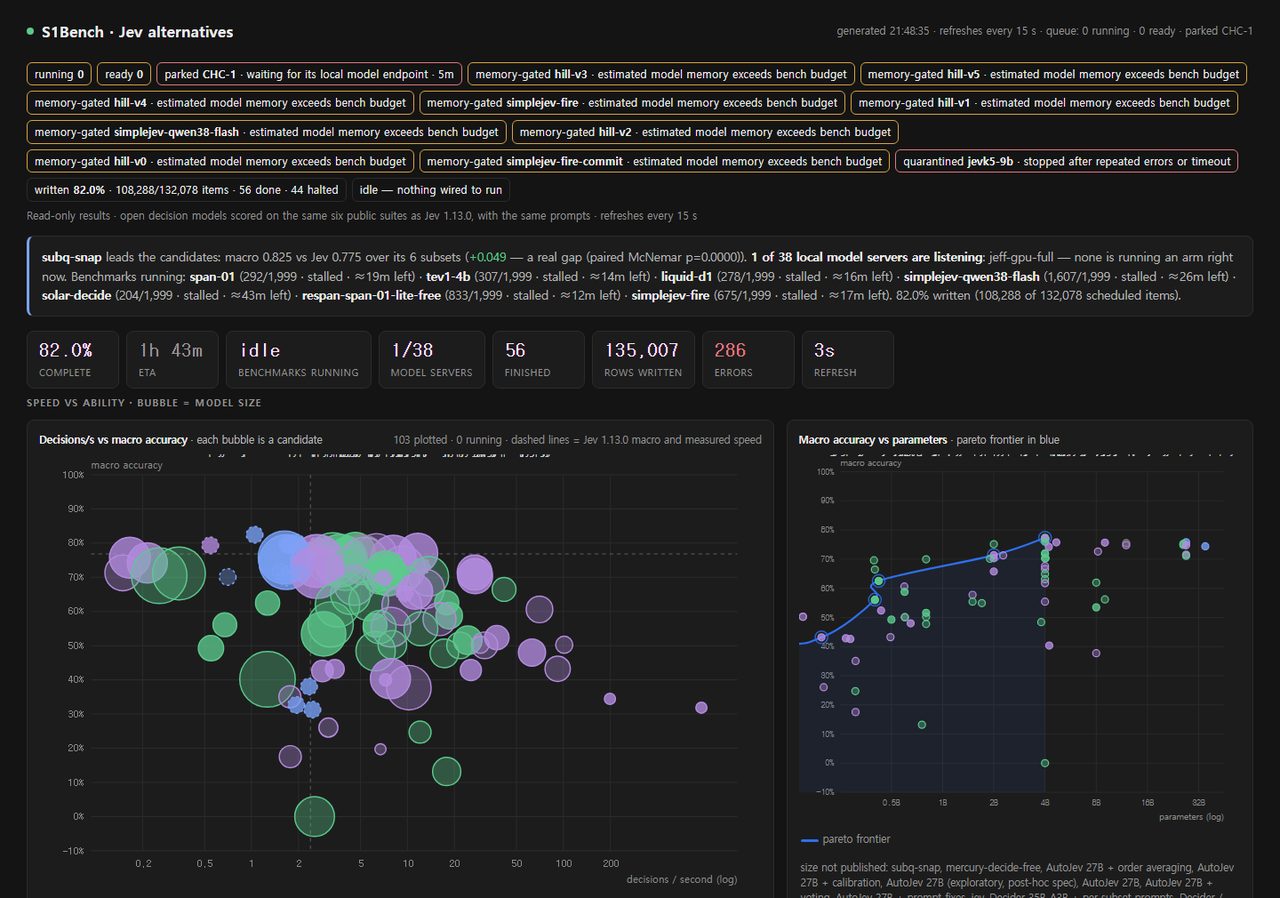
S1Bench (bench.jakecuth.com) has alternative models answer 1,999 items from six public evaluations with the same prompt as Jev 1.13.0, and records the mean accuracy over the six together with the number of items processed per second. The six are vitaminc, massive, boolq, helpsteer2, aegis2 and paws.
As of 13 October, 8 of the 52 models that have finished all six score higher than Jev (0.7751). They are subq-snap (0.8245) and mercury-decide-free (0.8021), both offered through an API, and six models of the CHC family (0.792 to 0.795). The CHC family carries a training data contamination flag on five of the six evaluations. The flag means the evaluation items may have been mixed into the training data.

Architecture of the alternative models
Clef: a decision head on top of a generative model
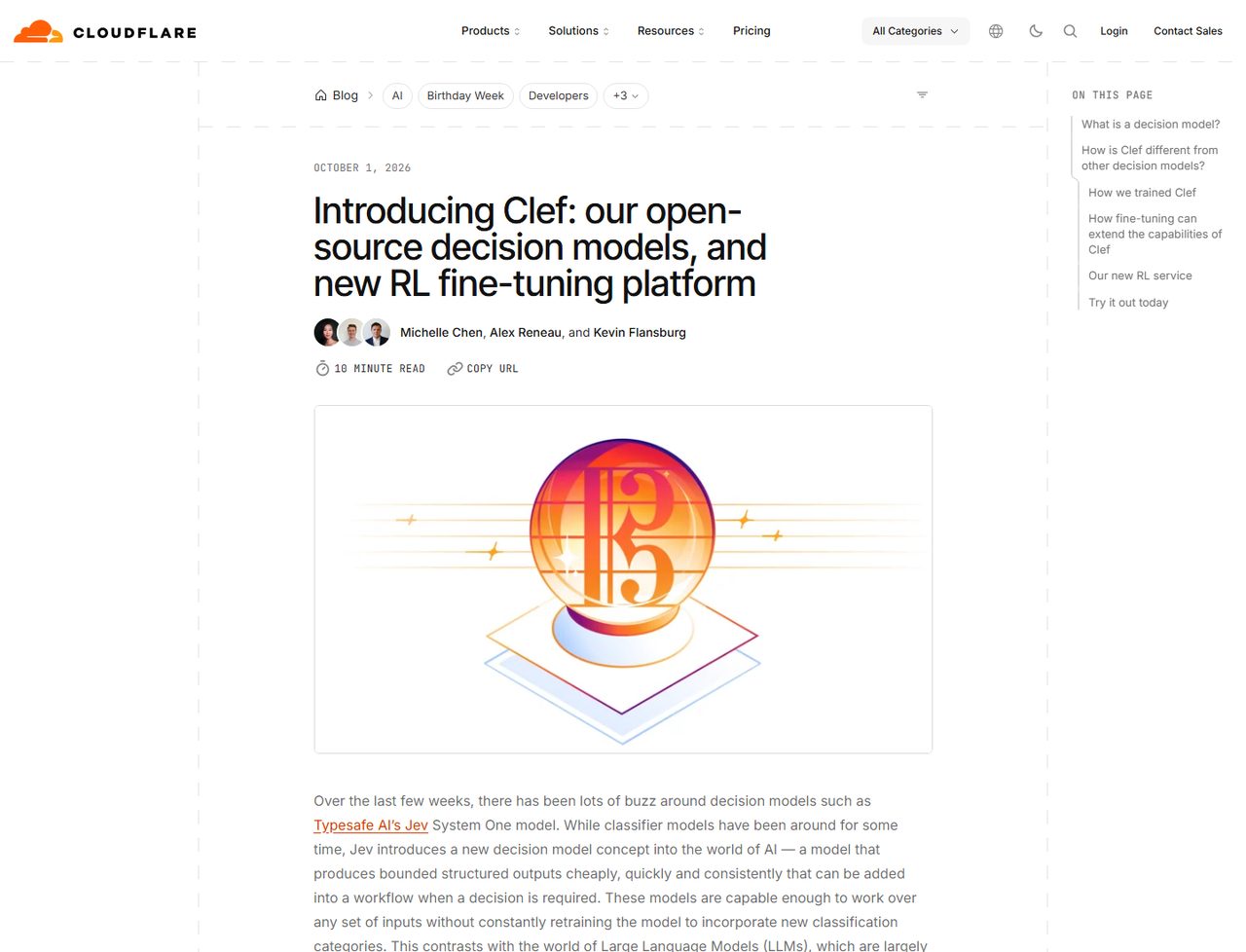
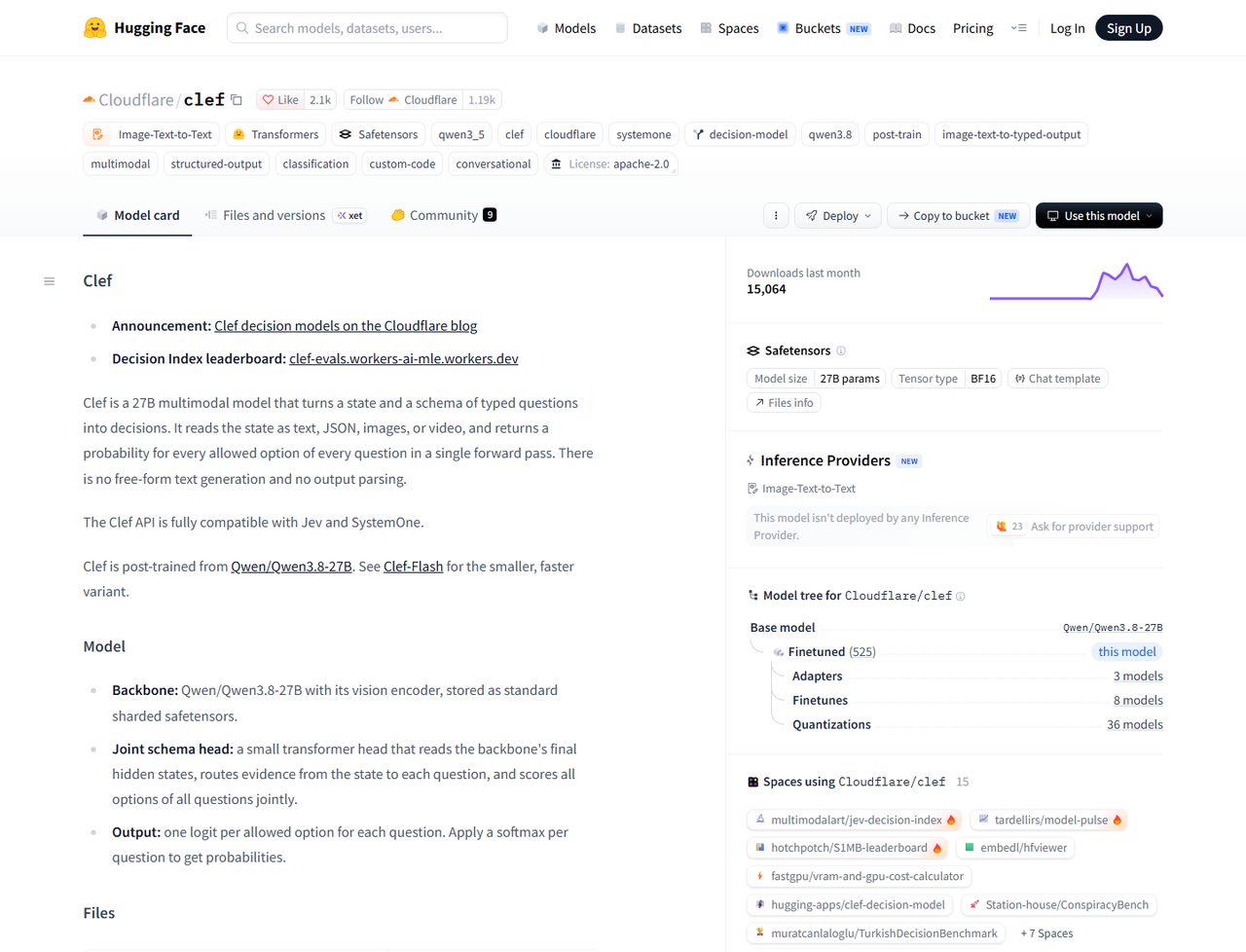
Clef, which Cloudflare released on 1 October, uses the open generative model Qwen3.8-27B as its backbone (the main body that reads and understands the input). On top of it sits a head (a small layer that takes the values the backbone computed and produces the final output). Instead of choosing the next word, Clef's head computes a score for each option.
In this architecture, several questions are answered in one forward pass (one computation of the model over the input from start to finish). The official model card says the model "returns a probability for every allowed option of every question in a single forward pass". For example, one email can be asked at once whether it is a refund request, whether it is urgent and which department handles it.
Cloudflare named two differences from Jev. Clef has a vision encoder, so it also classifies images. Its context length is up to 64k, longer than Jev's 32k. The weights are released under Apache 2.0, so you can download them and run them on your own server.
Decision 2.0: six sizes
The vLLM Semantic Router team released Decision 2.0 on 3 October. It comes in six sizes: 0.6B, 0.8B, 2B, 4B, 9B and 27B. Like Clef, it answers several questions in one forward pass. Vega, the 27B model, scores 71.3 points on JevBench.

Architecture alone says little about the score
JevBench notes each model's architecture in one line. Laid out by architecture, the scores are as follows.
| Architecture | Model | JevBench score |
|---|---|---|
| Output layer built for decisions (noncausal decision readout) | Perplexity Decider v1.1 27B | 82.8 |
| Reads the probability a generative model gives each option letter (option-letter logits) | Quyet-1.0-Large | 81.7 |
| Offered as an API, weights not released | Jev 1.13.0 | 77.1 |
| A head that computes questions and options together (joint schema head) | Clef | 75.3 |
| Small encoder model (ModernBERT-large, 421M) | Laya | 32.5 |
Quyet-1.0-Large takes the simplest approach. It tells a generative model to "answer with one of A, B or C" and reads the probability that the next letter is A, B or C. This approach, with no separately designed head, scores 6.4 points higher than Clef with its dedicated head.

Performance comparison
S1Bench: how much accuracy you give up for speed
These are the S1Bench values on 13 October.
| Model | Speed vs Jev | Accuracy vs Jev |
|---|---|---|
| Clef (27B) | 1.1x | 2.8%p lower |
| Clef-flash (9B) | 3.4x | 1.8%p lower |
| Reflex-4b | 3.0x | 5.6%p lower |
| Decider-2b | 11.4x | 7.2%p lower |
| Laya (421M) | 7.5x | 15.0%p lower |
In this table, Clef-flash comes out best. It is 3.4 times as fast as Jev, and its accuracy is 1.8%p lower. Decider-2b, a 2B model, is 11.4 times as fast and 7.2%p lower.
Decision Index: Clef and Jev are good at different problems
Decision Index is a collection of evaluations for decision models. Of the 41 results that Cloudflare got by running version 0.2.1 itself and published in the Clef model card, Clef leads Jev on 26 and trails on 15. Which side wins follows a clear pattern.
Jev leads by up to 30%p on problems that need knowledge and several steps of reasoning, such as graduate-level science questions (GPQA Diamond). Clef leads on problems that classify into fixed categories, such as BANKING77, which sorts customer enquiries into one of 77 intents.
On the work-task evaluations that Typesafe built, the gap narrows. These values were also measured by Cloudflare and published in the model card.
| Task | Clef | Jev |
|---|---|---|
| Invoice processing (all actions match) | 64.7 | 61.8 |
| Customer support (all actions match) | 76.3 | 76.0 |
| Security incidents (all actions match) | 62.9 | 61.7 |
| Reading agent logs (main action) | 68.5 | 71.6 |
Clef leads in three of the four areas, and the differences range from 0.3 to 3.1 points.
JevBench and S1Bench rank them differently
On JevBench, Clef-flash scores 63.8 points, 11.5 points below Clef (75.3 points). On S1Bench it scores 0.7567, above Clef (0.7474). JevBench uses 1,500 private items, and S1Bench uses six public evaluations.
When choosing a model, look at the scores on evaluation items similar to your own work rather than the rank on one leaderboard. If the goal is classifying customer enquiries, look at the BANKING77 and CLINC150 scores; if the goal is long reasoning, look at the GPQA and BBH scores.

Training your own
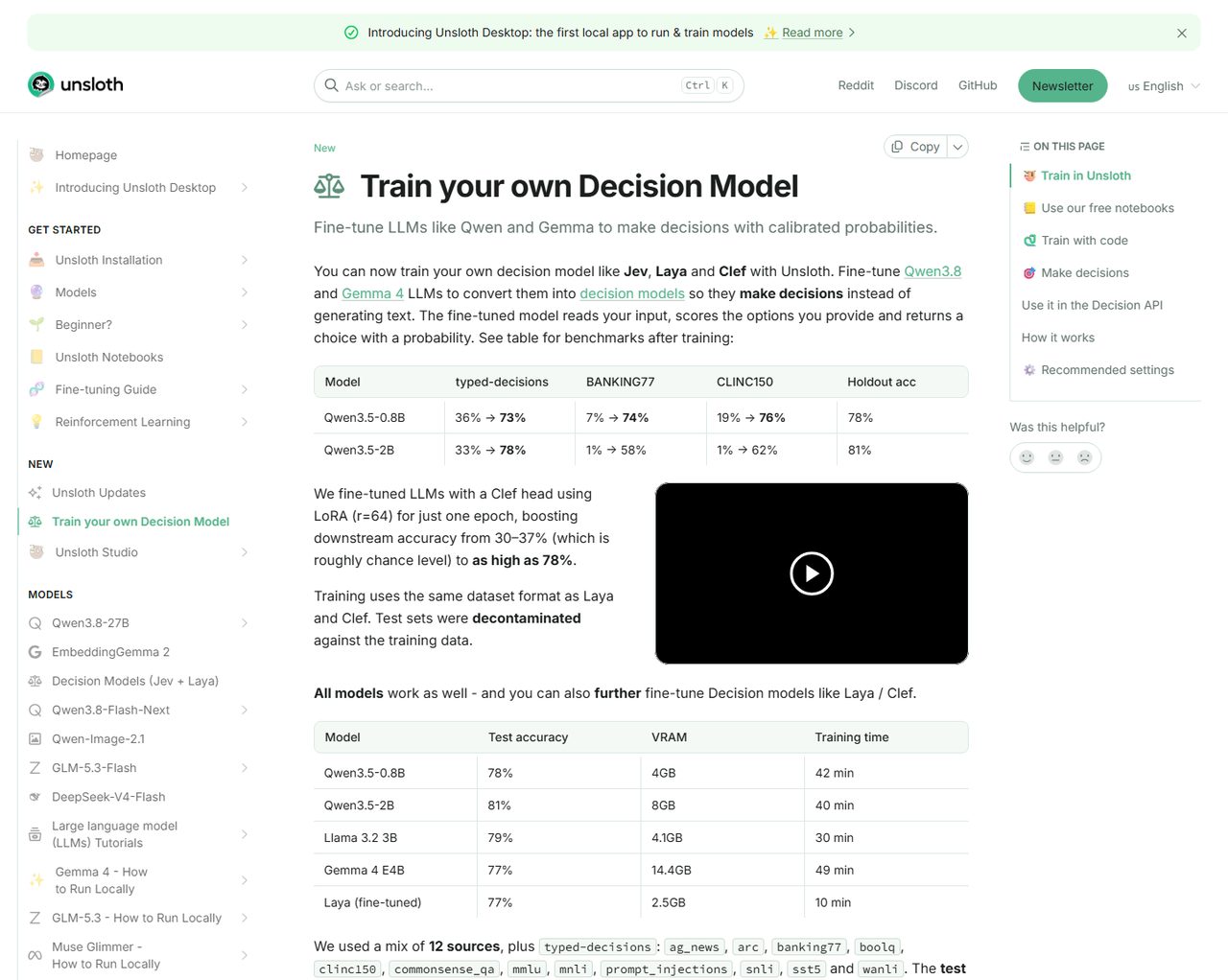
Unsloth published a guide and code for training a decision model yourself. It applies the same architecture as Clef to small models. You take an open generative model as the backbone, freeze its weights, and train the head on top of it with your own data. There is also a setup that uses LoRA as well (a method that adds small auxiliary weights to the backbone and trains only part of the model).
Unsloth's evaluation data has 3,000 items: 2,000 from typed-decisions, 500 from BANKING77 and 500 from CLINC150. Before training, Qwen3.5-0.8B scored 36%, 7% and 19% on the three evaluations, and after training it scored 73%, 74% and 76%. Training took 4GB of VRAM and 42 minutes.
| Model | Evaluation accuracy | VRAM, training time |
|---|---|---|
| Qwen3.5-0.8B | 78% | 4GB, 42 minutes |
| Qwen3.5-2B | 81% | 8GB, 40 minutes |
| Llama 3.2 3B | 79% | 4.1GB, 30 minutes |
| Gemma 4 E4B | 77% | 14.4GB, 49 minutes |
| Laya (further training) | 77% | 2.5GB, 10 minutes |
For work with a fixed set of options, such as classifying internal documents or judging defect types, you can try building a dedicated decision model on a GPU with around 4GB of VRAM if you have example data. The data does not have to be sent to an outside API.
What to choose
- For judgements that need knowledge and multi-step reasoning, Jev is strong. On GPQA Diamond and BBH in Decision Index, Jev leads Clef by 19 to 30%p.
- For work that classifies into fixed categories, work that takes images as input, or work that has to run on your own servers, Clef is worth considering first. On BANKING77, Clef leads by 14.5%p.
- If the volume is high and response time matters, consider Clef-flash or a model in the 2B to 4B range. On S1Bench they were 3 to 11 times as fast, with accuracy 2 to 7%p lower.
- If you have example data from your own work, train the head of a small model yourself. According to Unsloth, a 0.8B model reached 78% with 4GB and 42 minutes.
In every case, what a decision model returns is a probability. An answer with a high probability can still be wrong. Actions that are hard to undo, such as transferring money, deleting or deploying, should not run on the decision model's output alone; they need a separate approval step.
What was checked
- The JevBench and S1Bench figures were read directly from the data of the two leaderboards on 13 October 2026. Both leaderboards keep being updated.
- The Decision Index and Typesafe work-task figures are values that Cloudflare got from its own runs and published in the Clef model card. They were checked on 8 October.
- HDATF has not trained the models in this article or run the benchmarks itself.
- The five pictures at the top of the page and at the start of the sections were generated with Codex.
Sources
- Leaderboards: benchmarkheaven.com/jev-models, bench.jakecuth.com
- Official material: Cloudflare's Clef announcement, Clef model card, vLLM Semantic Router, Unsloth guide